Results by title
4 books match the query 'Monetary unions'
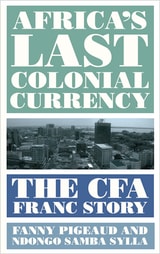
Africa's Last Colonial Currency
The CFA Franc StoryFanny Pigeaud
Pluto Press, 2021
Colonialism persists in many African countries due to the continuation of imperial monetary policy. This is the little-known account of the CFA Franc and economic imperialism. The CFA Franc was created in 1945, binding fourteen African states and split into two monetary zones. Why did French colonial authorities create it and how does it work? Why was independence not extended to monetary sovereignty for former French colonies? Through an exploration of the genesis of the currency and an examination of how the economic system works, the authors seek to answer these questions and more. As protests against the colonial currency grow, the need for myth-busting on the CFA Franc is vital and this exposé of colonial infrastructure proves that decolonization is unfinished business.
[more]

Forging an Integrated Europe
Barry Eichengreen and Jeffry Frieden, Editors
University of Michigan Press, 1998
As European integration has deepened and become more invasive, the tension between the authority of the European Union and the autonomy of member states has increased, while dissatisfaction with the political institutions of the European Union has increased dramatically. How fast and how far European integration will proceed are critical issues for scholars and policymakers in Europe and the United States. Barry Eichengreen and Jeffry Frieden have assembled a group of prominent economists and political scientists to discuss the most important--and most difficult--political and economic issues involved in European integration. The book focuses on three major issues: economic and monetary union, the reform and development of responsive political institutions for the Union, and the enlargement of the Union to include states to the east.
In examining these issues, the writers consider such prob-lems as the trade-off between the benefits of international economic cooperation and the ability to pursue domestic welfare policies; how to increase the political accountability of the institutions of the EU; and how the EU can both be enlarged in membership and deepened in terms of the powers given community institutions.
The contributors are Steven Arndt, Peter Bofinger, Christian de Boisseu, Michele Fratianni, Geoffrey Garrett, Jurgen von Hagen, Ander Todal Jenssen, Ken Kletzer, Lisa Martin, Jonathan Moses, Jean Pisani-Ferry, and Michael Wallerstein, in addition to the editors.
Barry Eichengreen is Professor of Economics, University of California, Berkeley. Jeffry Frieden is Professor of Government, Harvard University.
[more]
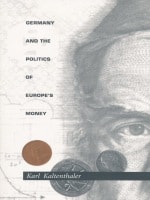
Germany and the Politics of Europe's Money
Karl Kaltenthaler
Duke University Press, 1998
As countries in the European Union struggle to comply with the Maastricht Treaty, the question of monetary integration is at the forefront of European politics. Germany and the Politics of Europe’s Money explores how and why Germany—whose economic power makes it a pivotal player in the European monetary system—has developed inconsistent policies toward European monetary institutions and how international institutions affect domestic politics that, in turn, influence state policies toward these institutions.
Moving away from state-centered and Marxist approaches to the study of the European monetary integration process, Karl Kaltenthaler offers a new analytical framework to assess the dynamics within and among the participating countries. Using official and unofficial documents as well as interviews with players ranging from presidents of the Bundesbank to functionaries in the trade unions, Kaltenthaler argues that the number of decision makers negotiating policy and their accountability to interest groups, political parties, government ministries, and Germany’s central bank have made Germany’s fluctuations in policy inevitable. Germany and the Politics of Europe’s Money examines twenty years of German policy through an analysis of four key episodes: the creation of the European Monetary System, the creation of the Franco-German Economic and Financial Council, the establishment of policy toward the European Monetary Union, and the institutional transformation of the EMS in the 1990s. It thus brings a new understanding to Germany’s dynamic policies and the political forces behind them.
Moving away from state-centered and Marxist approaches to the study of the European monetary integration process, Karl Kaltenthaler offers a new analytical framework to assess the dynamics within and among the participating countries. Using official and unofficial documents as well as interviews with players ranging from presidents of the Bundesbank to functionaries in the trade unions, Kaltenthaler argues that the number of decision makers negotiating policy and their accountability to interest groups, political parties, government ministries, and Germany’s central bank have made Germany’s fluctuations in policy inevitable. Germany and the Politics of Europe’s Money examines twenty years of German policy through an analysis of four key episodes: the creation of the European Monetary System, the creation of the Franco-German Economic and Financial Council, the establishment of policy toward the European Monetary Union, and the institutional transformation of the EMS in the 1990s. It thus brings a new understanding to Germany’s dynamic policies and the political forces behind them.
[more]