Results by title
3 books match the query 'Monsiváis, Carlos'
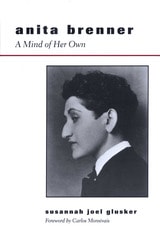
Anita Brenner
A Mind of Her OwnBy Susannah Joel Glusker
University of Texas Press, 1998
Journalist, historian, anthropologist, art critic, and creative writer, Anita Brenner was one of Mexico's most discerning interpreters. Born to a Jewish immigrant family in Mexico a few years before the Revolution of 1910, she matured into an independent liberal who defended Mexico, workers, and all those who were treated unfairly, whatever their origin or nationality.
In this book, her daughter, Susannah Glusker, traces Brenner's intellectual growth and achievements from the 1920s through the 1940s. Drawing on Brenner's unpublished journals and autobiographical novel, as well as on her published writing, Glusker describes the origin and impact of Brenner's three major books, Idols Behind Altars,Your Mexican Holiday, and The Wind That Swept Mexico.
Along the way, Glusker traces Brenner's support of many liberal causes, including her championship of Mexico as a haven for Jewish immigrants in the early 1920s. This intellectual biography brings to light a complex, fascinating woman who bridged many worlds—the United States and Mexico, art and politics, professional work and family life.
Fatefully, Faithfully Feminist
A Critical History of Women, Patriarchy, and Mexican National DiscourseCarlos Monsiváis, edited by Norma Kahn and Ilana Luna
Vanderbilt University Press, 2024
Pillar of Salt
An Autobiography, with 19 Erotic SonnetsBy Salvador Novo, Translated by Marguerite Feitlowitz, Introduction by Carlos Monsiváis
University of Texas Press, 2014
Written with exquisite sensitivity and wit, this memoir by one of Mexico’s foremost men of letters describes coming of age during the violence of the Mexican Revolution and “living dangerously” as an openly homosexual man in a brutally machista society.
Salvador Novo (1904–1974) was a provocative and prolific cultural presence in Mexico City through much of the twentieth century. With his friend and fellow poet Xavier Villaurrutia, he cofounded Ulises and Contemporáneos, landmark avant-garde journals of the late 1920s and 1930s. At once “outsider” and “insider,” Novo held high posts at the Ministries of Culture and Public Education and wrote volumes about Mexican history, politics, literature, and culture. The author of numerous collections of poems, including XX poemas, Nuevo amor, Espejo, Dueño mío, and Poesía 1915–1955, Novo is also considered one of the finest, most original prose stylists of his generation.
Pillar of Salt is Novo’s incomparable memoir of growing up during and after the Mexican Revolution; shuttling north to escape the Zapatistas, only to see his uncle murdered at home by the troops of Pancho Villa; and his initiations into literature and love with colorful, poignant, complicated men of usually mutually exclusive social classes. Pillar of Salt portrays the codes, intrigues, and dynamics of what, decades later, would be called “a gay ghetto.” But in Novo’s Mexico City, there was no name for this parallel universe, as full of fear as it was canny and vibrant. Novo’s memoir plumbs the intricate subtleties of this world with startling frankness, sensitivity, and potential for hilarity. Also included in this volume are nineteen erotic sonnets, one of which was long thought to have been lost.