Results by title
5 books match the query 'Monsters in motion pictures'

Alien Identities
Exploring Differences in Film and FictionEdited by Deborah Cartmell, Heidi Kaye, I. Q. Hunter, and Imelda Whelehan
Pluto Press, 1999
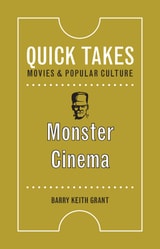
Monster Cinema
Grant, Barry Keith
Rutgers University Press, 2018
Armed with an encyclopedic knowledge of film history, Grant presents us with an eclectic array of monster movies, from Nosferatu to Get Out. As he discovers, although monster movies might claim to be about Them!, they are really about the capacity for horror that lurks within each of us.
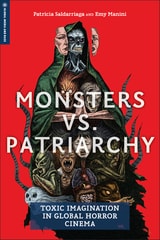
Monsters vs. Patriarchy
Toxic Imagination in Global Horror CinemaPatricia Saldarriaga
Rutgers University Press, 2025
Monsters vs. Patriarchy examines female monstrosity as it appears in horror films from around the world and considers specific political, scientific, and historical contexts to better understand how we construct and reconstruct monstrosity, using an intersectional approach to examine the imposition of gender and racial hierarchies that support national power structures. The authors contend that monstrous female cinematic subjects, including ghosts, witches, cannibals, and posthuman beings, are becoming empowered, using the tools of their monstrification to smash the colonial, white supremacist, and misogynist structures that created them.
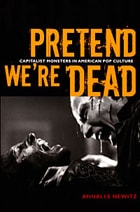
Pretend We're Dead
Capitalist Monsters in American Pop CultureAnnalee Newitz
Duke University Press, 2006
Newitz looks at representations of serial killers, mad doctors, the undead, cyborgs, and unfortunates mutated by their involvement with the mass media industry. Whether considering the serial killer who turns murder into a kind of labor by mass producing dead bodies, or the hack writers and bloodthirsty actresses trapped inside Hollywood’s profit-mad storytelling machine, she reveals that each creature has its own tale to tell about how a freewheeling market economy turns human beings into monstrosities.
Newitz tracks the monsters spawned by capitalism through b movies, Hollywood blockbusters, pulp fiction, and American literary classics, looking at their manifestations in works such as Norman Mailer’s “true life novel” The Executioner’s Song; the short stories of Isaac Asimov and H. P. Lovecraft; the cyberpunk novels of William Gibson and Marge Piercy; true-crime books about the serial killers Ted Bundy and Jeffrey Dahmer; and movies including Modern Times (1936), Donovan’s Brain (1953), Night of the Living Dead (1968), RoboCop (1987), The Silence of the Lambs (1991), and Artificial Intelligence: AI (2001). Newitz shows that as literature and film tell it, the story of American capitalism since the late nineteenth century is a tale of body-mangling, soul-crushing horror.
Skin Shows
Gothic Horror and the Technology of MonstersJack Halberstam
Duke University Press, 1995
Deploying feminist and queer approaches to the monstrous body, Halberstam views the Gothic as a broad-based cultural phenomenon that supports and sustains the economic, social, and sexual hierarchies of the time. She resists familiar psychoanalytic critiques and cautions against any interpretive attempt to reduce the affective power of the monstrous to a single factor. The nineteenth-century monster is shown, for example, as configuring otherness as an amalgam of race, class, gender, and sexuality. Invoking Foucault, Halberstam describes the history of monsters in terms of its shifting relation to the body and its representations. As a result, her readings of familiar texts are radically new. She locates psychoanalysis itself within the gothic tradition and sees sexuality as a beast created in nineteenth century literature. Excessive interpretability, Halberstam argues, whether in film, literature, or in the culture at large, is the actual hallmark of monstrosity.