Results by title
6 books match the query 'Montgomery (Ala.)'
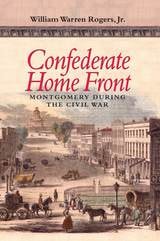
Confederate Home Front
Montgomery during the Civil WarWilliam Warren Rogers, Jr.
University of Alabama Press, 2001
Drawing from a wealth of historic documents and personal papers, William Warren Rogers, Jr., provides a fascinating and detailed political, economic, social, and commercial history of Montgomery from 1860 to 1865. His account begins with an examination of daily life in the city before the war began-how slaves outnumbered whites, how an unvarnished frontier atmosphere prevailed on the streets despite citizens' claims to refinement, how lush crops of corn and cotton grew in fields right up to the city limits, and how class divisions were distinct and immovable.
Rogers arranges his material topically, covering the events that led to the decision for secession and Montgomery's heady days as the Confederacy's first capital; the industrialization of the city's war effort as it became a hub of activity and served as a military post; the city's business patterns and administration as it attempted to promote the Confederacy and defend itself from federal forces; and the plight of the small group of Unionists who inhabited Montgomery through the war. Rogers concludes with chapters examining the situation in Montgomery as the Confederacy unraveled and the city fell to Union troops.
The Montgomery experience offers a microcosm of life on the Confederate home front and demonstrates that citizens generally experienced the same hopes, deprivations, and tragedies that other Southerners did at this time. Rogers's well-written, comprehensive history of the wartime city makes an original contribution to Civil War homefront and community studies that should appeal to general readers and scholars alike.
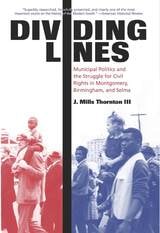
Dividing Lines
Municipal Politics and the Struggle for Civil Rights in Montgomery, Birmingham, and SelmaJ. Mills Thornton, III
University of Alabama Press, 2006
Presents the story of the civil rights movement from the perspective of community-municipal history at the grassroots level
Thornton demonstrates that the movement had powerful local sources in its three birth cities—Montgomery, Birmingham, and Selma. There, the arcane mechanisms of state and city governance and the missteps of municipal politicians and civic leaders—independent of emerging national trends in racial mores—led to the great swell of energy for change that became the civil rights movement.
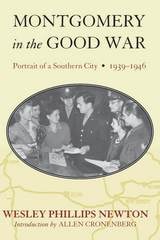
Montgomery in the Good War
Portrait of a Southern City, 1939-1946Wesley Phillips Newton
University of Alabama Press, 2000
One city. One war. A story of transformation at home and abroad.
Using newspaper accounts, interviews, letters, journals, and his own memory of the time, Wesley Newton reconstructs wartime-era Montgomery, Alabama--a sleepy southern capital that was transformed irreversibly during World War II.
The war affected every segment of Montgomery society: black and white, rich and poor, male and female, those who fought in Europe and the Pacific and those who stayed on the home front. Newton follows Montgomerians chronologically through the war from Pearl Harbor to Hiroshima as they experience patriotism, draft and enlistment, rationing, scarcity drives, and the deaths of loved ones. His use of small vignettes based on personal recollections adds drama and poignancy to the story.
Montgomery in the Good War is an important reminder that wars are waged at home as well as abroad and that their impact reverberates well beyond those who fight on the front lines. Those who came of age during the war will recognize themselves in this moving volume. It will also be enlightening to those who have lived in times of relative peace.
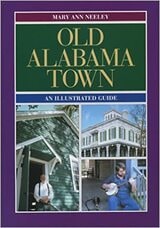
Old Alabama Town
An Illustrated GuideMary Ann Neeley
University of Alabama Press, 2002
Old Alabama Town is a visual and historical chronicle of one of the South's important architectural landmarks—four blocks of 19th-century buildings restored to their original condition, collectively forming an educational village that preserves and displays life as it was lived in Alabama from the 1830s through the 1890s. A creation of the Landmarks Foundation of Montgomery, a nonprofit organization developed in 1967, Old Alabama Town displays the lifestyles and environment of the time period through architecture, decorative arts, and living history. The "town" has been made available for students, secondary school educators for field trips, and to tourists for entertainment and family excursions.
More than 50 historic structures, all formerly in danger of demolition, have been transported from around central Alabama and restored on site. The Living Block of the village allows visitors to explore a log cabin, dogtrot house, carriage house, "shotgun" house, pole barn, schoolhouse, tavern, grange hall, and grocery. The Working Block allows patrons to visit a blacksmith's shop, drugstore, grist mill, cotton gin, woodcarver's shop, print shop, and cookhouse. Additional regions of the village present some of the most significant historic homes to be preserved in the state: the Cram-Lakin House, Thompson Mansion, and the Ordeman-Mitchell-Shaw House, among others.
Designed in full color, this paperback guide is introduced by the author's historical, sociological, and cultural overview of Montgomery. The 45 individual entries detail the history and features of each structure and are supplemented by a map, archival photographs of the buildings, and 60 contempo-rary color photographs. This book will be useful to tourists, preservationists, students and scholars of Alabama history and architecture, and all those interested in an interpretive museum of southern life.
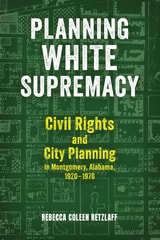
Planning White Supremacy
Civil Rights and City Planning in Montgomery, Alabama, 1920–1970Rebecca Coleen Retzlaff
University of Alabama Press, 2026
An unflinching account of how city planning was deployed to enforce white supremacy in Montgomery, Alabama—the birthplace of the Civil Rights Movement—and how Black activists fought back, block by neighborhood block.
At the heart of the Civil Rights Movement was a city meticulously designed to enforce inequality. In Planning White Supremacy: Civil Rights and City Planning in Montgomery, Alabama, 1920–1970, Rebecca Coleen Retzlaff traces how city officials used the tools of modern planning—zoning, infrastructure, housing codes, public investment, and highway construction—to suppress political power, economic opportunity, and spatial freedom for Black citizens.
As the birthplace of the Civil Rights Movement, Montgomery became a battleground where urban planning and direct-action protest collided, shaping the city’s culture in ways that still resonate today. Retzlaff’s analysis exposes the calculated use of municipal power to control land use, displace Black communities, keep schools and neighborhoods segregated, and preserve white political dominance. By placing urban planning at the center of Montgomery’s story, this groundbreaking work reframes the movement not only as a fight for voting rights and legal equality, but as a struggle for space, housing, mobility, education, and the right to live with dignity. Retzlaff also highlights the resilience and joy of the close-knit Black neighborhoods that nurtured the civil rights activists who changed history.
Retzlaff reveals how urban planning decisions systematically targeted Black neighborhoods, reinforcing racial inequality under the guise of modernization. With historical depth and critical insight, Planning White Supremacy situates Montgomery within the broader context of American urban history—offering a vital perspective on the intersection of race, space, and power. Essential for scholars of urban planning, history, and racial justice, this book also provides urgent insight into how these legacies continue to shape cities and Black socioeconomic opportunities today.

Sweet Mystery
A Book of RememberingJudith Hillman Paterson
University of Alabama Press, 2020
Judith Paterson was just nine years old in 1946 when her mother died of a virulent combination of alcoholism and mental illness at the age of 31. Sweet Mystery: A Book of Remembering is Paterson’s harrowing account of the memories of her mother, told with eloquence and understanding. Set largely in Montgomery, Alabama, the story plays out against a backdrop of relatives troubled almost as much by southern conflicts over race and class as by the fallout from a long family history of drinking, denial, and mental illness.
While rich in the details and flavor of small-town life in the South during the 1940s, Sweet Mystery transcends time and regionalism to evoke universal American themes. Ultimately, it confirms the damaging effects of early trauma on children as well as the innate and familial strengths that enable some children to survive, grow up, and heal.
Originally published in 1996 to critical acclaim in the national media, Sweet Mystery was called “a beautifully written, excruciating collision of form and emotion, joy and pain, willpower and self-examination, control and surrender” by the Washington Post. This edition contains a new afterword written by the author as well as a list of suggested readings.