Results by title
3 books match the query 'Monumentality'
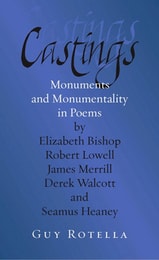
Castings
Monuments and Monumentality in Poems by Elizabeth Bishop, Robert Lowell, James Merrill, Derek Walcott, and Seamus HeaneyGuy Rotella
Vanderbilt University Press, 2004
In Castings, Guy Rotella examines the work of five important poets who have engaged in that effort: Elizabeth Bishop, Robert Lowell, James Merrill, Derek Walcott, and Seamus Heaney. Considering their wider careers as well as particular poems--including Bishop's "The Monument," Lowell's "For the Union Dead," Merrill's "Bronze," Walcott's "The Sea Is History," and Heaney's "In Memoriam Francis Ledwidge"--Rotella argues that these writers are less concerned with defending or condemning monuments than with pursuing ancient and current debates about the political, aesthetic, and broadly cultural issues that monuments condense. Among these concerns are the competing claims of life and art, persistence and change, meaning and meaninglessness, the self and society, and the governing and the governed.
Original and provocative, Rotella's readings will make us ponder how the human impulse to build to last, to reify our culturally derived and ideologically driven faiths, might coexist with those other creeds of our place and time: relativism, multiculuralism, and diversity.
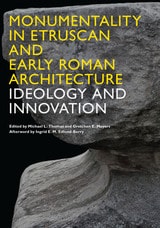
Monumentality in Etruscan and Early Roman Architecture
Ideology and InnovationEdited by Michael L. Thomas and Gretchen E. Meyers
University of Texas Press, 2012
Every society builds, and many, if not all, utilize architectural structures as markers to define place, patron, or experience. Often we consider these architectural markers as “monuments” or “monumental” buildings. Ancient Rome, in particular, is a society recognized for the monumentality of its buildings. While few would deny that the term “monumental” is appropriate for ancient Roman architecture, the nature of this characterization and its development in pre-Roman Italy is rarely considered carefully. What is “monumental” about Etruscan and early Roman architecture?
Delving into the crucial period before the zenith of Imperial Roman building, Monumentality in Etruscan and Early Roman Architecture addresses such questions as, “What factors drove the emergence of scale as a defining element of ancient Italian architecture?” and “How did monumentality arise as a key feature of Roman architecture?” Contributors Elizabeth Colantoni, Anthony Tuck, Nancy A. Winter, P. Gregory Warden, John N. Hopkins, Penelope J. E. Davies, and Ingrid Edlund-Berry reflect on the ways in which ancient Etruscans and Romans utilized the concepts of commemoration, durability, and visibility to achieve monumentality. The editors’ preface and introduction underscore the notion of architectural evolution toward monumentality as being connected to the changing social and political strategies of the ruling elites.
By also considering technical components, this collection emphasizes the development and the ideological significance of Etruscan and early Roman monumentality from a variety of viewpoints and disciplines. The result is a broad range of interpretations celebrating both ancient and modern perspectives.
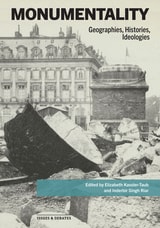
Monumentality
Geographies, Histories, IdeologiesElizabeth Kassler-Taub
J. Paul Getty Trust, The, 0
An exploration of how monuments—both physical and conceptual—shape memory, identity, and public debate across cultures and time.
This compelling volume invites readers to reimagine how monuments shape history, identity, and public space. Monumentality is explored as a dynamic and contested idea—one that moves beyond grand buildings and enduring structures to understand how societies remember the past and envision the future.
Engaging scholarly essays, accompanied by focused reflections on objects held in Getty collections, analyze the emotional, ideological, and technological dimensions of monuments by tracing their changing meanings across cultures and historical periods. Spanning themes of destruction, circulation, territorialization, and empire, the book investigates topics such as the ruin aesthetic of the Paris Commune, the material remnants of Buddhism in India, the construction of Cold War dams, and the influence of Almohad minaret architecture. Throughout, readers will encounter the enduring effects of colonialism, modernization, and settlements on societies around the world—from nineteenth-century West Africa to postwar Japan and Guam to present-day Israel and Ukraine.
Together, these studies integrate histories of art, architecture, and urban landscapes to examine the role of monuments in contemporary life. Monumentality offers fresh perspectives on what we choose to honor, why the past is preserved (or forgotten), and how the complex narratives embedded in memorials or public art condition our experience of the present.