Results by title
2 books match the query 'Moore, Harry T.'
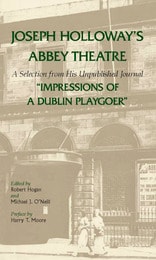
Joseph Holloway's Abbey Theatre
A Selection from His Unpublished Journal "Impressions of a Dublin Playgoer"Edited by Robert Hogan and Michael J. O'Neill. Preface by Harry T. Moore
Southern Illinois University Press, 1967
Until his death in 1944, Holloway attended almost every performance of the Abbey Theatre and daily recorded in his journal his reactions to plays and players and his comments about and conversations with literary and theatrical people. From the journal’s 221 bulky volumes, housed in the National Library of Ireland, Mr. Hogan and Mr. O’Neill have compiled this book of extracts from the approximately 25,000,000 words written by the Irishman. The years from 1899 to 1926 were chosen because they are generally considered to be the significant ones for the Abbey Theatre: the year of its founding to the production of Sean O’Casey’s The Plough and the Stars, which caused a riot in the theatre. Mr. Holloway attended every play during these years, as well as many rehearsals, and talked with nearly everybody who had anything to do with the theatre. This journal reflects the tensions, feuds, and anguish that produced one of the great theatres of modern times.
The meticulous display of minute detail makes Joseph Holloway’s Abbey Theatre imperative reading for the student of modern theatre, particularly since its character as a daily account permits ready checking of dates listed in previous works about the Irish National Theatre.
The Character of Truth
Historical Figures in Contemporary FictionNaomi Jacobs
Southern Illinois University Press, 1990
Can the novel survive in an age when tales of historical figures and contemporary personalities dominate the reading lists of the book-buying public?
Naomi Jacobs addresses this question in a study of writers such as William Styron, E. L. Doctorow, and Robert Coover, who challenge the dominance of nonfiction by populating their fictions with real people, living and dead. Jacobs explores the genesis, varieties, and implications of this trend in a prose as lively as that of the writers she critiques.
Using as a case study Robert Coover’s portrait of Richard Nixon in The Public Burning, Jacobs addresses the important legal and ethical questions raised by this trend and applies contemporary libel law to the fictionalization of living people, such as Richard Nixon. She closes her study by speculating on the future of this device and of the novel.