Results by title
3 books match the query 'Moral Order'
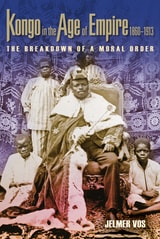
Kongo in the Age of Empire, 1860–1913
The Breakdown of a Moral OrderJelmer Vos
University of Wisconsin Press, 2015
This richly documented account of the arrival of rubber traders, new Christian missionaries, and the Portuguese colonial state in the Kongo realm is told from the perspective of the kingdom's inhabitants. Jelmer Vos shows that both Africans and Europeans were able to forward differing social, political, and economic agendas as Kongo's sacred city of São Salvador became a vital site for the expansion of European imperialism in Central Africa. Kongo people, he argues, built on the kingdom's long familiarity with Atlantic commerce and cultures to become avid intermediaries in a new system of colonial trade and mission schools.
Vos underlines that Kongo's incorporation in the European state system also had tragic consequences, including the undermining of local African structures of authority—on which the colonial system actually depended. Kongo in the Age of Empire carefully documents the involvement of Kongo's royal court in the exercise of Portuguese rule in northern Angola and the ways that Kongo citizens experienced colonial rule as an increasingly illegitimate extension of royal power.
Vos underlines that Kongo's incorporation in the European state system also had tragic consequences, including the undermining of local African structures of authority—on which the colonial system actually depended. Kongo in the Age of Empire carefully documents the involvement of Kongo's royal court in the exercise of Portuguese rule in northern Angola and the ways that Kongo citizens experienced colonial rule as an increasingly illegitimate extension of royal power.
[more]
Theatre Symposium, Vol. 15
Theatre and Moral OrderM. Scott Phillips
University of Alabama Press, 2007
The essays gathered together in Volume 15 of the annual journal Theatre Symposium investigate how, historically, the theatre has been perceived both as a source of moral anxiety and as an instrument of moral and social reform.
Essays consider, among other subjects, ethnographic depictions of the savage “other” in Buffalo Bill’s engagement at the Columbian Exposition of 1893; the so-called “Moral Reform Melodrama” in the nineteenth century; charity theatricals and the ways they negotiated standards of middle-class respectability; the figure of the courtesan as a barometer of late nineteenth and early twentieth-century moral and sexual discourse; Aphra Behn’s subversion of Restoration patriarchal sexual norms in The Feigned Courtesans; and the controversy surrounding one production of Tony Kushner Angels in America, during which officials at one of the nation’s more prominent liberal arts colleges attempted to censor the production, a chilling reminder that academic and artistic freedom cannot be taken for granted in today’s polarized moral and political atmosphere.
[more]
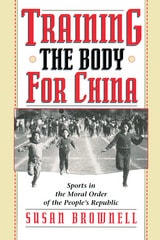
Training the Body for China
Sports in the Moral Order of the People's RepublicSusan Brownell
University of Chicago Press, 1995
Competing in the 1986 National College Games of the People's Republic of China, Susan Brownell earned both a gold medal in the heptathlon and fame throughout China as "the American girl who won glory for Beijing University." Now an anthropologist, Brownell draws on her direct experience of Chinese athletics in this fascinating look at the culture of sports and the body in China.
Training the Body for China is the first book on Chinese sports based on extended fieldwork by a Westerner. Brownell introduces the notion of "body culture" to analyze Olympic sports as one element in a whole set of Chinese body practices: the "old people's disco dancing" craze, the new popularity of bodybuilding (following reluctant official acceptance of the bikini), mass calisthenics, martial arts, military discipline, and more.
Translating official and dissident materials into English for the first time and drawing on performance theory and histories of the body, Brownell uses the culture of the body as a focal point to explore the tensions between local and global organizations, the traditional and the modern, men and women. Her intimate knowledge of Chinese social and cultural life and her wide range of historic examples make Training the Body for China a unique illustration of how gender, the body, and the nation are interlinked in Chinese culture.
[more]