Results by title
9 books match the query 'Morals'

For an Ontology of Morals
A Critique of Contemporary Ethical TheoryHenry B. Veatch
Northwestern University Press, 1971

Killer Fat
Media, Medicine, and Morals in the American "Obesity Epidemic”Boero, Natalie
Rutgers University Press, 2013
In the past decade, obesity has emerged as a major public health concern in the United States and abroad. At the federal, state, and local level, policy makers have begun drafting a range of policies to fight a war against fat, including body-mass index (BMI) report cards, “snack taxes,” and laws to control how fast food companies market to children. As an epidemic, obesity threatens to weaken the health, economy, and might of the most powerful nation in the world.
In Killer Fat, Natalie Boero examines how and why obesity emerged as a major public health concern and national obsession in recent years. Using primary sources and in-depth interviews, Boero enters the world of bariatric surgeries, Weight Watchers, and Overeaters Anonymous to show how common expectations of what bodies are supposed to look like help to determine what sorts of interventions and policies are considered urgent in containing this new kind of disease.
Boero argues that obesity, like the traditional epidemics of biological contagion and mass death, now incites panic, a doomsday scenario that must be confronted in a struggle for social stability. The “war” on obesity, she concludes, is a form of social control. Killer Fat ultimately offers an alternate framing of the nation’s obesity problem based on the insights of the “Health at Every Size” movement.
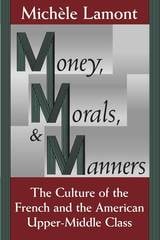
Money, Morals, and Manners
The Culture of the French and the American Upper-Middle ClassMichèle Lamont
University of Chicago Press, 1992
Money, Morals, and Manners is an ambitious and sophisticated attempt to illuminate the nature of social class in modern society. For all those who downplay the importance of unequal social groups, it will be a revelation.
"A powerful, cogent study that will provide an elevated basis for debates in the sociology of culture for years to come."—David Gartman, American Journal of Sociology
"A major accomplishment! Combining cultural analysis and comparative approach with a splendid literary style, this book significantly broadens the understanding of stratification and inequality. . . . This book will provoke debate, inspire research, and serve as a model for many years to come."—R. Granfield, Choice
"This is an exceptionally fine piece of work, a splendid example of the sociologist's craft."—Lewis Coser, Boston College

Moral Stealth
How "Correct Behavior" Insinuates Itself into Psychotherapeutic PracticeArnold Goldberg
University of Chicago Press, 2007
A psychiatrist writes a letter to a journal explaining his decision to marry a former patient. Another psychiatrist confides that most of his friends are ex-patients. Both practitioners felt they had to defend their behavior, but psychoanalyst Arnold Goldberg couldn’t pinpoint the reason why. What was wrong about the analysts’ actions?
In Moral Stealth, Goldberg explores and explains that problem of “correct behavior.” He demonstrates that the inflated and official expectations that are part of an analyst’s training—that therapists be universally curious, hopeful, kind, and purposeful, for example—are often of less help than simple empathy amid the ambiguous morality of actual patient interactions. Being a good therapist and being a good person, he argues, are not necessarily the same.
Drawing on case studies from his own practice and from the experiences of others, as well as on philosophers such as John Dewey, Slavoj Žižek, and Jürgen Habermas, Goldberg breaks new ground and leads the way for therapists to understand the relationship between private morality and clinical practice.

Morals Of History
Tzvetan Todorov
University of Minnesota Press, 1995

Morals, Reason, and Animals
S. Sapontzis
Temple University Press, 1992

Mugwumps, Morals and Politics 1884-1920
Gerald W. McFarland
University of Massachusetts Press, 1975
The conventional approach has been to concentrate on only a dozen or so of the best known Mugwumps and to trace their careers no further than 1900. In contrast, McFarland greatly extends the number of individuals whose activities must be considered reflections of the movement, discussing a sample of hundreds of active Mugwumps, and traces their careers well into the twentieth century.
Mugwump orthodoxy is demonstrated by an examination of their largely negative goals in the anti-Blaine bolt of 1884, their narrow political program during the late 1880s, and their politically disastrous loyalty to Grover Cleveland. But their innovative side is also highlighted by a searching analysis of their successes, including their participation in the movement to professionalize such occupations as law, medicine, and higher education, and their contributions to urban, political, and social reform.

Postures of the Mind
Essays on Mind and MoralsAnnette Baier
University of Minnesota Press, 1975
Postures of the Mind was first published in 1985. Minnesota Archive Editions uses digital technology to make long-unavailable books once again accessible, and are published unaltered from the original University of Minnesota Press editions.
Annette Baier develops, in these essays, a posture in philosophy of mind and in ethics that grows out of her reading of Hume and the later Wittgenstein, and that challenges several Kantian or analytic articles of faith. She questions the assumption that intellect has authority over all human feelings and traditions; that to recognize order we must recognize universal laws—descriptive or prescriptive; that the essential mental activity is representing; and that mental acts can be analyzed into discrete basic elements, combined according to statable rules of synthesis.
In the first group of essays—"Varieties of Mental Postures"—Baier evaluates the positions taken by philosophers ranging from Descartes to Dennett and Davidson. Among her topics are remembering, intending, realizing, caring, representing, changing one's mind, justifying one's actions and feelings, and having conflicting reasons for them. The second group of essays—"Varieties of Moral Postures" - explores the sort of morality we get when all of these capacities become reflective and self-corrective. Some deal with particular moral issues—our treatment of animals, our policies regarding risk to human life, our contractual obligations; others, with more general questions on the role of moral philosophers and the place of moral theory. These essays respond to the theories of Hobbes, Kant, Rawls, and MacIntyre, but Baier's most positive reaction is to David Hume; Postures of the Mind affirms and cultivates his version of a moral reflection that employs feeling and tradition as well as reason.

The Quest for Eternity
Manners and Morals in the Age of Chivalry. [Orig. pub. as The Age of Chivalry.]Charles T. Wood
Brandeis University Press, 1983