Results by title

9 books match the query 'More, Thomas, Saint'
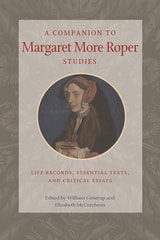
cover of A Companion to Margaret More Roper Studies: Life Records, Essential Texts, and Critical Essays

A Companion to Margaret More Roper Studies

Life Records, Essential Texts, and Critical Essays

Elizabeth McCutcheon

Catholic University of America Press, 2022

This volume is an important contribution to the field of Margaret More Roper studies, early modern women's writing, as well as Erasmian piety, Renaissance humanism, and historical and cultural studies more generally.

Margaret More Roper is the learned daughter of St. Thomas More, the Catholic martyr; their lives are closely linked to each other and to early sixteenth-century changes in politics and religion and the social upheaval and crises of conscience that they brought. Specifically, Roper's major works - her translation of Erasmus's commentary on the Lord's Prayer and the long dialogue letter between More and Roper on conscience - highlight two major preoccupations of the period: Erasmian humanism and More's last years, which led to his death and martyrdom.

Roper was one of the most learned women of her time and a prototype of the woman writer in England, and this edited volume is a tribute to her life, writings, and place among early women authors. It combines comprehensive and convenient joining of biographical, textual, historical, and critical components within a single volume for the modern reader. There is no comparable study in print, and it fills a significant gap in studies of early modern women writers.
[more]
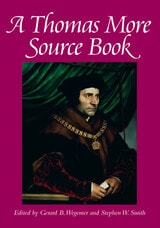
cover of A Thomas More Source Book

A Thomas More Source Book

Gerard B. Wegemer

Catholic University of America Press, 2004
This Source Book brings together classic texts by and about Thomas More--poet, scholar, statesman, family man, educational reformer, philosopher, historian, and saint
[more]
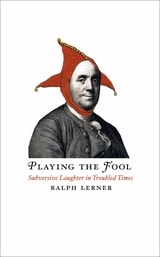
cover of Playing the Fool: Subversive Laughter in Troubled Times

Playing the Fool

Subversive Laughter in Troubled Times

Ralph Lerner

University of Chicago Press, 2009

The role of the fool is to provoke the powerful to question their convictions, preferably while avoiding a beating. Fools accomplish this not by hectoring their audience, but by broaching sensitive topics indirectly, often disguising their message in a joke or a tale. Writers and thinkers throughout history have adopted the fool’s approach, and here Ralph Lerner turns to six of them—Thomas More, Francis Bacon, Robert Burton, Pierre Bayle, Benjamin Franklin, and Edward Gibbon—to elucidate the strategies these men employed to persuade the heedless, the zealous, and the overly confident to pause and reconsider.

As Playing the Fool makes plain, all these men lived through periods marked by fanaticism, particularly with regard to religion and its relation to the state. In such a troubled context, advocating on behalf of skepticism and against tyranny could easily lead to censure, or even, as in More’s case, execution. And so, Lerner reveals, these serious thinkers relied on humor to move their readers toward a more reasoned understanding of the world and our place in it. At once erudite and entertaining, Playing the Fool is an eloquently thought-provoking look at the lives and writings of these masterly authors.
[more]
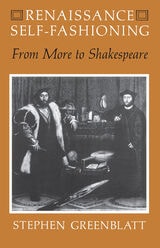
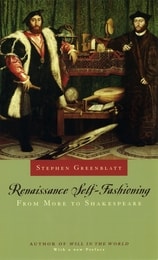
cover of Renaissance Self-Fashioning: From More to Shakespeare

Renaissance Self-Fashioning

From More to Shakespeare

Stephen Greenblatt

University of Chicago Press, 1983

Renaissance Self-Fashioning is a study of sixteenth-century life and literature that spawned a new era of scholarly inquiry. Stephen Greenblatt examines the structure of selfhood as evidenced in major literary figures of the English Renaissance—More, Tyndale, Wyatt, Spenser, Marlowe, and Shakespeare—and finds that in the early modern period new questions surrounding the nature of identity heavily influenced the literature of the era. Now a classic text in literary studies, Renaissance Self-Fashioning continues to be of interest to students of the Renaissance, English literature, and the new historicist tradition, and this new edition includes a preface by the author on the book's creation and influence.

"No one who has read [Greenblatt's] accounts of More, Tyndale, Wyatt, and others can fail to be moved, as well as enlightened, by an interpretive mode which is as humane and sympathetic as it is analytical. These portraits are poignantly, subtly, and minutely rendered in a beautifully lucid prose alive in every sentence to the ambivalences and complexities of its subjects."—Harry Berger Jr., University of California, Santa Cruz
[more]
cover of Renaissance Self-Fashioning: From More to Shakespeare

Renaissance Self-Fashioning

From More to Shakespeare

Stephen Greenblatt

University of Chicago Press, 2005

Renaissance Self-Fashioning is a study of sixteenth-century life and literature that spawned a new era of scholarly inquiry. Stephen Greenblatt examines the structure of selfhood as evidenced in major literary figures of the English Renaissance—More, Tyndale, Wyatt, Spenser, Marlowe, and Shakespeare—and finds that in the early modern period new questions surrounding the nature of identity heavily influenced the literature of the era. Now a classic text in literary studies, Renaissance Self-Fashioning continues to be of interest to students of the Renaissance, English literature, and the new historicist tradition, and this new edition includes a preface by the author on the book's creation and influence.

"No one who has read [Greenblatt's] accounts of More, Tyndale, Wyatt, and others can fail to be moved, as well as enlightened, by an interpretive mode which is as humane and sympathetic as it is analytical. These portraits are poignantly, subtly, and minutely rendered in a beautifully lucid prose alive in every sentence to the ambivalences and complexities of its subjects."—Harry Berger Jr., University of California, Santa Cruz
[more]
cover of The Kingdom Suffereth Violence: The Machiavelli / Erasmus / More Correspondence and Other Unpublished Documents

The Kingdom Suffereth Violence

The Machiavelli / Erasmus / More Correspondence and Other Unpublished Documents

Philippe Bénéton

St. Augustine's Press, 2012
[more]
cover of The One Thomas More

The One Thomas More

Travis Curtright

Catholic University of America Press, 2012
The One Thomas More carefully studies the central humanist and polemical texts written by More to illustrate a coherent development of thought.
[more]
cover of Thomas More on Statesmanship

Thomas More on Statesmanship

Gerard Wegemer

Catholic University of America Press, 1996
[more]
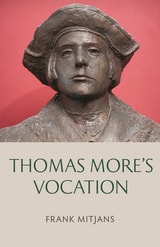
cover of Thomas More's Vocation

Thomas More's Vocation

Frank Mitjans

Catholic University of America Press, 2022

The book considers Thomas More’s early life-choices. An early letter is cited by biographers but most miss More’s reference to the market place. More’s great-grandson, Cresacre, a Londoner, understood it correctly, and that gives reason to trust him on other aspects of More’s youth. This study is based on early testimonies, those of Erasmus, Roper, Harpsfield, Stapleton and Cresacre More, as well as More’s early writings, the Pageant Verses, and his additions / omissions to the Life of Pico; evidence drawn from authors he recommended, like Hilton and Gerson; and finally, his epitaph. Attention is given to his lectures on St Augustine’s City of God, and to St John Chrysostom. It is argued More studied Chrysostom’s Homilies on the Gospel of St Matthew,/i> from a Greek manuscript. Chrysostom, in the introductory homily, spoke of the city and the market place, as the setting in which Christians practice the teaching of Christ. More practiced law and taught it. He was attracted to becoming a Christian humanist alongside Grocyn, Colet, Linacre, and Lily. With them he studied Greek, the classics and Fathers of the Church. Helped by them he became a man of prayer, aware of the need to seek holiness in the midst of the world as a layman. Faced with the dilemma of the humanist in choosing between the contemplative life of the philosopher and an active life of engagement with the world, he deliberately chose the active life in service to society, and the contemplative life of the Christian as a married man. This awareness and choice is what is called vocation, implying determination to persevere throughout life: More saw his life as a pilgrimage towards heaven as described in the last chapter focusing on More’s last work, De tristitia, tedio, pavore, et oratione christi ante captionem eius.
[more]