Results by title
18 books match the query 'Mormonism'

A Chosen People, a Promised Land
Mormonism and Race in Hawai’iHokulani K. Aikau
University of Minnesota Press, 2012
Christianity figured prominently in the imperial and colonial exploitation and dispossession of indigenous peoples worldwide, yet many indigenous people embrace Christian faith as part of their cultural and ethnic identities. A Chosen People, a Promised Land gets to the heart of this contradiction by exploring how Native Hawaiian members of the Church of Jesus Christ of Latter-Day Saints (more commonly known as Mormons) understand and negotiate their place in this quintessentially American religion.
Mormon missionaries arrived in Hawai‘i in 1850, a mere twenty years after Joseph Smith founded the church. Hokulani K. Aikau traces how Native Hawaiians became integrated into the religious doctrine of the church as a “chosen people”—even at a time when exclusionary racial policies regarding black members of the church were being codified. Aikau shows how Hawaiians and other Polynesian saints came to be considered chosen and how they were able to use their venerated status toward their own spiritual, cultural, and pragmatic ends.
Using the words of Native Hawaiian Latter-Day Saints to illuminate the intersections of race, colonization, and religion, A Chosen People, a Promised Land examines Polynesian Mormon articulations of faith and identity within a larger political context of self-determination.

Archiving Heaven and Earth
The Historian's Office and the Making of MormonismRobin Scott Jensen
University of Illinois Press, 2027
Robin Scott Jensen explores the Church Historian’s Office against the backdrop of how writing and archiving what was written shaped the growth, faith, and identity of the nineteenth-century Latter Day Saint movement. As Jensen shows, records simultaneously created and preserved history. Journal keeping and letter writing stood alongside official documents as an essential means for Saints to understand their mission and place in American society. Over time, the Church Historian’s Office evolved into a powerful institution that guided memory and authority by deciding what to collect, copy, or destroy. Jensen tells the stories of the forgotten archivists, many of them women, who built the Church Historian’s Office, while revealing the choices and conflicts that led to Native and other voices being marginalized or erased.
Detailed and candid, Archiving Heaven and Earth provides a rare look at a foundational organization.
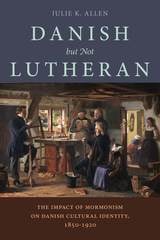
Danish, But Not Lutheran
The Impact of Mormonism on Danish Cultural Identity, 1850–1920Julie K. Allen
University of Utah Press, 2017
The Danish-Mormon migration to Utah in the nineteenth century was, relative to population size, one of the largest European religious out-migrations in history. Hundreds of thousands of Americans can trace their ancestry to Danish Mormons, but few know about the social and cultural ramifications of their ancestors’ conversion to Mormonism. This book tells that exciting and complex story for the first time.
In 1849, after nearly a thousand years of state- controlled religion, Denmark’s first democratic constitution granted religious freedom. One year later, the arrival of three Mormon missionaries in Denmark and their rapid success at winning converts to their faith caused a crisis in Danish society over the existential question: "How could someone be Danish but not Lutheran?" Over the next half-century nearly thirty thousand Danes joined the LDS Church, more than eighteen thousand of whom emigrated to join their fellow Mormons in Utah. This volume explores the range of Danish public reactions to Mormonism over a seventy-year period—from theological concerns articulated by Søren and Peter Christian Kierkegaard in the 1850s to fear-mongering about polygamy and white slavery in silent films of the 1910s and 1920s—and looks at the personal histories of converts.
Honorable Mention for Best International Book from the Mormon History Association.
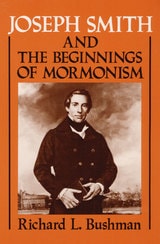
Joseph Smith and the Beginnings of Mormonism
Richard L. Bushman
University of Illinois Press, 1984
Winner of the David Woolley Evans and Beatrice Evans Biography Award and a History Book Club selection, 1985.
The core of Mormon belief was a conviction about actual events. The test of faith was not adherence to a certain confession of faith but belief that Christ was resurrected, that Joseph Smith saw God, that the Book of Mormon was true history, and that Peter, James, and John restored the apostleship. Mormonism was history, not philosophy.
It is as history that Richard L. Bushman analyzes the emergence of Mormonism in the early nineteenth century. Bushman, however, brings to his study a unique set of credentials--he is both a prize-winning historian and a faithful member of the Latter-day Saints church. For Mormons and non-Mormons alike, his book provides a very special perspective on an endlessly fascinating subject.
Building upon previous accounts and incorporating recently discovered contemporary sources, Bushman focuses on the first twenty-five years of Joseph Smith's life--up to his move to Kirtland, Ohio, in 1831. Bushman shows how the rural Yankee culture of New England and New York--especially evangelical revivalism, Christian rationalism, and folk magic--both influenced and hindered the formation of Smith's new religion.
Mormonism, Bushman argues, must be seen not only as the product of this culture, but also as an independent creation based on the revelations of its charismatic leader. In the final analysis, it was Smith's ability to breathe new life into the ancient sacred stories and to make a sacred story out of his own life which accounted for his own extraordinary influence. By presenting Smith and his revelations as they were viewed by the early Mormons themselves, Bushman leads us to a deeper understanding of their faith.
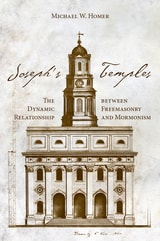
Joseph’s Temples
The Dynamic Relationship between Freemasonry and MormonismMichael W. Homer
University of Utah Press, 2014
There are indications that Freemasonry was a pervasive foundational element in Mormonism and that its rituals and origin legends influenced not just the secret ceremonies of the LDS temples but also such important matters as the organization of the Mormon priesthood, the foundation of the women’s Relief Society, the introduction and concealment of polygamy, and the church’s position on African Americans’ full membership. Freemasonry was also an important facet of Mormons’ relations with broader American society.
The two movements intertwined within a historical context of early American intellectual, social, and religious ferment, which influenced each of them and in varying times and situations placed them either in the current or against the flow of mainstream American culture and politics. Joseph’s Temples provides a comprehensive examination of a dynamic relationship and makes a significant contribution to the history of Mormonism, Freemasonry, and their places in American history.
Recipient of the Meritorious Book Award from the Utah Division of State History

Junius And Joseph
Presidential Politics and the Assassination of the First Mormon ProphetRobert S. Wicks & Fred R. Foister
Utah State University Press, 2005
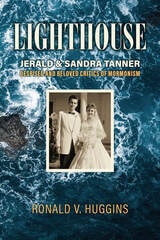
Lighthouse
Jerald and Sandra Tanner, Despised and Beloved Critics of MormonismRonald V. Huggins
Signature Books, 2022
The Tanners consistently challenged the church’s position on many historical issues. Utah Lighthouse was long the only source for Mormon scholars to obtain crucial historical reprints, which they still happily or begrudgingly purchase; for others, the Tanners’ writings have been the source of disillusionment with the church. Despised or beloved, the influence of Jerald and Sandra Tanner cannot be underestimated or ignored.
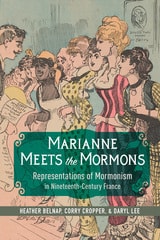
Marianne Meets the Mormons
Representations of Mormonism in Nineteenth-Century FranceHeather Belnap, Corry Cropper, and Daryl Lee
University of Illinois Press, 2022
Surprising and innovative, Marianne Meets the Mormons looks at how nineteenth-century French observers engaged with the idea of Mormonism in order to reframe their own cultural preoccupations.
Mormonism and the Making of a British Zion
Matthew L. Rasmussen
University of Utah Press, 2016
After many British believers left for America, church membership in England fell so sharply that the movement in Britain seemed to be on the brink of collapse. Yet British Mormonism gradually resurged and continues today. How did this religious minority flourish when so many nineteenth-century revivalist movements did not? Rasmussen explains Mormonism’s inception, perpetuation, and maturation in Britain in a compelling case study of a “new religious movement” with staying power. From its establishment in 1837 to its maturation in 1998, the Mormon perspective of Britain shifted dramatically. This book chronicles that shift, and illustrates how doctrinal adaptation has enabled Mormonism in Britain to persist.
Mormonism
THE STORY OF A NEW RELIGIOUS TRADITIONJan Shipps
University of Illinois Press, 1985
Mormons and Mormonism
An Introduction to an American World ReligionEdited by Eric A. Eliason
University of Illinois Press, 2001
This volume explains how the earliest Mormons viewed their religion and suggests that the Book of Mormon appeared to them as an exciting document of social protest. Contributors consider the history of persecution of the Mormons, the church's relationship with the state of Utah and with other divisions of Christianity, and culture clashes in the church's missionary efforts. Mormons and Mormonism also places beliefs such as vicarious baptism for the dead in a larger context of community and religious ideals.
The founding of Mormonism and its rapid emergence as a new world religion are among the most intriguing aspects of American religious history and among the most neglected in the religion classroom. This much-needed volume lays the groundwork for a better understanding of the LDS Church and its historical and potential impact on the United States and the world.
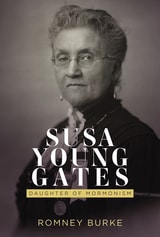
Susa Young Gates
Daughter of MormonismRomney Burke
Signature Books, 2022
After divorcing her first husband, Alma Dunford, the trauma associated with that union was such that she steadfastly refused to mention it ever again. She also lost some of her children over the course of her life and was unable to reconcile her older sister’s departure from the LDS Church and conversion to Catholicism. Yet despite her trials, Susa found fulfillment in her faith through service, as a prolific writer—co-authoring with her daughter Leah Dunford Widtsoe the 1930 biography of her father, Life Story of Brigham Young, founding the Young Women’s Journal in 1889, the Relief Society Magazine in 1915, and in her associations with such prominent women’s advocates such as Susan B. Anthony.
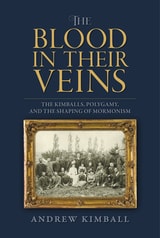
The Blood in Their Veins
The Kimballs, Polygamy, and the Shaping of MormonismKimball, Andrew
Signature Books, 2025
This meticulously documented, deeply engaging book represents a unique approach to Utah and Latter-day Saint history, drawing on previously untapped private letters and diaries of members of the large and widely known polygamist family of the prominent Latter-day Saint leader, Heber C. Kimball.
The story includes compelling accounts of Helen Kimball Whitney, who married Joseph Smith polygamously at fourteen and became, according to Emmeline B. Wells, “one of the best known and most estimable women of the Church,” and of her son Orson F. Whitney, who forswore his embrace of reincarnation only six years before his call as an apostle of the Church of Jesus Christ of Latter-day Saints. Another daughter, Alice Kimball Smith, married a man who was tracked to a brothel and arrested for armed robbery and assault in 1883, after which Alice turned to family friend and apostle Joseph F. Smith and became his fifth wife. Heber’s son, J. Golden Kimball, one of the most beloved and colorful personalities in Mormon and Utah history, is brought to life in another sketch. The Kimballs had to navigate the ticklish business of explaining or obfuscating polygamy to disapproving family in the East, including the extended claim by Heber’s wife Christeen to her New Jersey family that she had married a Mr. Chase monogamously. Two of Heber’s sons, both stake presidents, contemplated plural marriage in the first decade of the twentieth century, well after the church publicly disavowed the practice.
Additional light is shone on the now-defunct Latter-day Saint practices of adult adoptions and speaking in tongues, Mormon-settler relations with the Utes and Pahvants, the 1856 handcart rescue, the John Hyrum Koyle “Dream Mine,” the Jackson County, Missouri, Temple Lot suit of 1892, and federal pursuit of polygamists.
The September Six and the Struggle for the Soul of Mormonism
Patterson, Sara M.
Signature Books, 2023
The September Six and the Struggle for the Soul of Mormonism
Patterson, Sara M.
Signature Books, 2024
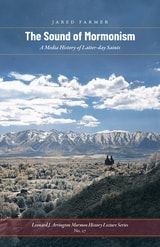
The Sound of Mormonism
A Media History of Latter-day SaintsJared Farmer
Utah State University Press, 2024
The Arrington Lecture series, established in honor of one of the twentieth-century American West’s most distinguished historians, Leonard Arrington, has become a leading forum for prominent scholars to address topics related to Latter-day Saint history. Utah State University hosts the Leonard J. Arrington Mormon History Lecture Series through the Merrill-Cazier Library’s Special Collections and Archives.
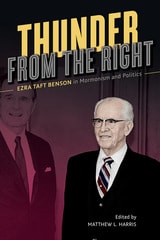
Thunder from the Right
Ezra Taft Benson in Mormonism and PoliticsEdited by Matthew L. Harris
University of Illinois Press, 2019

Women and Mormonism
Historical and Contemporary PerspectivesEdited by Kate Holbrook and Matthew Bowman
University of Utah Press, 2016
This engaging and seminal volume employs a variety of sources—vivid primary documents, candid surveys, and illuminating oral histories—to explore the perspectives of Latter-day Saint (LDS) women. The expansive approach of this essay collection highlights an assortment of individuals, viewpoints, and challenges that ultimately invigorate our understanding of women and religion. Contributors include lay members and prominent scholars in multiple disciplines, including both LDS and non-LDS viewpoints.