Results by title

4 books match the query 'Motherhood in popular culture'
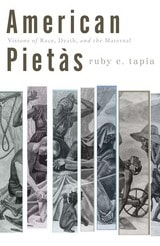
cover of American Pietàs: Visions of Race, Death, and the Maternal

American Pietàs

Visions of Race, Death, and the Maternal

Ruby C. Tapia

University of Minnesota Press, 2010

In American Pietàs, Ruby C. Tapia reveals how visual representations of racialized motherhood shape and reflect national citizenship. By means of a sustained engagement with Roland Barthes’s suturing of race, death, and the maternal in Camera Lucida, Tapia contends that the contradictory essence of the photograph is both as a signifier of death and a guarantor of resurrection.

Tapia explores the implications of this argument for racialized productions of death and the maternal in the context of specific cultural moments: the commemoration of Princess Diana in U.S. magazines; the intertext of Toni Morrison’s and Hollywood’s Beloved; the social and cultural death in teen pregnancy, imaged and regulated in California’s Partnership for Responsible Parenting campaigns; and popular constructions of the “Widows of 9/11” in print and televisual journalism.

Taken together, these various visual media texts function in American Pietàs as cultural artifacts and as visual nodes in a larger network of racialized productions of maternal bodies in contexts of national death and remembering. To engage this network is to ask how and toward what end the racial project of the nation imbues some maternal bodies with resurrecting power and leaves others for dead. In the spaces between these different maternities, says Tapia, U.S. citizen-subjects are born—and reborn.
[more]
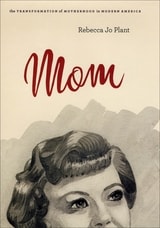
cover of Mom: The Transformation of Motherhood in Modern America

Mom

The Transformation of Motherhood in Modern America

Rebecca Jo Plant

University of Chicago Press, 2010
 
In the early twentieth century, Americans often waxed lyrical about “Mother Love,” signaling a conception of motherhood as an all-encompassing identity, rooted in self-sacrifice and infused with social and political meaning. By the 1940s, the idealization of motherhood had waned, and the nation’s mothers found themselves blamed for a host of societal and psychological ills. In Mom, Rebecca Jo Plant traces this important shift by exploring the evolution of maternalist politics, changing perceptions of the mother-child bond, and the rise of new approaches to childbirth pain and suffering.
Plant argues that the assault on sentimental motherhood came from numerous quarters. Male critics who railed against female moral authority, psychological experts who hoped to expand their influence, and women who strove to be more than wives and mothers—all for their own distinct reasons—sought to discredit the longstanding maternal ideal. By showing how motherhood ultimately came to be redefined as a more private and partial component of female identity, Plant illuminates a major reorientation in American civic, social, and familial life that still reverberates today.

[more]
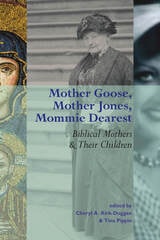
cover of Mother Goose, Mother Jones, Mommie Dearest: Biblical Mothers and Their Children

Mother Goose, Mother Jones, Mommie Dearest

Biblical Mothers and Their Children

Cheryl A. Kirk-Duggan

SBL Press, 2009

Who are the mothers in the biblical text? What do they do? What kinds of power do they have? Issues of identity, authority, violence, gender, sexuality, race, ethnicity, sexual exploitation and rape-marriage, murder, and relation to God have haunted the characters and representations of motherhood from Eve to Mary and beyond. For better or for worse, these images speak potent messages even today. To explore biblical mothers and their relationships with their daughters and sons, the contributors to this volume participate in a comparative analysis between biblical mothers and mothers in popular media, history, literature, and the arts. The diversity of methods they employ prompts a rich discussion on the deconstruction of motherhood, offering new ways of envisioning both biblical and contemporary motherhood. The contributors are Cheryl A. Kirk-Duggan and Tina Pippin, Madeline McClenney-Sadler, Wil Gafney, Brian Britt, Frank M. Yamada, Mignon R. Jacobs, Linda S. Schering, Mark Roncace and Deborah Whitehead, Andrew M. Mbuvi, Stephanie Buckhanon Crowder, Brenda Wallace, Margaret Aymer, Tat-siong Benny Liew, and Alison Jasper.
[more]
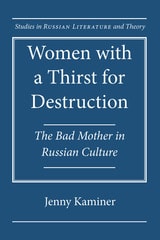
cover of Women with a Thirst for Destruction: The Bad Mother in Russian Culture

Women with a Thirst for Destruction

The Bad Mother in Russian Culture

Jenny Kaminer

Northwestern University Press, 2014

Winner, 2014 AWSS Best Book in Slavic/East European/Eurasian Women's Studies

In Russian culture, the archetypal mother is noble and self-sacrificing. In Women with a Thirst for Destruction, however, Jenny Kaminer shows how this image is destabilized during periods of dramatic rupture in Russian society, examining in detail the aftermath of three key moments in the country’s history: the emancipation of the serfs in 1861, the Russian Revolution of 1917, and the fall of the Communist regime in 1991. She explores works both familiar and relatively unexamined: Leo Tolstoy’s Anna Karenina, Mikhail Saltykov-Shchedrin’s The Golovlev Family, Fyodor Gladkov’s Cement, and Liudmila Petrushevskaia’s The Time: Night, as well as a late Soviet film (Vyacheslav Krishtofovich’s Adam’s Rib, 1990) and media coverage of the Chechen conflict. Kaminer’s book speaks broadly to the mutability of seemingly established cultural norms in the face of political and social upheaval.

 
[more]