Results by title

12 books match the query 'Motion picture theaters'
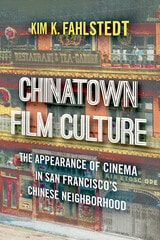
cover of Chinatown Film Culture: The Appearance of Cinema in San Francisco’s Chinese Neighborhood

Chinatown Film Culture

The Appearance of Cinema in San Francisco’s Chinese Neighborhood

Kim K. Fahlstedt

Rutgers University Press, 2020
Chinatown Film Culture provides the first comprehensive account of the emergence of film and moviegoing in the transpacific hub of San Francisco in the early twentieth century. Working with materials previously left in the margins of grand narratives of history, Kim K. Fahlstedt uncovers the complexity of a local entertainment culture that offered spaces where marginalized Chinese Americans experienced and participated in local iterations of modernity. At the same time, this space also fostered a powerful Orientalist aesthetic that would eventually be exported to Hollywood by San Francisco showmen such as Sid Grauman. Instead of primarily focusing on the screen-spectator relationship, Fahlstedt suggests that immigrant audiences' role in the proliferation of cinema as public entertainment in the United States saturated the whole moviegoing experience, from outside on the street to inside the movie theater. By highlighting San Francisco and Chinatown as featured participants rather than bit players, Chinatown Film Culture provides an historical account from the margins, alternative to the more dominant narratives of U.S. film history.
[more]
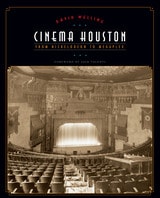
cover of Cinema Houston: From Nickelodeon to Megaplex

Cinema Houston

From Nickelodeon to Megaplex

By David Welling

University of Texas Press, 2007

Cinema Houston celebrates a vibrant century of movie theatres and moviegoing in Texas's largest city. Illustrated with more than two hundred historical photographs, newspaper clippings, and advertisements, it traces the history of Houston movie theatres from their early twentieth-century beginnings in vaudeville and nickelodeon houses to the opulent downtown theatres built in the 1920s (the Majestic, Metropolitan, Kirby, and Loew's State). It also captures the excitement of the neighborhood theatres of the 1930s and 1940s, including the Alabama, Tower, and River Oaks; the theatres of the 1950s and early 1960s, including the Windsor and its Cinerama roadshows; and the multicinemas and megaplexes that have come to dominate the movie scene since the late 1960s.

While preserving the glories of Houston's lost movie palaces—only a few of these historic theatres still survive—Cinema Houston also vividly re-creates the moviegoing experience, chronicling midnight movie madness, summer nights at the drive-in, and, of course, all those tasty snacks at the concession stand. Sure to appeal to a wide audience, from movie fans to devotees of Houston's architectural history, Cinema Houston captures the bygone era of the city's movie houses, from the lowbrow to the sublime, the hi-tech sound of 70mm Dolby and THX to the crackle of a drive-in speaker on a cool spring evening.
[more]
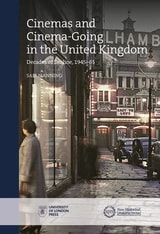
cover of Cinemas and Cinema-Going in the United Kingdom: Decades of Decline, 1945–1965

Cinemas and Cinema-Going in the United Kingdom

Decades of Decline, 1945–1965

Sam Manning

University of London Press, 2020

Cinema-going was the most popular commercial leisure activity in the United Kingdom during the first half of the twentieth century, with attendance growing significantly during World War II and peaking in 1946 with 1.6 billion recorded admissions. Though “going to the pictures” remained a popular pastime for the remainder of the forties, the transition from war to peacetime altered citizens’ leisure habits. During the fifties, a range of factors led to rapid declines in attendance, and by 1965, admissions had plummeted to 327 million.

Cinema attendance fell in all regions, but the speed, nature, and extent of this decline varied widely across the United Kingdom. By presenting detailed case studies of two similarly-sized industrial cities, Belfast and Sheffield, this book adds nuance and detail to the discussion of regional variations in film exhibition and audience habits. Using a wide range of sources, such as oral testimony, box-office data, newspapers, and trade journals, Cinemas and Cinema-Going in the United Kingdom conveys the diverse and ever-changing nature of the cinema industry.
[more]
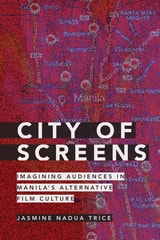
cover of City of Screens: Imagining Audiences in Manila's Alternative Film Culture

City of Screens

Imagining Audiences in Manila's Alternative Film Culture

Jasmine Nadua Trice

Duke University Press, 2021
In City of Screens Jasmine Nadua Trice examines the politics of cinema circulation in early-2000s Manila. She traces Manila's cinema landscape by focusing on the primary locations of film exhibition and distribution: the pirated DVD district, mall multiplexes, art-house cinemas, the university film institute, and state-sponsored cinematheques. In the wake of digital media piracy and the decline of the local commercial film industry, the rising independent cinema movement has been a site of contestation between filmmakers and the state, each constructing different notions of a prospective, national public film audience. Discourses around audiences become more salient given that films by independent Philippine filmmakers are seldom screened to domestic audiences, despite their international success. City of Screens provides a deeper understanding of the debates about the competing roles of the film industry, the public, and the state in national culture in the Philippines and beyond.
[more]
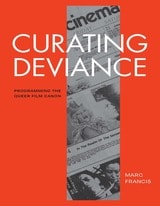
cover of Curating Deviance: Programming the Queer Film Canon

Curating Deviance

Programming the Queer Film Canon

Marc Francis

Duke University Press, 2026
In Curating Deviance, Marc Francis scavenges film history for signs of vibrant, wayward life in the film programming of US art house and repertory cinemas between 1968 and 1989. Francis examines how creative and savvy programmers screened films by the likes of John Waters, Pier Paolo Pasolini, Russ Meyer, Rainer Werner Fassbinder, and a bevy of others in major cities across the United States, forming intertextual constellations in their repertory calendars. These programs allied a dizzying range of sexual and gendered outlaws, including stigmatized practices often overlooked by LGBT-focused queer theory. Curating Deviance reveals how repertory and art cinemas built a coalition of outcasts stigmatized for their taboo desires or identities, rekindling queer utopian imaginaries.
[more]
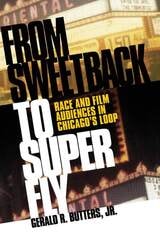
cover of From SWEETBACK to SUPER FLY: Race and Film Audiences in Chicago's Loop

From SWEETBACK to SUPER FLY

Race and Film Audiences in Chicago's Loop

Gerald R. Butters, Jr.

University of Missouri Press, 2014
 
Racial politics and capitalism found a way to blend together in 1970s Chicago in the form of movie theaters targeted specifically toward African Americans. In From Sweetback to Super Fly, Gerald Butters examines the movie theaters in Chicago’s Loop that became, as he describes them, “black spaces” during the early 1970s with theater managers making an effort to gear their showings toward the African American community by using black-themed and blaxploitation films.


Butters covers the wide range of issues that influenced the theaters, from changing racial patterns to the increasingly decrepit state of Chicago’s inner city and the pressure on businesses and politicians alike to breathe life into the dying area. Through his extensive research, Butters provides an in-depth look at this phenomenon, delving into an area that has not previously been explored. His close examination of how black-themed films were marketed and how theaters showing these films tried to draw in crowds sheds light on race issues both from an industrial standpoint on the side of the theaters and movie producers, as well as from a cultural standpoint on the side of the moviegoers and the city of Chicago as a whole. Butters provides a wealth of information on a very interesting yet underexamined part of history, making From Sweetback to Super Fly a supremely enjoyable and informative book.
[more]
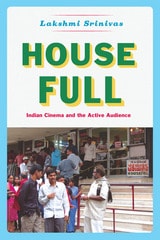
cover of House Full: Indian Cinema and the Active Audience

House Full

Indian Cinema and the Active Audience

Lakshmi Srinivas

University of Chicago Press, 2016

India is the largest producer and consumer of feature films in the world, far outstripping Hollywood in the number of movies released and tickets sold every year. Cinema quite simply dominates Indian popular culture, and has for many decades exerted an influence that extends from clothing trends to music tastes to everyday conversations, which are peppered with dialogue quotes.
            With House Full, Lakshmi Srinivas takes readers deep into the moviegoing experience in India, showing us what it’s actually like to line up for a hot ticket and see a movie in a jam-packed theater with more than a thousand seats. Building her account on countless trips to the cinema and hundreds of hours of conversation with film audiences, fans, and industry insiders, Srinivas brings the moviegoing experience to life, revealing a kind of audience that, far from passively consuming the images on the screen, is actively engaged with them. People talk, shout, whistle, cheer; others sing along, mimic, or dance; at times audiences even bring some of the ritual practices of Hindu worship into the cinema, propitiating the stars onscreen with incense and camphor. The picture Srinivas paints of Indian filmgoing is immersive, fascinating, and deeply empathetic, giving us an unprecedented understanding of the audience’s lived experience—an aspect of Indian film studies that has been largely overlooked.
[more]
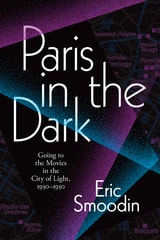
cover of Paris in the Dark: Going to the Movies in the City of Light, 1930–1950

Paris in the Dark

Going to the Movies in the City of Light, 1930–1950

Eric Smoodin

Duke University Press, 2020
In Paris in the Dark Eric Smoodin takes readers on a journey through the streets, cinemas, and theaters of Paris to sketch a comprehensive picture of French film culture during the 1930s and 1940s. Drawing on a wealth of journalistic sources, Smoodin recounts the ways films moved through the city, the favored stars, and what it was like to go to the movies in a city with hundreds of cinemas. In a single week in the early 1930s, moviegoers might see Hollywood features like King Kong and Frankenstein, the new Marlene Dietrich and Maurice Chevalier movies, and any number of films from Italy, Germany, and Russia. Or they could frequent the city's ciné-clubs, which were hosts to the cinéphile subcultures of Paris. At other times, a night at the movies might result in an evening of fascist violence, even before the German Occupation of Paris, while after the war the city's cinemas formed the space for reconsolidating French film culture. In mapping the cinematic geography of Paris, Smoodin expands understandings of local film exhibition and the relationships of movies to urban space.
[more]
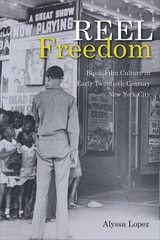
cover of Reel Freedom: Black Film Culture in Early Twentieth-Century New York City

Reel Freedom

Black Film Culture in Early Twentieth-Century New York City

Alyssa Lopez

Temple University Press, 2025

Reel Freedom intimately captures the relationship between Black film culture and space in New York City. Alyssa Lopez argues that Black film culture, from its origins in the early twentieth century to its firm establishment in the 1930s, was necessarily both entertainment and resistance, connected as it was to Black New Yorkers’ demands for access and equality in the city.

Lopez investigates how ordinary people, labor activists, journalists, filmmakers, theater managers, and owners all shaped Black film culture. Black girls and women used moviegoing as a means of independence and control over their lives. Race filmmaker Oscar Micheaux fought with New York State’s censorship board to get his films screened with limited edits in local theaters. And Harlem’s Black projectionists battled for unionization and fair pay, while journalists linked cinema to Black New Yorkers’ lived experiences.

In Reel Freedom, Lopez chronicles the wide-ranging and remarkable pervasiveness of Black film culture in New York City, redefining a period and place most associated with the Harlem Renaissance.  In doing so, she illustrates how Black New Yorkers leveraged cinema to make the city their own and to enjoy urban living to its fullest.

In the series Urban Life, Landscape, and Policy
[more]
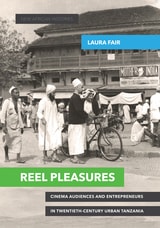
cover of Reel Pleasures: Cinema Audiences and Entrepreneurs in Twentieth-Century Urban Tanzania

Reel Pleasures

Cinema Audiences and Entrepreneurs in Twentieth-Century Urban Tanzania

Laura Fair

Ohio University Press, 2017

Reel Pleasures brings the world of African moviehouses and the publics they engendered to life, revealing how local fans creatively reworked global media—from Indian melodrama to Italian westerns, kung fu, and blaxploitation films—to speak to local dreams and desires. In it, Laura Fair zeroes in on Tanzanians’ extraordinarily dynamic media cultures to demonstrate how the public and private worlds of film reception brought communities together and contributed to the construction of genders, generations, and urban citizenship over time. Radically reframing the literatures on media exhibition, distribution, and reception, Reel Pleasures demonstrates how local entrepreneurs and fans worked together to forge the most successful cinema industry in colonial sub-Saharan Africa. The result is a major contribution to the literature on transnational commodity cultures.
[more]
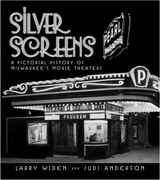
cover of Silver Screens: A Pictorial History of Milwaukee's Movie Theaters

Silver Screens

A Pictorial History of Milwaukee's Movie Theaters

Larry Widen

Wisconsin Historical Society Press, 2007

Silver Screens traces the rich history of Milwaukee's movie theaters, from 1890s nickelodeons to the grand palaces of the Roaring Twenties to the shopping mall outlets of today. And the story doesn't end there: in the past two decades, the revival of interest in preservation and restoration of theaters has confirmed that there's still life in these beloved old structures. With the publication of Silver Screens, authors Larry Widen and Judi Anderson help ensure that our old theaters, those being restored and those long since vanished, will remain forever embedded in our collective memory.

In this revised edition of their book Milwaukee Movie Palaces, the authors present new findings on film innovations, drive-in theaters, projection booths, movie promotions, noted theater personalities, recent restoration efforts, and much more. Illuminated with more than a hundred photographs, including many never before published, Silver Screens is a stunning tribute to the legacy of the movie theater.
[more]
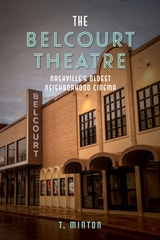
cover of The Belcourt Theatre: Nashville's Oldest Neighborhood Cinema

The Belcourt Theatre

Nashville's Oldest Neighborhood Cinema

T. Minton

Vanderbilt University Press, 2026

Since opening in 1925 as the Hillsboro Theatre, the Belcourt has stood at the center of Nashville’s changing cultural life. Over the course of a century, it has been a neighborhood movie house, a stage for live performance, a home for community theater, an art-house cinema, a music venue, and a nonprofit film center. Its story is also the story of a city shaped by shifting technologies, urban change, grassroots activism, and evolving ideas about what cultural institutions are for.

The Belcourt Theatre offers the first full history of this enduring landmark, tracing how one cultural center adapted again and again to serve new audiences while remaining a vital place for public gathering, artistic exchange, and shared experience.

[more]