Results by title

4 books match the query 'Motion pictures and globalization'

cover of Dream Factories of a Former Colony: American Fantasies, Philippine Cinema

Dream Factories of a Former Colony

American Fantasies, Philippine Cinema

José B. Capino

University of Minnesota Press, 2010

Philippine cinema, the dream factory of the former U.S. colony, teems with American figures and plots. Local movies feature GIs seeking Filipina brides, cold war spies hunting down native warlords, and American-born Filipinos wandering in the parental homeland. The American landscape furnishes the settings for the triumphs and tragedies of Filipino nurses, GI babies, and migrant workers.

By tracking American fantasies in Philippine movies from the postindependence period to the present, José B. Capino offers an innovative account of cinema's cultural work in decolonization and globalization. Capino examines how a third world nation's daydreams both articulate empire and mobilize against it, provide imaginary maps and fables of identity for its migrant workers and diasporan subjects, pose challenges to the alibis of patriarchy and nationalism, and open up paths for participating in the cultures of globality.

Through close readings of more than twenty Philippine movies, Capino demonstrates the postcolonial imagination's vital role in generating pragmatic and utopian visions of living with empire. Illuminating an important but understudied cinema, he creates a model for understanding the U.S. image in the third world.
[more]
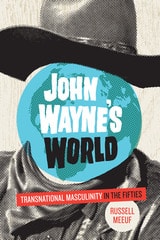
cover of John Wayne’s World: Transnational Masculinity in the Fifties

John Wayne’s World

Transnational Masculinity in the Fifties

By Russell Meeuf

University of Texas Press, 2013

In a film career that spanned five decades, John Wayne became a U.S. icon of heroic individualism and rugged masculinity. His widespread popularity, however, was not limited to the United States: he was beloved among moviegoers in Asia, Africa, Latin America, and Europe. In John Wayne’s World, Russell Meeuf considers the actor’s global popularity and makes the case that Wayne’s depictions of masculinity in his most popular films of the 1950s reflected the turbulent social disruptions of global capitalism and modernization taking place in that decade.

John Wayne’s World places Wayne at the center of gender- and nation-based ideologies, opening a dialogue between film history, gender studies, political and economic history, and popular culture. Moving chronologically, Meeuf provides new readings of Fort Apache, Red River, Hondo, The Searchers, Rio Bravo, and The Alamo and connects Wayne’s characters with a modern, transnational masculinity being reimagined after World War II. Considering Wayne’s international productions, such as Legend of the Lost and The Barbarian and the Geisha, Meeuf shows how they resonated with U.S. ideological positions about Africa and Asia. Meeuf concludes that, in his later films, Wayne’s star text shifted to one of grandfatherly nostalgia for the past, as his earlier brand of heroic masculinity became incompatible with the changing world of the 1960s and 1970s. The first academic book-length study of John Wayne in more than twenty years, John Wayne’s World reveals a frequently overlooked history behind one of Hollywood’s most iconic stars.
[more]
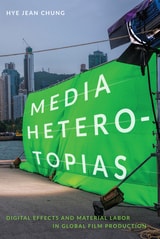
cover of Media Heterotopias: Digital Effects and Material Labor in Global Film Production

Media Heterotopias

Digital Effects and Material Labor in Global Film Production

Jean Hye Chung

Duke University Press, 2018
In Media Heterotopias Hye Jean Chung challenges the widespread tendency among audiences and critics to disregard the material conditions of digital film production. Drawing on interviews with directors, producers, special effects supervisors, and other film industry workers, Chung traces how the rhetorical and visual emphasis on seamlessness masks the social, political, and economic realities of global filmmaking and digital labor. In films such as Avatar (2009), Interstellar (2014), and The Host (2006)—which combine live action footage with CGI to create new hybrid environments—filmmaking techniques and "seamless" digital effects allow the globally dispersed labor involved to go unnoticed by audiences. Chung adapts Foucault's notion of heterotopic spaces to foreground this labor and to theorize cinematic space as a textured, multilayered assemblage in which filmmaking occurs in transnational collaborations that depend upon the global movement of bodies, resources, images, and commodities. Acknowledging cinema's increasingly digitized and globalized workflow, Chung reconnects digitally constructed and composited imagery with the reality of production spaces and laboring bodies to highlight the political, social, ethical, and aesthetic stakes in recognizing the materiality of collaborative filmmaking.
[more]
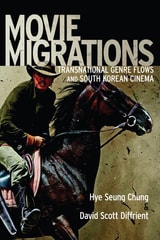
cover of Movie Migrations: Transnational Genre Flows and South Korean Cinema

Movie Migrations

Transnational Genre Flows and South Korean Cinema

Hye Seung Chung and David Scott Diffrient

Rutgers University Press, 2015

As the two billion YouTube views for “Gangnam Style” would indicate, South Korean popular culture has begun to enjoy new prominence on the global stage. Yet, as this timely new study reveals, the nation’s film industry has long been a hub for transnational exchange, producing movies that put a unique spin on familiar genres, while influencing world cinema from Hollywood to Bollywood. 
 
Movie Migrations is not only an introduction to one of the world’s most vibrant national cinemas, but also a provocative call to reimagine the very concepts of “national cinemas” and “film genre.” Challenging traditional critical assumptions that place Hollywood at the center of genre production, Hye Seung Chung and David Scott Diffrient bring South Korean cinema to the forefront of recent and ongoing debates about globalization and transnationalism. In each chapter they track a different way that South Korean filmmakers have adapted material from foreign sources, resulting in everything from the Manchurian Western to The Host’s reinvention of the Godzilla mythos. 
 
Spanning a wide range of genres, the book introduces readers to classics from the 1950s and 1960s Golden Age of South Korean cinema, while offering fresh perspectives on recent favorites like Oldboy and Thirst. Perfect not only for fans of Korean film, but for anyone curious about media in an era of globalization, Movie Migrations will give readers a new appreciation for the creative act of cross-cultural adaptation. 
 

[more]