Results by title
9 books match the query 'Motivation (Psychology)'
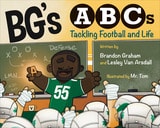
BG's ABCs
Tackling Football and LifeWritten by Brandon Graham and Lesley Van Arsdall; Illustrated by Mr. Tom
Temple University Press, 2025
BG’s ABCs emphasizes a never give up mindset while also teaching lessons of kindness and respect. Using BG’s ABCs as a guide, young readers are sure to achieve victory while also developing a zest for life!
Getting Your Way
Strategic Dilemmas in the Real WorldJames M. Jasper
University of Chicago Press, 2006
Getting other people to do what we want is a useful skill for anyone. Whether you’re seeking a job, negotiating a deal, or angling for that big promotion, you’re engaged in strategic thought and action. In such moments, you imagine what might be going on in another person’s head and how they’ll react to what you do or say. At the same time, you also try to pick the best way to realize your goals, both with and without the other person’s cooperation. Getting Your Way teaches us how to win that game by offering a fuller understanding of how strategy works in the real world.
As we all know, rules of strategy are regularly discovered and discussed in popular books for business executives, military leaders, and politicians. Those works with their trendy lists of pithy maxims and highly effective habits can help people avoid mistakes or even think anew about how to tackle their problems. But they are merely suggestive, as each situation we encounter in the real world is always more complex than anticipated, more challenging than we had hoped. James M. Jasper here shows us how to anticipate those problems before they actually occur—by recognizing the dilemmas all strategic players must negotiate, with each option accompanied by a long list of costs and risks. Considering everyday dilemmas in a broad range of familiar settings, from business and politics to love and war, Jasper explains how to envision your goals, how to make the first move, how to deal with threats, and how to employ strategies with greater confidence.
Alexander the Great, Genghis Khan, Rosa Parks, Hugo Chávez, and David Koresh all come into play in this smart and engaging book, one that helps us recognize and prepare for the many dilemmas inherent in any strategic action.
Microsociology
Discourse, Emotion, and Social StructureThomas J. Scheff
University of Chicago Press, 1990
Thomas J. Scheff brings together the study of communication and the social
psychology of emotions to explore the microworld of thoughts, feelings,
and moods. Drawing on strikingly diverse and rich sources—the findings of
artificial intelligence and cognitive science, and examples from literary
dialogues and psychiatric interviews—Scheff provides an inventive account
of the nature of social life and a theory of motivation that brilliantly
accounts for the immense complexity involved in understanding even the most
routine conversation.
"A major contribution to some central debates in social theory at the
present time. . . . What Thomas Scheff seeks to develop is essentially a
quite novel account of the nature of social life, its relation to language
and human reflexivity, in which he insists upon the importance of a theory
of emotion. . . . A work of true originality and jolting impact. . . .
Microsociology is of exceptional interest, which bears witness to the
very creativity which it puts at the center of human social contact."
—Anthony Giddens, from the Foreword
"Scheff provides a rich theory that can easily generate further exploration. And he drives home the message that sociological work on interaction, social bonds, and society cannot ignore human emotionality."—Candace Clark, American Journal of Sociology
"This outstanding and ground-breaking little volume contains a wealth of original ideas that bring together many insights concerning the relationship of emotion to motivation in a wide variety of social settings. It is strongly recommended to all serious students of emotion, of society, and of human nature."—Melvin R. Lansky, American Journal of Psychiatry
Motivation and the Primacy of Perception
Merleau-Ponty's Phenomenology of KnowledgePeter Antich
Ohio University Press, 2021
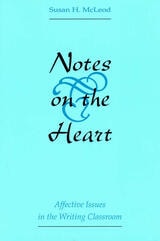
Notes on the Heart
Affective Issues in the Writing ClassroomSusan H. McLeod
Southern Illinois University Press, 1997
It has long been recognized that affect (that is, the noncognitive aspect of mental activity) plays a large role in writing and in learning to write. According to Susan H. McLeod, however, the model that has been most used for empirical research on the writing process is based on cognitive psychology and does not take into account affective phenomena. Nor does the social constructionist view of the writing process acknowledge the affective realm except in a very general way. To understand the complete picture, McLeod insists, we need to explore how cognitive, affective, and social elements interact as people write.
In this book, McLeod follows a group of students through a semester of writing assignments, tracking the students’ progress and examining the affective elements relevant to their writing. To facilitate future discussion of these phenomena, McLeod also provides suggested definitions for terms in the affective domain.
In a very real sense, this book is the result of a collaboration of three Susans: Susan McLeod, who researched and wrote the book; Sue Hallett, an instructor in Washington State University’s composition program whose classes McLeod observed and who helped provide much of the data; and Susan Parker, a graduate student who observed Hallett’s class and who ran a tutorial connected to that class. To provide a narrative structure, McLeod and her two collaborators have constructed a simulated semester, conflating the year and a half of the study into one semester and creating a class that is a composite drawn from seven classrooms over three semesters.
Although philosophers have had much to say about the affective domain, Notes on the Heart is based for the most part on research from the social sciences. Discussions of pedagogy, while meant to have practical value, are suggestive rather than prescriptive. The goal is to help teachers see their practice in new way.
Teachers will be particularly interested in McLeod’s discussion of teacher affect/effect. This section examines both the issue of the "Pygmalion effect" (students becoming better because the teacher believes they are) and perhaps the more common opposite, the "golem effect" (students becoming less capable because their teachers view them that way).
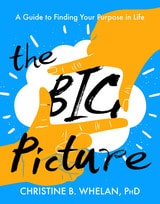
The Big Picture
A Guide to Finding Your Purpose in LifeChristine B. Whelan
Templeton Press, 2016
“If young adults could be guided in the right direction for a life journey of meaning and purpose, we would be grooming the leaders of tomorrow for a better world. This book is the perfect guide.” —Deepak Chopra, MD, FACP, founder of the Chopra Center for Wellbeing
What am I going to do for the rest of my life?
This question is familiar for young people at a turning point—whether it’s facing the end of high school, college, graduate school, or just a dead-end job. Maybe they have the degree they want but don’t know where to start their job search. Perhaps they’re still choosing a major and, given the range—from “Biochemistry” to “Adventure Education”—are lost in the options. Maybe they’re facing a mountain of debt but don’t want to get locked into a job they hate.
While other books might advise writing resumes or preparing for interviews, they only go so far. Young people want more than just another job—they want a life, and a meaningful one at that.
Enter The Big Picture. Created by the leading authority on self-help research and reviewed by over six hundred college students, Dr. Christine B. Whelan’s The Big Picture offers a guide to discovering one’s talents, dreams, and desires that can lead one to a fulfilling career but fulfilling life. It guides young people to take a step back and look at the “big picture” of who they are, what they want, and why they’re here.
Through quizzes and questionnaires which college students have vetted, Whelan guides the reader through “big picture” questions like,
- What are my talents—and how can I use those to help others and create meaning?
- How have my life experiences shaped who I am and what I can give?
- What do I value—and how can I be happy while being true to those values?
Although there are endless books on finding a job, this is the first book that presents research-based and tested material to help young people answer the question, What will I do with my life? The Big Picture provides the resources needed to find—and live—a purposeful life. An excellent gift for a graduate or a guide for yourself.
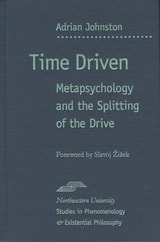
Time Driven
Metapsychology and the Splitting of the DriveAdrian Johnston
Northwestern University Press, 2005
Johnston draws on Jacques Lacan's oeuvre in conjunction with certain philosophical resources-elements from transcendental philosophy, structuralism, and phenomenology-to rectify the inconsistencies within the Freudian metapsychological model of drive. In doing so, he helps to answer a question haunting Freud at the end of his career: Why is humanity plagued by a perpetual margin of discontent, despite technological and cultural progress?
In Time Driven, Johnston is able to make sense of Freud's metapsychology both as a whole and in its historical development of Lacan's reinterpretation of Freud, and of the place of both Freud and Lacan in modern philosophy.
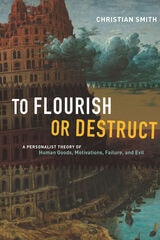
To Flourish or Destruct
A Personalist Theory of Human Goods, Motivations, Failure, and EvilChristian Smith
University of Chicago Press, 2015
In his 2010 book What Is a Person?, Christian Smith argued that sociology had for too long neglected this fundamental question. Prevailing social theories, he wrote, do not adequately “capture our deep subjective experience as persons, crucial dimensions of the richness of our own lived lives, what thinkers in previous ages might have called our ‘souls’ or ‘hearts.’” Building on Smith’s previous work, To Flourish or Destruct examines the motivations intrinsic to this subjective experience: Why do people do what they do? How can we explain the activity that gives rise to all human social life and social structures?
Smith argues that our actions stem from a motivation to realize what he calls natural human goods: ends that are, by nature, constitutionally good for all human beings. He goes on to explore the ways we can and do fail to realize these ends—a failure that can result in varying gradations of evil. Rooted in critical realism and informed by work in philosophy, psychology, and other fields, Smith’s ambitious book situates the idea of personhood at the center of our attempts to understand how we might shape good human lives and societies.
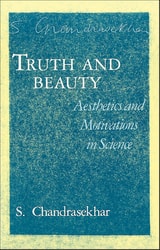
Truth and Beauty
Aesthetics and Motivations in ScienceS. Chandrasekhar
University of Chicago Press, 1987
The late S. Chandrasekhar was best known for his discovery of the upper
limit to the mass of a white dwarf star, for which he received the Nobel
Prize in Physics in 1983. He was the author of many books, including
The Mathematical Theory of Black Holes and, most recently,
Newton's Principia for the Common Reader.