Results by title
7 books match the query 'Motivation in education'
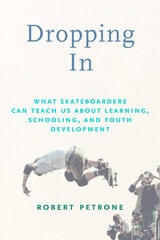
Dropping In
What Skateboarders Can Teach Us about Learning, Schooling, and Youth DevelopmentRobert Petrone
University of Massachusetts Press, 2023
The die-hard local skateboarders of Franklin Skatepark—a group of working-class, Latino and white young men in the rural Midwest—are typically classified by schools and society as “struggling,” “at-risk,” “failing,” and “in crisis.” But at the skatepark, they thrive and succeed, not only by landing tricks but also by finding meaning and purpose in their lives.
In Dropping In, Robert Petrone draws from multiple years of ethnographic research to bring readers into this rich environment, exploring how and why these young men engage more with skateboarding and its related cultural communities than with school. For them, it is in these alternative communities and spaces that they meet their intellectual, literate, and learning needs; cultivate meaningful and supportive relationships; and develop a larger understanding of their place in the world. By looking at what these skateboarders can teach us about what is right and working in their lives, Petrone asks educators and others committed to youth development to rethink schooling structures and practices to provide equitable education for all students.

Informed Learning
Christine Bruce
Assoc of College & Research Libraries, 2011
Learner-Centered Pedagogy
Principles and PracticeKevin Michael Klipfel
American Library Association, 2017
Today's emphasis on metrics and personalization make evidence-based instruction an imperative. In this practice-based handbook, the authors draw on the research of the humanistic psychologist and educator Carl Rogers to present an empathetic approach to information literacy sessions, reference service, and outreach. With an eye on everyday library work, they offer concrete, empirically-based strategies to connect with learners at all levels. Offering plentiful examples of pedagogy in action, this book covers:
- 6 cognitive principles for organizing information literacy instruction, with sample worksheets and organization tools for instruction planning;
- how to establish rapport and kindle learners' motivation;
- tactics for transcending "cite 5 sources" and other uninspiring research assignments;
- educational evidence debunking the mythical perception that because students are skilled at computers and mobile technology, they already know how to do research;
- questions to keep in mind for inspiring autonomous learning;
- the power of story, as described by Joan Didion, Brené Brown's Ted Talk, and educational psychology research;
- the science behind information overload; and
- a balanced framework for evaluating specific educational technology tools.
Fusing theory with practice, this handbook is a valuable resource to help every practitioner connect with learners more effectively.

Motivating Students in Information Literacy Classes
American Library Association, 2004
Motivating Students on a Time Budget
Pedagogical Frames and Lesson Plans for In-Person and Online Information Literacy InstructionSarah Steiner
Assoc of College & Research Libraries, 2019
The Fun Of Motivation
Crossing The Threshold Concepts-Pub#71Mary Francis
American Library Association, 2017
The Spark of Learning
Energizing the College Classroom with the Science of EmotionSarah Rose Cavanagh
West Virginia University Press, 2016