Results by title
16 books match the query 'Mountaineering'
Aconcagua
The Invention of Mountaineering on America’s Highest PeakJoy Logan
University of Arizona Press, 2011
Having done fieldwork on Aconcagua for six years, Logan offers keen insights into how the invention of mountaineering in the nineteenth century—and adventure tourism a century later—have both shaped and been shaped by local and global cultural narratives. She examines the roles and functions of mountain guides, especially in regard to notions of gender and nation; re-reads the mountaineering stories forged by explorers, scientists, tourism officials, and the gear industry; and considers the distinctions between foreign and Argentine climbers (some of whom are celebrities in their own right).
In Logan’s revealing analysis, Aconcagua is emblematic of the tensions produced by modernity, nation-building, tourism development, and re-ethnification. The evolution of mountain climbing on Aconcagua registers seismic shifts in attitudes toward adventure, the national, and the global. With an eye for detail and a flair for description, Logan invites her readers onto the mountain and into the lives it supports.

Big Wonderful
Notes from WyomingKevin Holdsworth
University Press of Colorado, 2006
Growing up in Utah, Holdsworth couldn't wait to move away. Once ensconced on the East Coast, however, he found himself writing westerns and dreaming of the mountains he'd skied and climbed. Fed up with city life, he moved to a small Wyoming town.
In Big Wonderful, he writes of a mountaineering companion's death, the difficult birth of his son, and his father's terminal illness - encounters with mortality that sharpened his ideas about risk, care, and commitment. He puts a new spin on mountaineering literature, telling wild tales from his reunion with the mountains but also relating the surprising willpower it took to turn back from risks he would have taken before he became a father. He found he needed courage to protect and engage deeply with his family, his community, and the wild places he loves.
Holdsworth's essays and poems are rich with anecdotes, characters, and vivid images. Readers will feel as if they themselves watched a bear destroy an entire expedition's food, walked with his great-great-grandmother along the icy Mormon Trail, and tried to plant a garden in Wyoming's infamous wind.
Readers who love the outdoors will enjoy this funny and touching take on settling down and adventuring in the West's most isolated country.
Climber’s Guide to Devil’s Lake
Sven Olof Swartling
University of Wisconsin Press, 2008
•a summary of the geologic and natural history of the Baraboo hills by Patricia K. Armstrong
•locations and updated descriptions of nearly 1,800 climbs
•landmark photographs from most major climbing areas
•GPS waypoints, map coordinates, altimeter readings, and approach information
•detailed diagrams locating climbing routes at most major climbing areas
•6 new diagrams, 5 new climbing areas, and 120 new routes
Contact
Mountain Climbing And Environmental ThinkingJeffrey Mccarthy
University of Nevada Press, 2008
Critical Hours
Search and Rescue in the White MountainsSandy Stott
University Press of New England, 2018

ESSAYS ON MOUNTAINEERING
ARMAND E. SINGER
West Virginia University Press, 1982
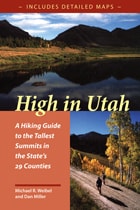
High in Utah
Michael Weibel
University of Utah Press, 1999
High in Utah is quite consciously a book for peak baggers, complete with a checklist and elevations. Summits range from Kings Peak, Utah’s highest at 13,528’ to the unnamed peak in Rich County, a mere 9,255’. In addition to the county high points, this book also has four “classic” climbs: Mt. Olympus in Salt Lake County; Mt. Timpanogos above Provo; Notch Peak in the House Range west of Delta; and Wellsville Cone, Cache Valley’s western landmark.
Since finding a place to start can often be the most frustrating part of a hike, emphasis is placed on directions to each trailhead. There is a road map for each hike, as well as a trail map showing contours. The routes in this guide are not always the easiest or most practical, but they may be the most appealing and are often the most commonly used (lessening human impact on other potential routes). Difficulty levels range from 'extreme'—long, steep routes that may require some route finding—to 'too easy'—reachable by car. Two sets of hiking times are provided to accommodate variations in hiking speed, and there are also sections on flora and fauna, mountain weather, low-impact hiking and camping, equipment, and altitude sickness.
"Alaska is our biggest, buggiest, boggiest state. Texas remains our largest unfrozen state. But mountainous Utah, if ironed out flat, would take up more space on a map than either."
—Edward Abbey, 1927–1989
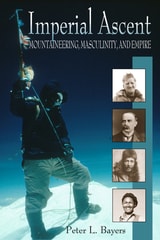
Imperial Ascent
Masculinity, Mountaineering, and EmpirePeter L. Bayers
University Press of Colorado, 2003
At the same time, he demonstrates how Tiger of the Snows,, Sherpa Tenzing Norgay's account of climbing Mount Everest, undermines Western conceptions of mountaineering and imperialism. Throughout this theoretically informed critique, Bayers manages to retain the sense of awe and adventure inherent in the original works, making Imperial Ascent a highly engaging read.
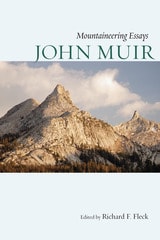
Mountaineering Essays
John Muir
University of Utah Press, 1997
One of the world’s foremost writers of the mountaineering essay—his writings are finely wrought expressions of the transcendental joy he found in the mountains—John Muir also founded the Sierra Club in 1892 as a way of supporting his belief that Americans must preserve national parks throughout the country in order that future generations might be spiritually inspired. Characterized by an iron endurance and an insatiable curiosity, Muir vowed to spend his days studying God’s unwritten Bible—nature—or what he termed the "University of the Wilderness." Muir early on learned to keep a journal in the manner of Emerson, but he is also considered one of America’s pioneer glaciologists, an interest he gained while wandering in Yosemite and the Sierra Nevada mountains. Whether frozen in a subzero blizzard on Mount Shasta, seemingly doomed on the unforgiving slopes of Mount Ritter, or exhilarated by the ice-shapes viewed from the summit of Mount Rainier, Muir reveled in the mountain experience.
This volume contains eleven mountain essays that include both adventurous narrative, joyful exultation, and descriptions of natural features such as alpine soil beds, ancient glaciers and living glaciers, and mountain sculpture. In each, Muir maintains a careful and subtle balance between the physical aspects of ascending and the more symbolic observations of the sublimity of his surroundings. Mountains are for him a source of discovery that provide an affirmation of the human spirit.
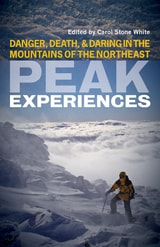
Peak Experiences
Danger, Death, and Daring in the Mountains of the NortheastEdited by Carol Stone White
University Press of New England, 2012
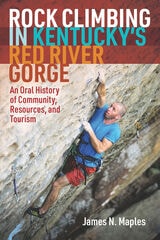
Rock Climbing in Kentucky's Red River Gorge
An Oral History of Community, Resources, and TourismJames N. Maples
West Virginia University Press, 2021
Rock Climbing in Kentucky’s Red River Gorge documents, for the first time, fifty years of oral history from this famous climbing community. Through extensive interviews, Maples reconstructs the growth of rock climbing in the region—including a twice-failed dam project, mysterious first routes, unauthorized sport-route growth on public lands, and a controversial archaeological dig. The book details five decades of collaborations to secure ongoing access to some of the world’s most beautiful and technically demanding routes and the challenges along the way.
More than a recounting of the past, however, Rock Climbing in Kentucky’s Red River Gorge uses the region’s extraordinary history to argue that climbing has the potential to be a valuable source of sustainable economic activity in rural areas throughout Appalachia today and in the years to come. The book concludes by offering policy recommendations and lessons learned about building beneficial partnerships among climbers, local communities, and public land managers to encourage community development and ecotourism alongside preservation.
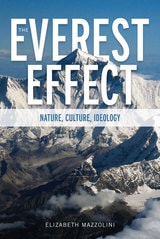
The Everest Effect
Nature, Culture, IdeologyElizabeth Mazzolini
University of Alabama Press, 2015
The Everest Effect is an accessibly written cultural history of how nature, technology, and culture have worked together to turn Mount Everest into a powerful and ubiquitous physical measure of Western values.
In The Everest Effect Elizabeth Mazzolini traces a series of ideological shifts in the status of Mount Everest in Western culture over the past century to the present day and links these shifts to technologies used in climbs. By highlighting the intersections of technology and cultural ideologies at this site of environmental extremity, she shows both how nature is shaped—physically and symbolically—by cultural values and how extreme natural phenomena shape culture.
Nostalgia, myth, and legend are intrinsic features of the conversations that surround discussions of historic and contemporary climbs of Everest, and those conversations themselves reflect changing relations between nature, technology, and ideology. Each of the book’s chapters links a particular value with a particular technology to show how technology is implicated in Mount Everest’s cultural standing and commodification: authenticity is linked with supplemental oxygen; utility with portable foodstuffs; individuality with communication technology; extremity with visual technology; and ability with money. These technologies, Mazzolini argues, are persuasive—and increasingly so as they work more quickly and with more intimacy on our bodies and in our daily lives.
As Mazzolini argues, the ideologies that situate Mount Everest in Western culture today are not debased and descended from a more noble time; rather, the material of the mountain and its surroundings and the technologies deployed to encounter it all work more immediately with the bodies and minds of actual and “armchair” mountaineers than ever before. By moving the analysis of a natural site and phenomenon away from the traditional labor of production and toward the symbolic labor of affective attachment, The Everest Effect shows that the body and nature have helped constitute the capitalization that is usually characterized as taking over Everest.
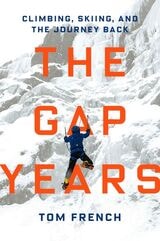
The Gap Years
Climbing, Skiing, and the Journey BackTom French
Brandeis University Press, 2026
At the end of 2019, Tom French retired from a four-decade career in business, determined to return to interests that had defined his youth and see what meaning they still held. One of these interests was mountaineering. Another was adventure travel, with a particular focus on Nepal. A third was cross-country ski racing. Having taken “gap years” between school and university, and again before he started work, he decided to take a gap year before settling into the expectations of retirement. One year turned into three as he rebuilt his athletic strength, competed in cross-country ski marathons, and climbed some of the world’s highest mountains, including two expeditions to Mount Everest. On the first Everest climb, a cyclone forced him to turn around high on the mountain and descend the treacherous Lhotse Face in a blizzard. On the second, he approached the mountain through the remote Makalu Barun region, the first climber ever to do so, and climbed to the summit on a moonlit night.
But this is a book about much more than Everest. It is about beauty and joy found in wild places, about cross-country ski racing and mountaineering more broadly, and—most of all—about a journey to find meaning in life and reconnect with the passions of youth.
The New Hiking the Monadnock Region
44 Nature Walks and Day-Hikes in the Heart of New EnglandJoe Adamowicz
University Press of New England, 2007
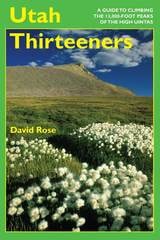
Utah Thirteeners
David M. Rose
University of Utah Press, 2004
Most Utahns are familiar with the Uinta Mountains, but few realize that the range has twenty-one peaks above 13,000 feet, some of them still unnamed. The elevation, challenging terrain and weather, solitude, and beautiful setting in Utah’s largest wilderness area make climbing these peaks a particularly rewarding experience. Better yet, in the summer and early fall every one of them can be climbed by a reasonably fit hiker without rope or climbing gear.
This guide provides detailed topographical maps and information on trailheads, access and summit routes with difficulty ratings, camp locations, estimated hiking times, weather, advice, and brief facts about geology and the history of the wilderness area. It also includes over fifty photographs of this breathtaking country.
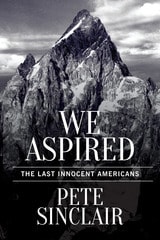
We Aspired
The Last Innocent AmericansPete Sinclair
University of Utah Press, 2017
Imbued with a sense of place, Pete Sinclair climbed mountains and rescued others trying the same. He thrived on the risky business of ascending sheer rock, of moving from one adrenaline-boosting moment to another. In this book he recounts his mountain-climbing and park ranger days from 1959 to 1970, a time some people call a golden era of climbing in America, a time when climbers knew one another and frequently gathered in Grand Teton National Park. There, Sinclair was the ranger in charge of mountain rescue, a job that, especially when it involved the North Face of Grand Teton, drew on all his young team’s climbing skills. Mixing adventure with personal reflection, Sinclair recounts expeditions taken with friends to scale mountains in Alaska, Mexico, and other parts of North America, as well as his work rescuing injured climbers in the Tetons. The book serves as a history of a past era in mountaineering as well as a meditation on what it all meant. Throughout the book, he challenges readers to consider their relationship with the western landscape. Originally published in 1993, We Aspired was a finalist for the Boardman-Tasker Award for Mountain Literature. The account of one famous rescue on the North Face of the Grand Teton is retold in The Grand Rescue, a film by independent Utah producer Jenny Wilson.