Results by title
6 books match the query 'Movement (Philosophy)'

Always More Than One
Individuation's DanceErin Manning
Duke University Press, 2012
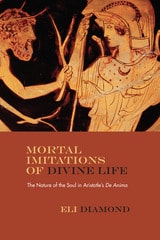
Mortal Imitations of Divine Life
The Nature of the Soul in Aristotle's De AnimaEli Diamond
Northwestern University Press, 2015
In Mortal Imitations of Divine Life, Diamond offers an interpretation of De Anima, which explains how and why Aristotle places souls in a hierarchy of value. Aristotle’s central intention in De Anima is to discover the nature and essence of soul—the principle of living beings. He does so by identifying the common structures underlying every living activity, whether it be eating, perceiving, thinking, or moving through space. As Diamond demonstrates through close readings of De Anima, the nature of the soul is most clearly seen in its divine life, while the embodied soul’s other activities are progressively clear approximations of this principle. This interpretation shows how Aristotle’s psychology and biology cannot be properly understood apart from his theological conception of God as life, and offers a new explanation of De Anima’s unity of purpose and structure.
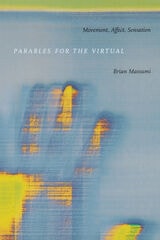
Parables for the Virtual
Movement, Affect, SensationBrian Massumi
Duke University Press, 2002
Renewing and assessing William James's radical empiricism and Henri Bergson's philosophy of perception through the filter of the post-war French philosophy of Deleuze, Guattari, and Foucault, Massumi links a cultural logic of variation to questions of movement, affect, and sensation. If such concepts are as fundamental as signs and significations, he argues, then a new set of theoretical issues appear, and with them potential new paths for the wedding of scientific and cultural theory. Replacing the traditional opposition of literal and figural with new distinctions between stasis and motion and between actual and virtual, Parables for the Virtual tackles related theoretical issues by applying them to cultural mediums as diverse as architecture, body art, the digital art of Stelarc, and Ronald Reagan's acting career. The result is an intriguing combination of cultural theory, science, and philosophy that asserts itself in a crystalline and multi-faceted argument.
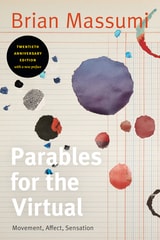
Parables for the Virtual
Movement, Affect, SensationBrian Massumi
Duke University Press, 2021
This twentieth anniversary edition includes a new preface in which Massumi situates the book in relation to developments since its publication and outlines the evolution of its main concepts. It also includes two short texts, “Keywords for Affect” and “Missed Conceptions about Affect,” in which Massumi explicates his approach to affect in ways that emphasize the book's political and philosophical stakes.
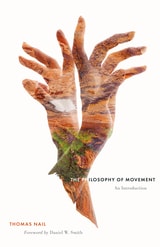
The Philosophy of Movement
An IntroductionThomas Nail
University of Minnesota Press, 2024
An influential thinker distills years of work on the philosophy of movement into one accessible account
Why are city dwellers worldwide walking on average ten percent faster than they were a decade ago? Why are newcomer immigrant groups so often maligned when migration has always constituted civilization? To analyze and understand the depth of the reasons, Thomas Nail suggests that it serves us well to turn to a philosophy of movement. Synthesizing and extending many years of his influential work, The Philosophy of Movement is a comprehensive argument for how motion is the primary force in human and natural history.
Nail critiques the bias toward stasis at the core of Western thought, asking: what would a philosophy that began with the primacy of movement look like? Interrogating the consequences of movement throughout history and in daily life in the twenty-first century, he draws connections and traces patterns between scales of reality, periods of history, and fields of knowledge. In our age of rapid movements shaped by accelerating climate change and ensuing mass global migration, as well as ubiquitous digital media, Nail provides a contemporary philosophy that helps us understand how we got here and how to grapple with these interlocking challenges.
With a foreword by philosopher Daniel W. Smith, The Philosophy of Movement: An Introduction is a must-read for scholars and students not only of philosophy but also history, anthropology, science and technology studies, mobility studies, and other fields across the humanities and social sciences.

The Sensible World and the World of Expression
Course Notes from the Collège de France, 1953Maurice Merleau-Ponty, Translated from the French with an introduction and notes by Bryan Smyth
Northwestern University Press, 2020
The Sensible World and the World of Expression was a course of lectures that Merleau-Ponty gave at the Collège de France after his election to the chair of philosophy in 1952. The publication and translation of Merleau-Ponty’s notes from this course provide an exceptional view into the evolution of his thought at an important point in his career.
In these notes, we see that Merleau-Ponty’s consideration of the problem of the perception of movement leads him to make a self-critical return to Phenomenology of Perception in order to rethink the perceptual encounter with the sensible world as essentially expressive, and hence to revise his understanding of the body schema accordingly in terms of praxical motor possibilities. Sketching out an embodied dialectic of expressive praxis that would link perception with art, language, and other cultural and intersubjective phenomena, up to and including truth, Merleau-Ponty’s notes for these lectures thus afford an exciting glimpse of how he aspired to overcome the impasse of ontological dualism.
Situated midway between Phenomenology of Perception and The Visible and the Invisible, these notes mark a juncture of crucial importance with regard to Merleau-Ponty’s later efforts to work out the ontological underpinnings of phenomenology in terms of a new dialectical conception of nature and history.