Results by title
14 books match the query 'Mulder, Jantinus'
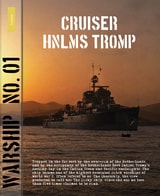
Cruiser HNLMS Tromp
Jantinus Mulder
Amsterdam University Press, 2023
Trapped in the Far East by the over-run of the Netherlands and by the occupancy of the Netherlands East Indies, Tromp's destiny lay in the Indian Ocean and Pacific onslaughts. The ship became one of the highest decorated Dutch warships of World War II. Often referred to as 'The Ghost Ship', the crew preferred to call her 'The Lucky Ship', since she was no less than five times claimed to be sunk.
[more]
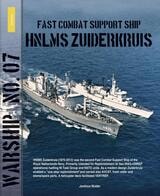
Fast Combat Support Ship HNLMS Zuiderkruis
Jantinus Mulder
Amsterdam University Press, 2023
HNLMS Zuiderkruis (1975-2012) was the second Fast Combat Support Ship of the Royal Netherlands Navy. It was primarily intended for Replenishment At Sea, fueling task groups and NATO units. As a modern design Zuiderkruis enabled a “one stop replenishment” and also carried AVCAT, fresh water and spare parts. A helicopter deck facilitated vertical replenishment.
[more]
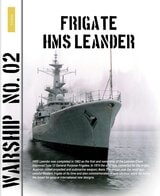
Frigate HMS Leander
Jantinus Mulder
Amsterdam University Press, 2023
HMS Leander was completed in 1963 as the first ship of the Leander Class Improved Type 12 General Purpose Frigates. In 1974, she joined the 3rd Frigate Squadron, which included other Leander-class frigates. The design was the most successful Western frigate of its time and led to several new international designs.
[more]
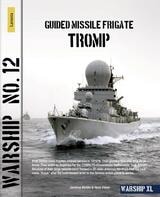
Guided Missile Frigate Tromp
Jantinus Mulder
Amsterdam University Press, 2023
Both Tromp-class frigates entered service in 1975/-76. Their primary task was area air defense. They acted as flagships for the COMNLTG (Commander Netherlands Task Group). Their large radome (which housed a 3D radar antenna) is why the ships had the nickname ‘Kojak’, after the bald-headed actor in the famous crime tv-series.
[more]
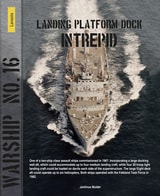
Landing Platform Dock Intrepid
Jantinus Mulder
Amsterdam University Press, 2024
One of a two-ship class assault ships commissioned in 1967. Incorporating a large docking well aft, which could accommodate up to four medium landing craft, while four 30 troop light landing craft could be loaded on davits each side of the superstructure. The large flight deck aft could operate up to six helicopters. Both ships operated with the Falkland Task Force in 1982.
[more]
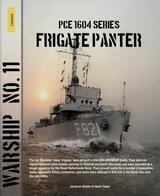
PCE 1604 Series, Frigate Panter
Henk Visser
Amsterdam University Press, 2023
The six Frigate Panters were all built in the USA with MDAP funds. They were designed to escort slow coastal convoys in the Channel and North Sea areas and were operated as a single squadron by the Royal Netherlands Navy. They proved useful in a number of peacetime tasks, especially fishery protection, and some retained this role in the North Sea until the mid-1980s.
[more]
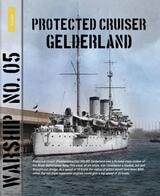
Protected cruiser Gelderland
Jantinus Mulder
Amsterdam University Press, 2023
Protected cruiser (Pantserdekschip) HNLMS Gelderland was a Holland-class cruiser of the Royal Netherlands Navy. This class, of six ships, was considered a modest, but well thought-out design. At a speed of 10 knots the radius of action would have been 8000 miles, while the two triple expansion engines could generate a maximum speed of 19,5 knots.
[more]
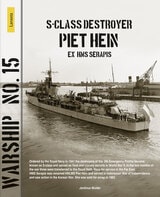
S-class destroyer Piet Hein (ex HMS Serapis)
Jantinus Mulder
Amsterdam University Press, 2024
Ordered by the Royal Navy in 1941, the destroyers of the 5th Emergency Flotilla became known as S-class and served as fleet and convoy escorts in World War II. In the last months of the war, three were transferred to the Royal Netherlands Navy for service in the Far East. HMS Serapis was renamed HNLMS Piet Hein and served in the Indonesian War of Independence and saw action in the Korean War. She was sold for scrap in 1962.
[more]
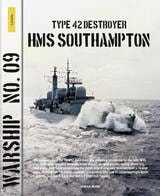
Type 42 destroyer Southampton
Jantinus Mulder
Amsterdam University Press, 2023
The primary role of the Type 42 destroyers was providing air defense for the fleet. With their long-range sensors, the ships could also act as radar pickets, sailing ahead of a task group. HMS Southampton was the eighth ship originally destined to be a 16-ship class – two of these ships have been exported to Argentina. The type 42 comprised eight Batch 1 vessels, four Batch 2 and four Batch 3 Stretched Type 42.
[more]
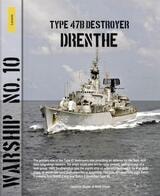
Type 47B Destroyer Drenthe
Jantinus Mulder
Amsterdam University Press, 2021
[more]
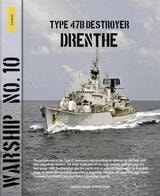
Type 47B Destroyer Drenthe
Jantinus Mulder
Amsterdam University Press, 2023
After World War II, the Royal Netherlands Navy ordered new ships to counter the growing threat coming from the Soviet submarines. These ships were classified as ASW destroyers (onderzeebootjagers), but close to contemporary destroyers in terms of specifications. The national industry designed and constructed two classes of these ships. Drenthe was of the more capable Type 47B series.
[more]
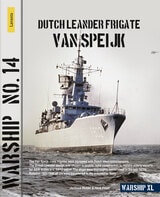
Warship 14
Dutch Leander Frigate Van SpeijkJantinus Mulder
Amsterdam University Press, 2023
The Van Speijk class frigates were equipped with Dutch electronics/sensors. The British Leander design was chosen to enable rapid construction to replace elderly escorts for ASW duties and NATO patrol. The ships were thoroughly modernised in the late 1970s. Between 1986-1990 all six were transferred to the Indonesian Navy.
[more]
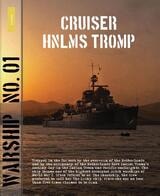
Warship 1
Cruiser HNLMS TrompJantinus Mulder
Amsterdam University Press, 2012
Trapped in the Far East by the over-run of the Netherlands and by the occupancy of the Netherlands East Indies, Tromp's destiny lay in the Indian Ocean and Pacific onslaughts. The ship became one of the highest decorated Dutch warships of World War II. Often referred to as 'The Ghost Ship', the crew preferred to call her 'The Lucky Ship', since she was no less than five times claimed to be sunk.
[more]
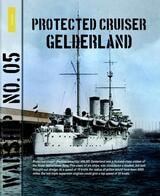
Warship 5
Protected Cruiser GelderlandJantinus Mulder
Amsterdam University Press, 0
Protected cruiser (Pantserdekschip) HNLMS Gelderland was a Holland-class cruiser of the Royal Netherlands Navy. This class, of six ships, was considered a modest, but well thought-out design. At a speed of 10 knots the radius of action would have been 8000 miles, while the two triple expansion engines could generate a maximum speed of 19,5 knots.
[more]