Results by title

4 books match the query 'Multimedia (Art)'

cover of Grime, Glitter, and Glass: The Body and the Sonic in Contemporary Black Art

Grime, Glitter, and Glass

The Body and the Sonic in Contemporary Black Art

Nikki A. Greene

Duke University Press, 2024

In Grime, Glitter, and Glass, Nikki A. Greene examines how contemporary Black visual artists use sonic elements to refigure the formal and philosophical developments of Black art and culture. Focusing on the multimedia art of Renée Stout, Radcliffe Bailey, and María Magdalena Campos-Pons, Greene traces the intersection of the visual’s sonic possibilities with the Black body’s physical, representational, and metaphorical use in art. She employs her concept of “visual aesthetic musicality” to interpret Black visual art by examining the musical genres of jazz and rap, along with the often-overlooked innovations of funk and rumba, within art historiography. From Bailey’s use of multilayered surfaces of glitter, mud, and recycled materials to meditate on Sun Ra’s Afrofuturism to Stout’s life-size cast of her own body that recalls funk musician Betty Davis to Campos-Pons’s performative and sculptural references to sugar that resonate with the legacy of Celia Cruz, Greene outlines how these artists use mediums such as molded glass sculptures, viscous wet plaster, and dazzling mannequin heads to enhance the manifestations of Black identity. By foregrounding the sonic elements of their work, Greene demonstrates that these artists use sound to make themselves legible, recognizable, and audible.
[more]
cover of Insurgent Aesthetics: Security and the Queer Life of the Forever War

Insurgent Aesthetics

Security and the Queer Life of the Forever War

Ronak K. Kapadia

Duke University Press, 2019
In Insurgent Aesthetics Ronak K. Kapadia theorizes the world-making power of contemporary art responses to US militarism in the Greater Middle East. He traces how new forms of remote killing, torture, confinement, and surveillance have created a distinctive post-9/11 infrastructure of racialized state violence. Linking these new forms of violence to the history of American imperialism and conquest, Kapadia shows how Arab, Muslim, and South Asian diasporic multimedia artists force a reckoning with the US war on terror's violent destruction and its impacts on immigrant and refugee communities. Drawing on an eclectic range of visual, installation, and performance works, Kapadia reveals queer feminist decolonial critiques of the US security state that visualize subjugated histories of US militarism and make palpable what he terms “the sensorial life of empire.” In this way, these artists forge new aesthetic and social alliances that sustain critical opposition to the global war machine and create alternative ways of knowing and feeling beyond the forever war.
[more]
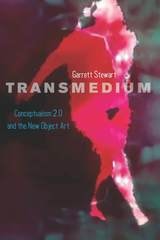
cover of Transmedium: Conceptualism 2.0 and the New Object Art

Transmedium

Conceptualism 2.0 and the New Object Art

Garrett Stewart

University of Chicago Press, 2018

If you attend a contemporary art exhibition today, you’re unlikely to see much traditional painting or sculpture. Indeed, artists today are preoccupied with what happens when you leave behind assumptions about particular media—such as painting, or woodcuts—and instead focus on collisions between them, and the new forms and ideas that those collisions generate.
 
Garrett Stewart in Transmedium dubs this new approach Conceptualism 2.0, an allusion in part to the computer images that are so often addressed by these works. A successor to 1960s Conceptualism, which posited that a material medium was unnecessary to the making of art, Conceptualism 2.0 features artworks that are transmedial, that place the aesthetic experience itself deliberately at the boundary between often incommensurable media. The result, Stewart shows, is art whose forced convergences break open new possibilities that are wholly surprising, intellectually enlightening, and often uncanny.
 
[more]
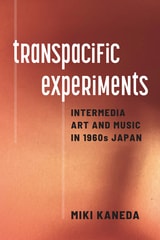
cover of Transpacific Experiments: Intermedia Art and Music in 1960s Japan

Transpacific Experiments

Intermedia Art and Music in 1960s Japan

Miki Kaneda

University of Michigan Press, 2026

Intermedia art—an avant-garde multimedia practice that combines sound and moving images—took root in Japan alongside other places in the 1960s. In Transpacific Experiments, Miki Kaneda analyzes intermedia as a practice that gives form to errant possibilities, unfolding in spaces of the everyday, to offer nuanced insights into the global flow of ideas, influence, and discourses of appropriation. The stories of intermedia art throughout the study offer feminist and transnational perspectives on experimental music and art that disorient existing narratives about the experimental and political in unexpected ways.

Transpacific Experiments contends that social, cultural, and political arrangements local to Japan had a greater influence on the transnational experimental music scene than previously acknowledged. Kaneda’s perspective extends, exceeds, and at times unsettles frameworks for experimental practices, revealing the limitations of any single political or aesthetic lens. 

[more]