Results by title
8 books match the query 'Mumbai (India)'
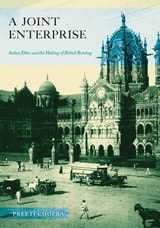
A Joint Enterprise
Indian Elites and the Making of British BombayPreeti Chopra
University of Minnesota Press, 2010
Chopra shows how the European and Indian engineers, architects, and artists worked with each other to design a city—its infrastructure, architecture, public sculpture—that was literally constructed by Indian laborers and craftsmen. Beyond the built environment, Indian philanthropists entered into partnerships with the colonial regime to found and finance institutions for the general public. Too often thought to be the product of the singular vision of a founding colonial regime, British Bombay is revealed by Chopra as an expression of native traditions meshing in complex ways with European ideas of urban planning and progress.
The result, she argues, was the creation of a new shared landscape for Bombay’s citizens that ensured that neither the colonial government nor the native elite could entirely control the city’s future.
Dharma's Daughters
Contemporary Indian Women and Hindu CultureMitter, Sara S
Rutgers University Press, 1991
Women in India today are faced with a major conflict: how to adjust to rapid modernization and industrialization without abandoning traditional roles and customs. One of the assets of Hinduism has been its ability to incorporate seemingly unorthodox ideas, not fight against them. Contemporary Indian women today are trying to reconcile innovation with tradition as they assert that women are significant participants in the economy, that crimes against women should be investigated and prosecuted, and that a woman can divorce her husband. This is no easy task in light of the highly structured nature of Indian society. It is both hierarchical and patriarchal. Regardless of a family's economic position, women in the family are considered inferior. It is the woman's job, first and foremost, to be loyal to her husband and to be a good mother to her children.
Dharma's Daughters is divided into three sections. The first introduces us to women who live and work in Bombay, where the population is dense and the housing is inadequate. We meet manual laborers, members of construction crews, and illiterate domestic workers who live in shanties. Mitter paints a vivid picture of the harried lives of these women. In the second section Mitter describes Hindu mythology and the traditions that form the basis for women's lives. In the final section, Mitter tells of the increasing mobilization and resistance of Indian women since the 1970s.
Drama of Democracy
Political Representation in MumbaiLisa Björkman
University of Minnesota Press, 2025
The performative arts of political communication and representation in Mumbai
In an era of global political passions, many have wondered whether some sort of natural affinity exists between political style and substance. Does liberal democracy speak the language of rationality and sincerity while political emotion, imagery, and embodiment properly belong to authoritarianism? Taking an ethnographic approach to the relationship between political form and political content, Drama of Democracy explores the material substance of representations (things like heady crowds and rousing images) together with language-based forms of political communication, such as public oration and community meetings.
Drawing on a decade of research in the city of Mumbai, Lisa Björkman shows that embodied performance is the very site and substance of representation and demonstrates how Mumbaikars evaluate performative bids to represent. The ethnographic accounts demonstrate the extraordinary fluency in this evaluative work in Mumbai, where people from all walks of life are remarkably astute at navigating and assessing political signs and representations, endlessly discussing and debating possible meanings of the city’s dense material-semiotic ecologies—whether words or images, cash or crowds, flyers or flowers.
In Mumbai, Björkman argues, the evaluative criterion of representation is not whether something is sign or substance, or even whether people are deemed to utter truths or falsehoods. Rather, what matters is whether and how a performance activates and actuates the social relations and political subjectivities that it professes to display. Drama of Democracy highlights Mumbaikars’ communicative fluency and theatrical acumen to offer a conceptual toolbox through which contemporary political churnings around the globe might be understood.
H.R.F. Keating
Post-Colonial Detection, A Critical StudyMeera Tamaya
University of Wisconsin Press, 1993
My Family and Other Saints
Kirin Narayan
University of Chicago Press, 2007
A touching, funny, and always affectionate memoir, My Family and Other Saints traces the reverberations of Rahoul's spiritual journey through the entire family. As their beachside Bombay home becomes a crossroads for Westerners seeking Eastern enlightenment, Kirin’s sari-wearing American mother wholeheartedly embraces ashrams and gurus, adopting her son’s spiritual quest as her own. Her Indian father, however, coins the term “urug”—guru spelled backward—to mock these seekers, while young Kirin, surrounded by radiant holy men, parents drifting apart, and a motley of young, often eccentric Westerners, is left to find her own answers. Deftly recreating the turbulent emotional world of her bicultural adolescence, but overlaying it with the hard-won understanding of adulthood, Narayan presents a large, rambunctious cast of quirky characters. Throughout, she brings to life not just a family but also a time when just about everyone, it seemed, was consumed by some sort of spiritual quest.
“A lovely book about the author's youth in Bombay, India. . . . The family home becomes a magnet for truth-seekers, and Narayan is there to affectionately document all of it.”—Body + Soul
Pipe Politics, Contested Waters
Embedded Infrastructures of Millennial MumbaiLisa Bjorkman
Duke University Press, 2015
Despite Mumbai's position as India's financial, economic, and cultural capital, water is chronically unavailable for rich and poor alike. Mumbai's dry taps are puzzling, given that the city does not lack for either water or financial resources. In Pipe Politics, Contested Waters, Lisa Björkman shows how an elite dream to transform Mumbai into a "world class" business center has wreaked havoc on the city’s water pipes. In rich ethnographic detail, Pipe Politics explores how the everyday work of getting water animates and inhabits a penumbra of infrastructural activity—of business, brokerage, secondary markets, and sociopolitical networks—whose workings are reconfiguring and rescaling political authority in the city. Mumbai’s increasingly illegible and volatile hydrologies, Björkman argues, are lending infrastructures increasing political salience just as actual control over pipes and flows becomes contingent on dispersed and intimate assemblages of knowledge, power, and material authority. These new arenas of contestation reveal the illusory and precarious nature of the project to remake Mumbai in the image of Shanghai or Singapore and gesture instead toward the highly contested futures and democratic possibilities of the actually existing city.
The Neighborhood of Gods
The Sacred and the Visible at the Margins of MumbaiWilliam Elison
University of Chicago Press, 2018
The Neighborhood of Gods explores this question, bringing an ethnographic lens to a range of visual and spatial practices: from the shrine construction that encroaches on downtown streets, to the “tribal art” practices of an indigenous group facing displacement, to the work of image production at two Bollywood film studios. A pioneering ethnography, this book offers a creative intervention in debates on postcolonial citizenship, urban geography, and visuality in the religions of India.
The Worlds of Victor Sassoon
Bombay, London, Shanghai, 1918–1941Rosemary Wakeman
University of Chicago Press, 2024
In this book, historian Rosemary Wakeman brings to life the frenzied, crowded streets, markets, ports, and banks of Bombay, London, and Shanghai. In the early twentieth century, these cities were at the forefront of the sweeping changes taking the world by storm as it entered an era of globalized commerce and the unprecedented circulation of goods, people, and ideas. Wakeman explores these cities and the world they helped transform through the life of Victor Sassoon, who in 1924 gained control of his powerful family’s trading and banking empire. She tracks his movements between these three cities as he grows his family’s fortune and transforms its holdings into a global juggernaut. Using his life as its point of entry, The Worlds of Victor Sassoon paints a broad portrait not just of wealth, cosmopolitanism, and leisure but also of the discrimination, exploitation, and violence wreaked by a world increasingly driven by the demands of capital.