Results by title
4 books match the query 'Munich'

In the Shadow of Munich
British Policy towards Czechoslovakia from the Endorsement to the Renunciation of the Munich Agreement (1938-1942)Vít Smetana
Karolinum Press, 2008
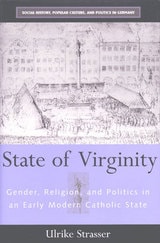
State of Virginity
Gender, Religion, and Politics in an Early Modern Catholic StateUlrike Strasser
University of Michigan Press, 2006
Winner: 2005 Book Award from the Society for the Study of Early Modern Women; Selected by the German Studies Association as one of the top five books of 2004 in early modern history
"A fresh, original study of gender roles and religious ideology in the early modern Catholic state. . . . Using a rich array of archival sources, Strasser explores ways in which an increasingly centralized Bavarian government in Munich inaugurated marriage and convent reforms and a civil religion based on the veneration of the Virgin Mary. Her carefully selected case studies show how church and state collaborated to produce a shared discourse and consistent policies proscribing extramarital sex, and excluding those without property from marriage. "
Ulrike Strasser is Associate Professor of History, Affiliate Faculty in Women's Studies, and Core Faculty in Religious Studies at the University of California, Irvine.
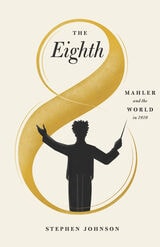
The Eighth
Mahler and the World in 1910Stephen Johnson
University of Chicago Press, 2020
September 12, 1910: The world premiere of Gustav Mahler’s Eighth Symphony and the artistic breakthrough for which the composer had yearned all his life. Munich’s new Musik Festhalle was filled to capacity on two successive evenings for the performances, which were received with rapturous applause. Representatives of many European royal houses were in attendance, along with an array of stars from the musical and literary world, including Thomas Mann and the young Arnold Schoenberg. Also present were Alma Mahler, the composer’s wife, and Alma’s longtime lover, the architect Walter Gropius. Knowledge of their relationship would precipitate an emotional crisis in Mahler that, compounded with his heart condition and the loss of his young daughter Maria, would lead to his premature death the next year.
In The Eighth, Stephen Johnson provides a masterful account of the symphony’s far-reaching consequences and its effect on composers, conductors, and writers of the time. The Eighth looks behind the scenes at the demanding one-week rehearsal period leading up to the premiere—something unheard of at the time—and provides fascinating insight into Mahler’s compositional habits, his busy life as a conductor, his philosophical and literary interests, and his personal and professional relationships. Johnson expertly contextualizes Mahler’s work among the prevailing attitudes and political climate of his age, considering the art, science, technology, and mass entertainment that informed the world in 1910. The Eighth is an absorbing history of a musical masterpiece and the troubled man who created it.
XV Congress of the International Organization for Septuagint and Cognate Studies
Munich, 2013Wolfgang Kraus
SBL Press, 2016
Essays from experts in the field of Septuagint studies
The study of Septuagint offers essential insights in ancient Judaism and its efforts to formulate Jewish identity within a non-Jewish surrounding culture. This book includes the papers given at the XV Congress of the International Organization for Septuagint and Cognate Studies (IOSCS), held in Munich, Germany, in 2013. The first part of this book deals with questions of textual criticism. The second part is dedicated to philology. The third part underlines the increasing importance of Torah in Jewish self-definition.
Features:
- Essays dealing with questions of textual criticism, mostly concerning the historical books and wisdom literature and ancient editions and translations
- Philological essays covering the historical background, studies on translation technique and lexical studies underline the necessity of both exploring general perspectives and working in detail