Results by title
7 books match the query 'Mura, David'
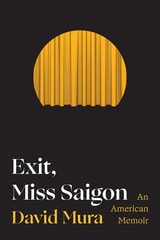
Exit, Miss Saigon
An American MemoirDavid Mura
University of Minnesota Press, 2026
A profound memoir of coming to terms with a lost racial identity
David Mura was well into his twenties when he began to explore his Asian American identity. His Japanese American parents had been incarcerated in internment camps during World War II, and in response to their traumatic experience, they abandoned their Japanese roots to try to assimilate into white, middle-class America. As a result, Mura was raised to consider himself as a white person, and his journey toward understanding and accepting his Asianness was a fraught road—one that left many fractured relationships in its wake. In Exit, Miss Saigon, Mura writes with frank openness about his personal experiences and the irrevocable ways they are rooted in the internalized, systemic racism that permeates American culture.
Starting out as a young poet in Minneapolis working toward a PhD, Mura avoided reading “minority literature,” yearning instead to be like famed poets in their ivory towers—Robert Lowell, Randall Jarrell, John Berryman, artists tortured by their families and personal demons rather than by politics or race. As Mura began to read more widely, his conceptions of race and its societal construction began to broaden. When the Ordway Theater in St. Paul, Minnesota, staged a presentation of Miss Saigon in 1992, Mura published “Secrets and Anger” in Mother Jones, a scathing critique of the play’s racist undertones and the arguments he’d been having with white artist friends about it. As a result, Mura was ostracized from the local, dominantly white writing community, yet in its place he found a deeper connection with other BIPOC writers and eventually started an Asian American arts organization in the Twin Cities.
Far more than a personal memoir, Exit, Miss Saigon is a clear-eyed examination of issues affecting Asian Americans: anti-Asian hate crimes during the pandemic, affirmative action, racial and sexual stereotypes in the media, interracial relationships and raising mixed-race children, the legacy of Japanese American internment, and the shortfalls of therapy in addressing race. Mura excavates the deep-seated racist stereotypes thrust on those perceived as “other” (read: nonwhite people) and works to uncover a more authentic, liberatory path to defining personal identity.
Retail e-book files for this title are screen-reader friendly.
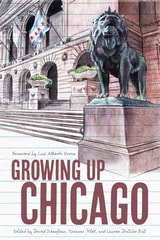
Growing Up Chicago
Edited by David Schaafsma, Roxanne Pilat, and Lauren DeJulio Bell, Foreword by Luis Alberto Urrea
Northwestern University Press, 2021
The stories evoke childhood trips to the Art Institute of Chicago, nighttime games of ringolevio, and the giant neon Magikist lips that once perched over the expressway, sharing perspectives that range from a young man who dreams of becoming an artist to a single mother revisiting her Mexican roots, from a woman’s experience with sexual assault to a child’s foray into white supremacy. This book memorably explores culture, social identity, and personal growth through the eyes of Chicagoans, affirming that we each hold the ability to shape the places in which we live and write and read as much as those places shape us.
Song for Uncle Tom, Tonto, and Mr. Moto
Poetry and IdentityDavid Mura
University of Michigan Press, 2002
Mura's writings recently have been at the center of various debates concerning race and literary standards. In this book, he argues the need for a more complicated and diverse set of literary standards than the canon has previously allowed, an opening up to the many voices that are "great within us." He contends that, when placed against a gathering awareness of a world literature, particularly in the so-called Third World, the boundaries of the traditional Anglo-American canon and its present-day proponents like Harold Bloom come to be seen as too narrow and parochial, reenacting the "tribal" label that many throw now at the advocates of multiculturalism.
Beyond its theoretical underpinnings, Song for Uncle Tom, Tonto, and Mr. Moto charts the wayward course of Mura's own development as a poet. In three interviews, Mura provides readings of his own work and discusses various issues of technique and form.
David Mura is a poet, memoirist, essayist, playwright, writer of fiction, performance artist, and literary critic. He is author of The Colors of Desire, After We Lost Our Way, and Turning Japanese: Memoirs of a Sansei.
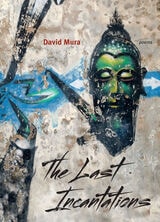
The Last Incantations
PoemsDavid Mura
Northwestern University Press, 2014
The personal, historical, and artistic are all in dialogue in David Mura’s daring collection, The Last Incantations. In a variety of poetic modes, Mura harmonizes and contrasts multiple voices to form a powerful meditation. Certain poems speak from his experiences as a third-generation Japanese American and his family’s struggles to prove their "Americanness." Others speak from the intersections of our multiracial society—an Asian teenager in love with a Somali Muslim girl, an apostrophe to Richard Pryor, poems about a Palestinian American friend, Abu Ghraib, the hapa sculptor Isamu Noguchi. The result is a sustained multifoliate poetry, bursting with elegance, heartache, and truth.

The Stories Whiteness Tells Itself
Racial Myths and Our American NarrativesDavid Mura
University of Minnesota Press, 2022
Uncovering the pernicious narratives white people create to justify white supremacy and sustain racist oppression
The police murders of two Black men, Philando Castile and George Floyd, frame this searing exploration of the historical and fictional narratives that white America tells itself to justify and maintain white supremacy. From the country’s founding through the summer of Black Lives Matter in 2020, David Mura unmasks how white stories about race attempt to erase the brutality of the past and underpin systemic racism in the present.
Intertwining history, literature, ethics, and the deeply personal, Mura looks back to foundational narratives of white supremacy (Jefferson’s defense of slavery, Lincoln’s frequently minimized racism, and the establishment of Jim Crow) to show how white identity is based on shared belief in the pernicious myths, false histories, and racially segregated fictions that allow whites to deny their culpability in past atrocities and current inequities. White supremacy always insists white knowledge is superior to Black knowledge, Mura argues, and this belief dismisses the truths embodied in Black narratives.
Mura turns to literature, comparing the white savior portrayal of the film Amistad to the novelization of its script by the Black novelist Alexs Pate, which focuses on its African protagonists; depictions of slavery in Faulkner and Morrison; and race’s absence in the fiction of Jonathan Franzen and its inescapable presence in works by ZZ Packer, tracing the construction of Whiteness to willfully distorted portraits of race in America. In James Baldwin’s essays, Mura finds a response to this racial distortion and a way for Blacks and other BIPOC people to heal from the wounds of racism.
Taking readers beyond apology, contrition, or sadness, Mura attends to the persistent trauma racism has exacted and lays bare how deeply we need to change our racial narratives—what white people must do—to dissolve the myth of Whiteness and fully acknowledge the stories and experiences of Black Americans.
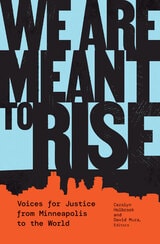
We Are Meant to Rise
Voices for Justice from Minneapolis to the WorldCarolyn Holbrook
University of Minnesota Press, 2021
A brilliant and rich gathering of voices on the American experience of this past year and beyond, from Indigenous writers and writers of color from Minnesota
In this significant collection, Indigenous writers and writers of color bear witness to one of the most unsettling years in the history of the United States. Essays and poems vividly reflect and comment on the traumas we endured in 2020, beginning with the arrival of the COVID-19 pandemic crisis, deepened by the blatant murder of George Floyd by Minneapolis police officers and the uprisings that immersed our city into the epicenter of passionate, worldwide demands for justice. In inspired and incisive writing these contributors speak unvarnished truths not only to the original and pernicious racism threaded through the American experience but also to the deeply personal, in essays about family, loss, food culture, economic security, and mental health. Their call and response is united here to rise and be heard.
We Are Meant to Rise lifts up the astonishing variety of BIPOC writers in Minnesota. From authors with international reputations to newly emerging voices, it features people from many cultures, including Indigenous Dakota and Anishinaabe, African American, Hmong, Somali, Afghani, Lebanese, Korean, Vietnamese, Japanese, Puerto Rican, Colombian, Mexican, transracial adoptees, mixed race, and LGBTQ+ perspectives. Most of the contributors have participated in More Than a Single Story, a popular and insightful conversation series in Minneapolis that features Indigenous and people of color speaking on what most concerns their communities.
We Are Meant to Rise meets the events of the day, the year, the centuries before, again and again, with powerful testament to the intrinsic and unique value of the human voice.
Contributors: Suleiman Adan, Mary Moore Easter, Louise Erdrich, Anika Fajardo, Safy-Hallan Farah, Said Farah, Sherrie Fernandez-Williams, Pamela R. Fletcher Bush, Shannon Gibney, Kathryn Haddad, Tish Jones, Ezekiel Joubert III, Douglas Kearney, Ed Bok Lee, Ricardo Levins Morales, Arleta Little, Resmaa Menakem, Tess Montgomery, Ahmad Qais Munhazim, Melissa Olson, Alexs Pate, Bao Phi, Mona Susan Power, Samantha Sencer-Mura, Said Shaiye, Erin Sharkey, Sun Yung Shin, Michael Torres, Diane Wilson, Kao Kalia Yang, and Kevin Yang.
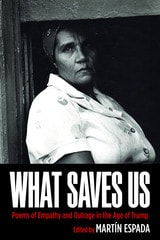
What Saves Us
Poems of Empathy and Outrage in the Age of TrumpEdited by Martín Espada
Northwestern University Press, 2019
This is an anthology of poems in the Age of Trump—and much more than Trump. These are poems that either embody or express a sense of empathy or outrage, both prior to and following his election, since it is empathy the president lacks and outrage he provokes.
There is an extraordinary diversity of voices here. The ninety-three poets featured include Elizabeth Alexander, Julia Alvarez, Richard Blanco, Carolyn Forché, Aracelis Girmay, Donald Hall, Juan Felipe Herrera, Yusef Komunyakaa, Naomi Shihab Nye, Marge Piercy, Robert Pinsky, Danez Smith, Patricia Smith, Brian Turner, Ocean Vuong, Bruce Weigl, and Eleanor Wilner. They speak of persecuted and scapegoated immigrants. They bear witness to violence: police brutality against African Americans, mass shootings in a school or synagogue, the rage inflicted on women everywhere. They testify to poverty: the waitress surviving on leftovers at the restaurant, the battles of a teacher in a shelter for homeless mothers, the emergency-room doctor listening to the heartbeats of his patients. There are voices of labor, in the factory and the fields. There are prophetic voices, imploring us to imagine the world we will leave behind in ruins lest we speak and act.
However, this is not merely a collection of grievances. The poets build bridges. One poet steps up to translate in Arabic at the airport; another walks through the city and sees her immigrant past in the immigrant present; another declaims a musical manifesto after the hurricane that devastated his island; another evokes a demonstration in the street, shouting in an ecstasy of defiance. The poets take back the language, resisting the demagogic corruption of words themselves. They assert our common humanity in the face of dehumanization.