Results by title
3 books match the query 'Mural painting and decoration, American'
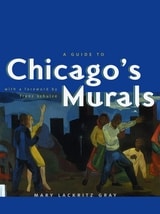
A Guide to Chicago's Murals
Mary Lackritz Gray
University of Chicago Press, 2001
With full-color illustrations of nearly two hundred Chicago murals and accompanying entries that describe their history—who commissioned them and why, how artists collaborated with architects, the subjects of the murals and their contexts—A Guide to Chicago's Murals serves both a general and a specific audience. Divided into easy-to-read geographical sections with useful maps for walking tours, it is the perfect companion for tourists or Chicagoans interested in coming to know better this aspect of the city's history. Gray also provides crucial information on lesser-known artists and on murals that have been destroyed over the years, filling a gap in the visual record of the city's development.
Gray also includes biographies of more than 150 artists and a glossary of key terms, making A Guide to Chicago's Murals essential reading for mural viewing. From post offices to libraries, fieldhouses to banks, and private clubs to street corners, Mary Gray chronicles the amazing works of artists who have sought to make public declarations in this most social of art forms.
"A major lacuna in the history of art in Chicago has been filled, with the thoroughness of the research proportionate to the richness of the material revealed."—From the Foreword by Franz Schulze
"Gray's book . . . can function as a guidebook, as the murals are conveniently arranged according to the quadrants of the city. But the book is also beautiful to look at and indespensable as art history and Chicago history as well. . . . This book is a wonderful guide to Chicago's rich and unique mural tradition."—Elizabeth Alexander, Chicago Tribune Books
"If you love art and history, this is a book you'll truly enjoy."—Al Paulson, Utne Reader
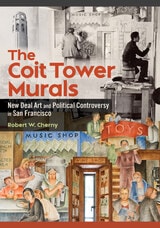
The Coit Tower Murals
New Deal Art and Political Controversy in San FranciscoRobert W. Cherny
University of Illinois Press, 2024
Created in 1934, the Coit Tower murals were sponsored by the Public Works of Art Project (PWAP), the first of the New Deal art programs. Twenty-five master artists and their assistants worked there, most of them in buon fresco, Nearly all of them drew upon the palette and style of Diego Rivera. The project boosted the careers of Victor Arnautoff, Lucien Labaudt, Bernard Zakheim, and others, but Communist symbols in a few murals sparked the first of many national controversies over New Deal art.
Sixty full-color photographs illustrate Robert Cherny’s history of the murals from their conception and completion through their evolution into a beloved San Francisco landmark. Cherny traces and critiques the treatment of the murals by art critics and historians. He also probes the legacies of Coit Tower and the PWAP before surveying San Francisco’s recent controversies over New Deal murals.
An engaging account of an artistic landmark, The Coit Tower Murals tells the full story behind a public art masterpiece.

The Virgin and the Dynamo
Public Murals in American Architecture, 1893–1917Bailey Van Hook
Ohio University Press, 2003
The beaux-arts mural movement in America was fueled by energetic young artists and architects returning from training abroad. They were determined to transform American art and architecture to make them more thematically cosmopolitan and technically fluid and accomplished. The movement slowly coalesced around the decoration of mansions of the Gilded Age elite, mostly in New York, and of public buildings and institutions across the breadth of the country.
The Virgin and the Dynamo: Public Murals in American Architecture, 1893-1917 is the first book in almost a century to concentrate exclusively on the beaux-arts mural movement in the United States. Beginning with a short history of the movement from its inception in Boston during the American Renaissance, Bailey Van Hook focuses on the movement’s public manifestations in the period between the World’s Columbian Exposition in Chicago in 1893 and the First World War.
Professor Van Hook explores different aspects of the mural movement, the concept and meaning of “decoration,” the claim that murals are inherently democratic, the shift in preference from allegory to history, the gendered concept of modernity, the ideologies behind the iconography, and, finally, the decline of the movement when it began to be seen as old fashioned and anachronistic.
The Virgin and the Dynamo raises our understanding of the beaux-arts movement to a new level. For the general reader, this illustrated history will explain many familiar representations of local and national values.