Results by title
9 books match the query 'Museum techniques'
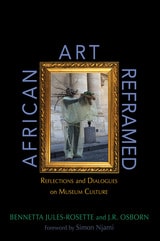
African Art Reframed
Reflections and Dialogues on Museum CultureBennetta Jules-Rosette and J. R. Osborn; Foreword by Simon Njami
University of Illinois Press, 2020
The authors take a three-pronged approach. Part One ranges from curiosity cabinets to virtual websites to offer a history of ethnographic and art museums and look at their organization and methods of reaching out to the public. In the second part, the authors examine museums as ecosystems and communities within communities, and they use semiotic methods to analyze images, signs, and symbols drawn from the experiences of curators and artists. The third part introduces innovative strategies for displaying, disseminating, and reclaiming African art. The authors also propose how to reinterpret the art inside and outside the museum and show ways of remixing the results.
Drawing on extensive conversations with curators, collectors, and artists, African Art Reframed is an essential guide to building new exchanges and connections in the dynamic worlds of African and global art.
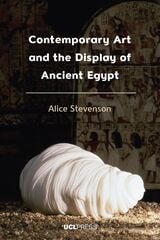
Contemporary Art and the Display of Ancient Egypt
Alice Stevenson
University College London, 2025
Contemporary art installations in Egyptian galleries are often framed as dialogues between past and present—but what if they are, instead, shaped by the museum itself? Contemporary Art and the Display of Ancient Egypt argues that both contemporary and ancient works are mediated through the structures and ideologies of the museum space. In this seminal work, Alice Stevenson examines how artists’ work influences museum discourse and public engagement with ancient artifacts.
Drawing on case studies from the British Museum, the Egyptian Museum in Turin, and the State Museum of Egyptian Art in Munich, this book assesses the motivations behind these interventions and their lasting impact. Through an evidence-based approach, Stevenson offers new insights into how curators, scholars, and artists can collaborate to create more meaningful and politically engaged museum experiences. Of particular interest to Egyptologists, museum professionals, and contemporary art scholars, this work redefines the role of artistic intervention in shaping our understanding of ancient cultures.
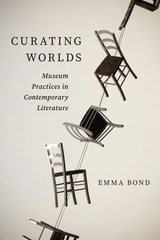
Curating Worlds
Museum Practices in Contemporary LiteratureEmma Bond
Northwestern University Press, 2025
Showing how museum practices shed new light on literary form
How and why do books deploy objects in order to narrate the past? To answer this question, Emma Bond sifts through collections of objects stored in boxes, drawers, baskets, and displayed on shelves in contemporary texts by authors such as Valeria Luiselli, Maaza Mengiste, Orhan Pamuk, and Olga Tokarczuk and interprets them using a framework of museum practices. These practices, which include collection, curation, conservation, and display, have helped to turn real-life museums into three-dimensional narrative spaces. Curating Worlds: Museum Practices in Contemporary Literature shows how we can use this same set of practices to shed light on literary form itself: how stories are created, shaped, and communicated. Harnessing museum practices as an innovative lens for critical interpretation, Bond provides a fresh theoretical framework to engage with the meanings of object collections in literature and to make sense of the lives, and afterlives, of things today.
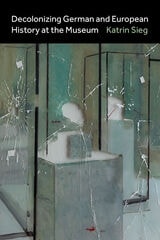
Decolonizing German and European History at the Museum
Katrin Sieg
University of Michigan Press, 2021
Decolonizing German and European History at the Museum examines efforts by European museums to investigate colonialism as part of an unprocessed past, confront its presence, and urge repair. A flurry of exhibitions and the overhaul of numerous large museums in the last decade signal that an emergent colonial memory culture is now reaching broader publics. Exhibitions pose the question of what Europeans owe to those they colonized.
Decolonizing German and European History at the Museum shows how museums can help visitors mourn historic violence and identify the contemporary agents, beneficiaries, victims, survivors, and resisters of colonial presence. At the same time, the book treats the museum as part of the racialized power relations that activists, academics, and artists have long protested against. This book asks whether museums have made the dream of activists, academics, and artists to build equitable futures more acceptable and more durable—or whether in packaging that dream for general audiences they curtail it. Confronting colonial violence, this book argues, pushes Europeans to face the histories of racism and urges them to envision antiracism at the global scale.
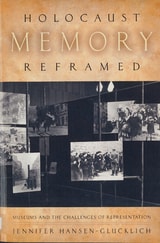
Holocaust Memory Reframed
Museums and the Challenges of RepresentationHansen-Glucklich, Jennifer
Rutgers University Press, 2014
In Holocaust Memory Reframed, Jennifer Hansen-Glucklich examines representations in three museums: Israel’s Yad Vashem in Jerusalem, Germany’s Jewish Museum in Berlin, and the United States Holocaust Memorial Museum in Washington, D.C. She describes a variety of visually striking media, including architecture, photography exhibits, artifact displays, and video installations in order to explain the aesthetic techniques that the museums employ. As she interprets the exhibits, Hansen-Glucklich clarifies how museums communicate Holocaust narratives within the historical and cultural contexts specific to Germany, Israel, and the United States. In Yad Vashem, architect Moshe Safdie developed a narrative suited for Israel, rooted in a redemptive, Zionist story of homecoming to a place of mythic geography and renewal, in contrast to death and suffering in exile. In the Jewish Museum in Berlin, Daniel Libeskind’s architecture, broken lines, and voids emphasize absence. Here exhibits communicate a conflicted ideology, torn between the loss of a Jewish past and the country’s current multicultural ethos. The United States Holocaust Memorial Museum presents yet another lens, conveying through its exhibits a sense of sacrifice that is part of the civil values of American democracy, and trying to overcome geographic and temporal distance. One well-know example, the pile of thousands of shoes plundered from concentration camp victims encourages the visitor to bridge the gap between viewer and victim.
Hansen-Glucklich explores how each museum’s concept of the sacred shapes the design and choreography of visitors’ experiences within museum spaces. These spaces are sites of pilgrimage that can in turn lead to rites of passage.
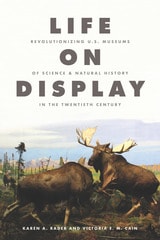
Life on Display
Revolutionizing U.S. Museums of Science and Natural History in the Twentieth CenturyKaren A. Rader and Victoria E. M. Cain
University of Chicago Press, 2014
Rader and Cain explain why science and natural history museums began to welcome new audiences between the 1900s and the 1920s and chronicle the turmoil that resulted from the introduction of new kinds of biological displays. They describe how these displays of life changed dramatically once again in the 1930s and 1940s, as museums negotiated changing, often conflicting interests of scientists, educators, and visitors. The authors then reveal how museum staffs, facing intense public and scientific scrutiny, experimented with wildly different definitions of life science and life science education from the 1950s through the 1980s. The book concludes with a discussion of the influence that corporate sponsorship and blockbuster economics wielded over science and natural history museums in the century’s last decades.
A vivid, entertaining study of the ways science and natural history museums shaped and were shaped by understandings of science and public education in the twentieth-century United States, Life on Display will appeal to historians, sociologists, and ethnographers of American science and culture, as well as museum practitioners and general readers.
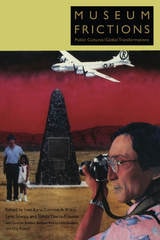
Museum Frictions
Public Cultures/Global TransformationsIvan Karp, Corinne A. Kratz, Lynn Szwaja, and Tomás Ybarra-Frausto With Gustavo Buntinx, Barbara Kirshenblatt-Gimblett, and Ciraj Rassool, eds.
Duke University Press, 2006
Whether contrasting the transformation of Africa’s oldest museum, the South Africa Museum, with one of its newest, the Lwandle Migrant Labor Museum; offering an interpretation of the audio guide at the Guggenheim Bilbao; reflecting on the relative paucity of art museums in Peru and Cambodia; considering representations of slavery in the United States and Ghana; or meditating on the ramifications of an exhibition of Australian aboriginal art at the Asia Society in New York City, the contributors highlight the frictions, contradictions, and collaborations emerging in museums and heritage sites around the world. The volume opens with an extensive introductory essay by Ivan Karp and Corinne A. Kratz, leading scholars in museum and heritage studies.
Contributors. Tony Bennett, David Bunn, Gustavo Buntinx, Cuauhtémoc Camarena, Andrea Fraser, Martin Hall, Ivan Karp, Barbara Kirshenblatt-Gimblett, Corinne A. Kratz, Christine Mullen Kreamer, Joseph Masco, Teresa Morales, Howard Morphy, Ingrid Muan, Fred Myers, Ciraj Rassool, Vicente Razo, Fath Davis Ruffins, Lynn Szwaja, Krista A. Thompson, Leslie Witz, Tomás Ybarra-Frausto
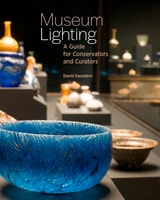
Museum Lighting
A Guide for Conservators and CuratorsDavid Saunders
J. Paul Getty Trust, The, 2020
Author David Saunders, former keeper of conservation and scientific research at the British Museum, explores how to balance the conflicting goals of visibility and preservation under a variety of conditions. Beginning with the science of how light, color, and vision function and interact, he proceeds to offer detailed studies of the impact of light on a wide range of objects, including paintings, manuscripts, textiles, bone, leather, and plastics.
With analyses of the effects of light on visibility and deterioration, Museum Lighting provides practical information to assist curators, conservators, and other museum professionals in making critical decisions about the display and preservation of objects in their collections.
The First Treatise on Museums
Samuel Quiccheberg’s Inscriptiones, 1565Samuel Quiccheberg
J. Paul Getty Trust, The, 2014
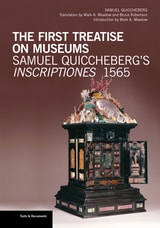
Samuel Quiccheberg’s Inscriptiones, first published in Latin in 1565, is an ambitious effort to demonstrate the pragmatic value of curiosity cabinets, or Wunderkammern, to princely collectors in sixteenth-century Europe and, by so doing, inspire them to develop their own such collections. Quiccheberg shows how the assembly and display of physical objects offered nobles a powerful means to expand visual knowledge, allowing them to incorporate empirical and artisanal expertise into the realm of the written word. But in mapping out the collectability of the material world, Quiccheberg did far more than create a taxonomy. Rather, he demonstrated how organizing objects made their knowledge more accessible; how objects, when juxtaposed or grouped, could tell a story; and how such strategies could enhance the value of any single object.
Quiccheberg’s descriptions of early modern collections provide both a point of origin for today’s museums and an implicit critique of their aims, asserting the fundamental research and scholarly value of collections: collections are to be used, not merely viewed. The First Treatise on Museums makes Quiccheberg’s now rare publication available in an English translation. Complementing the translation are a critical introduction by Mark A. Meadow and a preface by Bruce Robertson.