Results by title
2 books match the query 'Music and science'
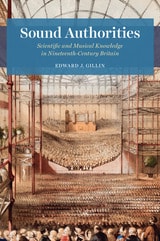
Sound Authorities
Scientific and Musical Knowledge in Nineteenth-Century BritainEdward J. Gillin
University of Chicago Press, 2021
Sound Authorities shows how experiences of music and sound played a crucial role in nineteenth-century scientific inquiry in Britain.
In Sound Authorities, Edward J. Gillin focuses on hearing and aurality in Victorian Britain, claiming that the development of the natural sciences in this era cannot be understood without attending to the study of sound and music.
During this time, scientific practitioners attempted to fashion themselves as authorities on sonorous phenomena, coming into conflict with traditional musical elites as well as religious bodies. Gillin pays attention to sound in both musical and nonmusical contexts, specifically the cacophony of British industrialization. Sound Authorities begins with the place of acoustics in early nineteenth-century London, examining scientific exhibitions, lectures, spectacles, workshops, laboratories, and showrooms. He goes on to explore how mathematicians mobilized sound in their understanding of natural laws and their vision of a harmonious ordered universe. In closing, Gillin delves into the era’s religious and metaphysical debates over the place of music (and humanity) in nature, the relationship between music and the divine, and the tensions between spiritualist understandings of sound and scientific ones.
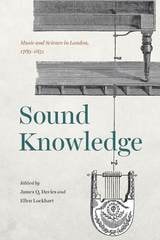
Sound Knowledge
Music and Science in London, 1789-1851Edited by J. Q. Davies and Ellen Lockhart
University of Chicago Press, 2017
Sound Knowledge examines how scientific truth was accrued by means of visual and aural experience, and, in turn, how musical knowledge was located in relation to empirical scientific practice. James Q. Davies and Ellen Lockhart gather work by leading scholars to explore a crucial sixty-year period, beginning with Charles Burney’s ambitious General History of Music, a four-volume study of music around the globe, and extending to the Great Exhibition of 1851, where musical instruments were assembled alongside the technologies of science and industry in the immense glass-encased collections of the Crystal Palace. Importantly, as the contributions show, both the power of science and the power of music relied on performance, spectacle, and experiment. Ultimately, this volume sets the stage for a new picture of modern disciplinarity, shining light on an era before the division of aural and visual knowledge.