Results by title
4 books match the query 'Music in universities and colleges'

Heartland Excursions
Ethnomusicological Reflections on Schools of MusicBruno Nettl
University of Illinois Press, 1995
In Heartland Excursions, a legendary ethnomusicologist takes the reader along for a delightful, wide-ranging tour of his workplace. Bruno Nettl provides an insightful, sometimes tongue-in-cheek, always pithy ethnography of midwestern university schools of music from a different perspective in each of four chapters, alternating among three distinct voices: the longtime professor, the "native informant," and the outside observer, an "ethnomusicologist from Mars."
If you've ever been to a concert or been connected to a university with a school of music, you ll discover yourself--or someone you know--in these pages.
"In the music building you can't tell the quick from the dead without a program."--Chapter 1, "In the Service of the Masters"
"The great ability of a violin student whom I observed was established when his dean was persuaded to accompany him."--Chapter 2, "Society of Musicians"
"Some teachers of music history would accuse students who listen to Elvis Presley not only of taking time away from hearing Brahms, but also of polluting themselves."--Chapter 3, "A Place for All Musics?"
At commencement, the graduates "were perhaps not aware that they had just participated in an event in which the principal values of the Western musical world . . . had been taken out of storage bins for annual exercise."--Chapter 4, "Forays into the Repertory"
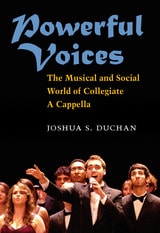
Powerful Voices
The Musical and Social World of Collegiate A CappellaJoshua S. Duchan
University of Michigan Press, 2016
Collegiate a cappella, part of a long tradition of unaccompanied singing, is known to date back on American college campuses to at least the colonial era. Considered in the context of college glee clubs, barbershop quartets, early-twentieth-century vocal pop groups, doo-wop groups, and contemporary a cappella manifestations in pop music, collegiate a cappella is an extension of a very old tradition of close harmony singing---one that includes but also goes beyond the founding of the Yale Whiffenpoofs. Yet despite this important history, collegiate a cappella has until now never been the subject of scholarly examination.
In Powerful Voices: The Musical and Social World of Collegiate A Cappella, Joshua S. Duchan offers the first thorough accounting of the music's history and reveals how the critical issues of sociability, gender, performance, and technology affect its music and experience. Just as importantly, Duchan provides a vital contribution to music scholarship more broadly, in several important ways: by expanding the small body of literature on choruses and amateur music; by addressing musical and social processes in a field where the vast majority of scholarship focuses on individuals and their products; and by highlighting a musical context long neglected by musicologists---the college campus. Ultimately, Powerful Voices is a window on a world of amateur music that has begun to expand its reach internationally, carrying this uniquely American musical form to new global audiences, while playing an important role in the social, cultural, and musical education of countless singers over the last century.
Teaching Difficult Topics
Reflections from the Undergraduate Music ClassroomOlivia R. Lucas and Laura Moore Pruett
University of Michigan Press, 2024
The teaching reflections in Teaching Difficult Topics examine difficult themes that fall into three primary categories: subjects that instructors sense to be controversial or emotionally challenging to discuss, those that derive from or intersect with real-world events that are difficult to process, and bigger-picture discussions of how music studies often focuses on dominant narratives while overlooking other perspectives. Some chapters offer practical guidance, lesson plans, and teaching materials to enable instructors to build discussions of race, gender, sexuality, and traumatic histories into their own classrooms; others take a more global view, reflecting on the importance and relevance of teaching these difficult topics and on how to respond in the music classroom when external events disrupt daily life.
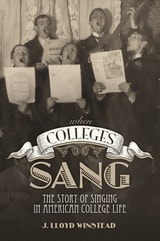
When Colleges Sang
The Story of Singing in American College LifeJ. Lloyd Winstead
University of Alabama Press, 2013