Results by title
2 books match the query 'Musical ability'

"Destined to Fail"
Carl Seashore’s World of Eugenics, Psychology, Education, and MusicJulia Eklund Koza
University of Michigan Press, 2021
A little-known fact about the prominent US psychologist and educator Carl E. Seashore (1866–1949) is that he was deeply involved in the American eugenics movement. He was among the US academics to support eugenics long before German Nazis embraced it. A titan in a host of disciplines and a proponent of radical education reform, Seashore used his positional power to promote a constellation of education reforms consistent with central precepts of eugenics. Many of these reforms, including tracking, gifted and talented programs, and high-stakes standardized testing, were adopted and remain standard practice in the United States today. He promulgated the idea that musical talent is biologically inheritable, and he developed the first standardized tests of musical talent; these tests were used by early-twentieth-century researchers in their attempts to determine whether there are race differences in musical talent. Seashore’s ideas and work profoundly shaped music education’s research trajectory, as well as enduring “commonsense” beliefs about musical ability. An intersectional analysis, “Destined to Fail” focuses on the relationship between eugenics and Seashore’s views on ability, race, and gender. Koza concludes that Seashore promoted eugenics and its companion, euthenics, because he was a true believer. She also discusses the longstanding silences surrounding Seashore’s participation in eugenics. As a diagnosis and critique of the present, “Destined to Fail” identifies resemblances and connections between past and present that illustrate the continuing influence of eugenics—and the systems of reasoning that made early-twentieth-century eugenics imaginable and seem reasonable—on education discourse and practice today. It maps out discursive, citational, and funding connections between eugenicists of the early twentieth-century and contemporary White supremacists; this mapping leads to some of Donald Trump’s supporters and appointees.
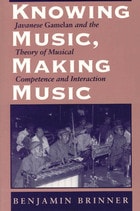
Knowing Music, Making Music
Javanese Gamelan and the Theory of Musical Competence and InteractionBenjamin Brinner
University of Chicago Press, 1995
Using illustrative examples from a variety of traditions, Benjamin Brinner first examines the elements and characteristics of musical competence, the different kinds of competence in a musical community, the development of multiple competences, and the acquisition and transformation of competence through time. He then shows how these factors come into play in musical interaction, establishing four intersecting theoretical perspectives based on ensemble roles, systems of communication, sound structures, and individual motivations. These perspectives are applied to the dynamics of gamelan performance to explain the social, musical, and contextual factors that affect the negotiation of consensus in musical interaction. The discussion ranges from sociocultural norms of interpersonal conduct to links between music, dance, theater, and ritual, and from issues of authority and deference to musicians' self-perceptions and mutual assessments.
Much more than a portrait of artists making music together, this book brings together a variety of cognitive approaches and a wide range of examples from many cultures to suggest ways of integrating our knowledge of music making both in individual cultures and crossculturally.