Results by title
8 books match the query 'Musical criticism'
Book Reports
A Music Critic on His First Love, Which Was ReadingRobert Christgau
Duke University Press, 2019

Deconstructive Variations
Music and Reason in Western SocietyRose Rosengard Subotnik
University of Minnesota Press, 1995
Deconstructive Variations was first published in 1995. Minnesota Archive Editions uses digital technology to make long-unavailable books once again accessible, and are published unaltered from the original University of Minnesota Press editions.
Unique in its focus and its interdisciplinary reach, Rose Rosengard Subotnik's work is among the most original and challenging being done in American musicology. Her concerns are both formal and sociological, firmly linking music to social and cultural context and breaking down the barriers between music and life.
Deconstructive Variations is a sequel to Subotnik's previous collection, Developing Variations. It expands and continues her achievement-the promotion of humanistic criticism as a significant activity in music scholarship and the portrayal of Western art music in relation to the social structures and cultural values of the society that created it.
Bringing to her subject a vast range of philosophical, artistic, and historical knowledge, Subotnik applies the insights of Kant, Adorno, Bakhtin, and Derrida to major works of Mozart and Chopin. Each of these essays functions as an argument between two views: for and against the ideal of structural listening; Enlightenment and Romantic readings of The Magic Flute; high-modernist and postmodernist readings of Chopin's A-Major Prelude; and conceptions of reason put forward by Allan Bloom and Spike Lee.
Rose Rosengard Subotnik is professor emerita in the department of music at Brown University, and is the author of Developing Variations: Style and Ideology in Western Music (Minnesota, 1991).
It's Just the Normal Noises
Marcus, Guralnick, No Depression, and the Mystery of Americana MusicTimothy Gray
University of Iowa Press, 2017
In It’s Just the Normal Noises, Timothy Gray examines a wide array of writing about roots music from the 1960s to the 2000s. In addition to chapters on the genre-defining work of Guralnick and Marcus, he explores the influential writings of Grant Alden and Peter Blackstock, the editors of No Depression magazine, and the writers who contributed to its pages, Bill Friskicks-Warren, Ed Ward, David Cantwell, and Allison Stewart among them. A host of memoirists and novelists, from Patti Smith and Ann Powers to Eleanor Henderson and Dana Spiotta, shed light on the social effects and personal attachments of the music’s many manifestations, from punk to alt country to hardcore. The ambivalent attitudes of rock musicians toward success and failure, the meaning of soul, the formation of alternative communities through magazine readership, and the obsession of Generation X scenes with DIY production values wend through these works.
Taking a personal approach to the subject matter, Gray reads criticism and listens to music as though rock ‘n’ roll not only explains American culture, but also shores up his life. This book is for everyone who’s heard in roots rock the sound of an individual and a nation singing themselves into being.
Listening to China
Sound and the Sino-Western Encounter, 1770-1839Thomas Irvine
University of Chicago Press, 2020
Through these stories, Irvine not only investigates how the Sino-Western encounter sounded, but also traces the West’s shifting response to China. As the trading relationships between China and the West broke down, travelers and music theorists abandoned the vision of shared musical approaches, focusing instead on China’s noisiness and sonic disorder and finding less to like in its music. At the same time, Irvine reconsiders the idea of a specifically Western music history, revealing that it was comparison with China, the great “other,” that helped this idea emerge. Ultimately, Irvine draws attention to the ways Western ears were implicated in the colonial and imperial project in China, as well as to China’s importance to the construction of musical knowledge during and after the European Enlightenment. Timely and original, Listening to China is a must-read for music scholars and historians of China alike.
Making Mexican Rock
Censorship, Journalism, and Popular Music after AvándaroAndrew J. Green
Vanderbilt University Press, 2024
Yet in light of the failures of successive democratically elected governments in Mexico, these histories are worth critically revisiting and updating. What stories about music censorship can be told after Mexico’s transition to multi-party democracy? Placing history and ethnography into dialogue, Making Mexican Rock explores historical and recent experiences of censorship and repression against popular music, focusing on the independent rock scene (or “escena independiente”) in Mexico City.
Informed by the so-called new censorship theory, ethnomusicologist Andrew J. Green challenges historical accounts that equate acts of censorship with state activity. The open-ended account of censorship assumed here helps us to understand, instead, how conceptions of censorship and expressive freedom transformed toward the end of single-party rule; how practices of policing live rock adapted to neoliberal securitization; and how histories of rock censorship have been invoked by those seeking to construct and protect emergent music scenes. Making Mexican Rock thus both decenters histories of music censorship from the state, and extends them into the country’s recent history.
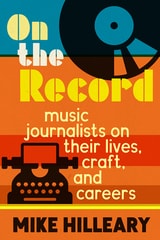
On the Record
Music Journalists on Their Lives, Craft, and CareersMike Hilleary
University of Massachusetts Press, 2020
Bringing together interviews from an impressive roster of over fifty music writers, Mike Hilleary offers up an engaging and wide-reaching examination of the past and potential future of music journalism. This accessible oral history contains professional insights into journalists’ craft and purpose, practical advice, and essential life lessons from a diverse cast of music writers—ranging from long-respected veterans of the field such as Rob Sheffield, Jessica Hopper, Ann Powers, and Chuck Klosterman to must-read modern voices including Amanda Petrusich, Hanif Abdurraqib, Lindsay Zoladz, and Jayson Greene. Honest and absorbing, On the Record will educate and enlighten anyone who wants to write about music, or anyone who wants a better understanding about those who do.
Pop Music And The Press
Steve Jones
Temple University Press, 2002
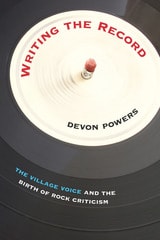
Writing the Record
The Village Voice and the Birth of Rock CriticismDevon Powers
University of Massachusetts Press, 2013
During the mid-1960s, a small group of young journalists made it their mission to write about popular music, especially rock, as something worthy of serious intellectual scrutiny. Their efforts not only transformed the perspective on the era's music but revolutionized how Americans have come to think, talk, and write about popular music ever since.
In Writing the Record, Devon Powers explores this shift by focusing on The Village Voice, a key publication in the rise of rock criticism. Revisiting the work of early pop critics such as Richard Goldstein and Robert Christgau, Powers shows how they stood at the front lines of the mass culture debates, challenging old assumptions and hierarchies and offering pioneering political and social critiques of the music. Part of a college-educated generation of journalists, Voice critics explored connections between rock and contemporary intellectual trends such as postmodernism, identity politics, and critical theory. In so doing, they became important forerunners of the academic study of popular culture that would emerge during the 1970s.
Drawing on archival materials, interviews, and insights from media and cultural studies, Powers not only narrates a story that has been long overlooked but also argues that pop music criticism has been an important channel for the expression of public intellectualism. This is a history that is particularly relevant today, given the challenges faced by criticism of all stripes in our current media environment. Powers makes the case for the value of well-informed cultural criticism in an age when it is often suggested that “everyone is a critic.”