Results by title
8 books match the query 'Musicians, Black'

Amplifications of Black Sound from Colonial Mexico
Vocality and BeyondSarah Finley
Vanderbilt University Press, 2024
Amplifications of Black Sound from Colonial Mexico is the first extensive study of Afro-descendant sonorities in New Spain or elsewhere in colonial Latin America. In this context, it attends to Black sounds through a framework that remixes Jacques Derrida’s reading of the ear’s anatomy with theories like Gilroy’s lower frequencies or Fred Moten’s phonic materiality. Sarah Finley’s aim is to unsettle the divide between self and other so the auditory archive might emerge as a polyphonic record that exceeds dichotomies of sounding object / listening subject. Through sampling the Afro-descendant sounds of this archive, this book recovers and rearticulates Black voices and auditory practices in New Spain.
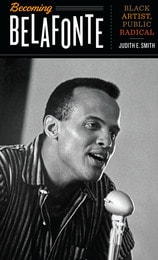
Becoming Belafonte
Black Artist, Public RadicalBy Judith E. Smith
University of Texas Press, 2014
A son of poor Jamaican immigrants who grew up in Depression-era Harlem, Harry Belafonte became the first black performer to gain artistic control over the representation of African Americans in commercial television and film. Forging connections with an astonishing array of consequential players on the American scene in the decades following World War II—from Paul Robeson to Ed Sullivan, John Kennedy to Stokely Carmichael—Belafonte established his place in American culture as a hugely popular singer, matinee idol, internationalist, and champion of civil rights, black pride, and black power.
In Becoming Belafonte, Judith E. Smith presents the first full-length interpretive study of this multitalented artist. She sets Belafonte’s compelling story within a history of American race relations, black theater and film history, McCarthy-era hysteria, and the challenges of introducing multifaceted black culture in a moment of expanding media possibilities and constrained political expression. Smith traces Belafonte’s roots in the radical politics of the 1940s, his careful negotiation of the complex challenges of the Cold War 1950s, and his full flowering as a civil rights advocate and internationally acclaimed performer in the 1960s. In Smith’s account, Belafonte emerges as a relentless activist, a questing intellectual, and a tireless organizer. From his first national successes as a singer of Calypso-inflected songs to the dedication he brought to producing challenging material on television and film regardless of its commercial potential, Belafonte stands as a singular figure in American cultural history—a performer who never shied away from the dangerous crossroads where art and politics meet.
Interspecies Communication
Sound and Music beyond HumanityGavin Steingo
University of Chicago Press, 2024
In Interspecies Communication, music scholar Gavin Steingo examines significant cases of attempted communication beyond the human—cases in which the dualistic relationship of human to non-human is dramatically challenged. From singing whales to Sun Ra to searching for alien life, Steingo charts the many ways we have attempted to think about, and indeed to reach, beings that are very unlike ourselves.
Steingo focuses on the second half of the twentieth century, when scientists developed new ways of listening to oceans and cosmic space—two realms previously inaccessible to the senses and to empirical investigation. As quintessential frontiers of the postwar period, the outer space of the cosmos and the inner space of oceans were conceptualized as parallel realities, laid bare by newly technologized “ears.” Deeply engaging, Interspecies Communication explores our attempts to cross the border between the human and non-human, to connect with non-humans in the depths of the oceans, the far reaches of the universe, or right under our own noses.
Kwaito's Promise
Music and the Aesthetics of Freedom in South AfricaGavin Steingo
University of Chicago Press, 2016
Politicians and cultural critics have long criticized kwaito for failing to provide any meaningful contribution to a society that desperately needs direction. As Steingo shows, however, these criticisms are built on problematic assumptions about the political function of music. Interacting with kwaito artists and fans, he shows that youth aren’t escaping their social condition through kwaito but rather using it to expand their sensory realities and generate new possibilities. Resisting the truism that “music is always political,” Steingo elucidates a music that thrives on its radically ambiguous relationship with politics, power, and the state.
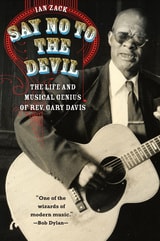
Say No to the Devil
The Life and Musical Genius of Rev. Gary DavisIan Zack
University of Chicago Press, 2015
The first biography of Davis, Say No to the Devil restores “the Rev’s” remarkable story. Drawing on extensive research and interviews with many of Davis’s former students, Ian Zack takes readers through Davis’s difficult beginning as the blind son of sharecroppers in the Jim Crow South to his decision to become an ordained Baptist minister and his move to New York in the early 1940s, where he scraped out a living singing and preaching on street corners and in storefront churches in Harlem. There, he gained entry into a circle of musicians that included, among many others, Lead Belly, Woody Guthrie, and Dave Van Ronk. But in spite of his tremendous musical achievements, Davis never gained broad recognition from an American public that wasn’t sure what to make of his trademark blend of gospel, ragtime, street preaching, and the blues. His personal life was also fraught, troubled by struggles with alcohol, women, and deteriorating health.
Zack chronicles this remarkable figure in American music, helping us to understand how he taught and influenced a generation of musicians.
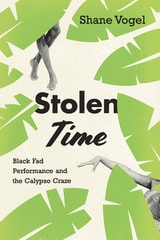
Stolen Time
Black Fad Performance and the Calypso CrazeShane Vogel
University of Chicago Press, 2018

Transounding
Listening for Black Queer Lusophone DiasporasDaniel da Silva
Duke University Press, 2027
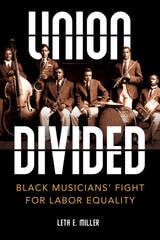
Union Divided
Black Musicians' Fight for Labor EqualityLeta E. Miller
University of Illinois Press, 2024
In the 1910s and 1920s, Black musicians organized more than fifty independent locals within the American Federation of Musicians (AFM) in an attempt to control audition criteria, set competitive wages, and secure a voice in national decision-making. Leta Miller follows the AFM’s history of Black locals, which competed directly with white locals in the same territories, from their origins and successes in the 1920s through Depression-era crises to the fraught process of dismantling segregated AFM organizations in the 1960s and 70s. Like any union, Black AFM locals sought to ensure employment and competitive wages for members with always-evolving solutions to problems. Miller’s account of these efforts includes the voices of the musicians themselves and interviews with former union members who took part in the difficult integration of Black and white locals. She also analyzes the fundamental question of how musicians benefitted from membership in a labor organization.
Broad in scope and rich in detail, Union Divided illuminates the complex working world of unionized Black musicians and the AFM’s journey to racial inclusion.