Results by title
7 books match the query 'Musicology'
Charles Ives in the Mirror
American Histories of an Iconic ComposerDavid C. Paul
University of Illinois Press, 2013
Paul explores both how Ives positioned his music amid changing philosophical and aesthetic currents and how others interpreted his contributions to American music. Although Ives's initial efforts to find a public in the early twenties attracted a few devotees, the resurgence of interest in the American literary past during the thirties made a concert staple of his "Concord" Sonata, a work dedicated to nineteenth-century transcendentalist writers. Paul shows how Ives was subsequently deployed as an icon of American freedom during the early Cold War period and how he came to be instigated at the head of a line of "American maverick" composers. Paul also examines why a recent cadre of scholars has beset the composer with Gilded Age social anxieties.
By embedding Ives' reception within the changing developments of a wide range of fields including intellectual history, American studies, literature, musicology, and American politics and society in general, Charles Ives in the Mirror: American Histories of an Iconic Composer greatly advances our understanding of Ives and his influence on nearly a century of American culture.
Current Thought in Musicology
Edited by John W. Grubbs
University of Texas Press, 1976
Current Thought in Musicology covers a variety of topics, ranging from the Middle Ages to the present and touching on all the major disciplines of musicology: music history, theory and composition, music education, and performance. Taken together, the nine papers constitute a broad overview of the direction of music scholarship in the 1970s.
In “Tractatus Esthetico-Semioticus: Model of the Systems of Human Communication,” Charles Seeger presents a model of the situations in which the study of humanistic art may best be conducted. Charles Hamm writes in “The Ecstatic and the Didactic: A Pattern in American Music” of the pattern of conflicting points of view in music history and theory. American composer Elliott Carter, in his chapter titled “Music and the Time Screen,” presents a lucid explanation of his compositional process, including his concept of musical time. In “Instruments and Voices in the Fifteenth-Century Chanson,” Howard Mayer Brown suggests the nature of fifteenth-century performance, drawn from iconography and various musical sources. “Nottebohm Revisited,” by Lewis Lockwood, reexamines Beethoven’s sketchbooks, showing the extent to which performing editions of his work must be updated. Daniel Heartz’s article, “The Chanson in the Humanist Era,” is multidisciplinary and will interest a variety of scholars, including French historians and French literary historians. Gilbert Chase applies structuralism to musicological studies in his chapter, “Musicology, History, and Anthropology: Current Thoughts.” The concluding essays, “The Prospects for Research in Medieval Music in the 1970’s,” by Gilbert Reaney, and “The Library of the Mind: Observations on the Relationship between Musical Scholarship and Bibliography,” by Vincent Duckles, provide a unique view of the opportunities for further work in these areas.
The volume also includes an introduction by the editor, notes on the contributors, and an index. Current Thought in Musicology is the result of a symposium held at the University of Texas at Austin in 1971.
Disciplining Music
Musicology and Its CanonsEdited by Katherine Bergeron and Philip V. Bohlman
University of Chicago Press, 1992
"Fortunately, in a blaze of good-humored . . . scholarship, [this] book helps brains unaccustomed to thinking about the future without jeopardizing the past imagine the wonder classical-music life might become if it embraced all people and all musics."—Laurence Vittes, Los Angeles Reader
"These essays will force us to rethink our position on many issues. . . [and] advance musicology into the twenty-first century."—Giulio Ongaro, American Music Teacher
With essays by Katherine Bergeron, Philip V. Bohlman, Richard Cohn and Douglas Dempster, Philip Gossett, Robert P. Morgan, Bruno Nettl, Don Michael Randel, Ruth A. Solie, and Gary Tomlinson.
Just Vibrations
The Purpose of Sounding GoodWilliam Cheng
University of Michigan Press, 2016
Modern academic criticism bursts with what Eve Kosofsky Sedgwick once termed paranoid readings—interpretative feats that aim to prove a point, persuade an audience, and subtly denigrate anyone who disagrees. Driven by strategies of negation and suspicion, such rhetoric tends to drown out softer-spoken reparative efforts, which forego forceful argument in favor of ruminations on pleasure, love, sentiment, reform, care, and accessibility.
Just Vibrations: The Purpose of Sounding Good calls for a time-out in our serious games of critical exchange. Charting the divergent paths of paranoid and reparative affects through illness narratives, academic work, queer life, noise pollution, sonic torture, and other touchy subjects, William Cheng exposes a host of stubborn norms in our daily orientations toward scholarship, self, and sound. How we choose to think about the perpetration and tolerance of critical and acoustic offenses may ultimately lead us down avenues of ethical ruin—or, if we choose, repair. With recourse to experimental rhetoric, interdisciplinary discretion, and the playful wisdoms of childhood, Cheng contends that reparative attitudes toward music and musicology can serve as barometers of better worlds.
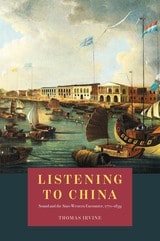
Listening to China
Sound and the Sino-Western Encounter, 1770-1839Thomas Irvine
University of Chicago Press, 2020
Through these stories, Irvine not only investigates how the Sino-Western encounter sounded, but also traces the West’s shifting response to China. As the trading relationships between China and the West broke down, travelers and music theorists abandoned the vision of shared musical approaches, focusing instead on China’s noisiness and sonic disorder and finding less to like in its music. At the same time, Irvine reconsiders the idea of a specifically Western music history, revealing that it was comparison with China, the great “other,” that helped this idea emerge. Ultimately, Irvine draws attention to the ways Western ears were implicated in the colonial and imperial project in China, as well as to China’s importance to the construction of musical knowledge during and after the European Enlightenment. Timely and original, Listening to China is a must-read for music scholars and historians of China alike.
Open Access Musicology
Volume OneLouis Epstein
Lever Press, 2020
In the fall of 2015, a collection of faculty at liberal arts colleges began a conversation about the challenges we faced as instructors: Why were there so few course materials accessible to undergraduates and lay readers that reflected current scholarly debate? How can we convey the relevance of studying music history to current and future generations of students? And how might we represent and reflect the myriad, often conflicting perspectives, positions, and identities that make up both music’s history and the writers of history?
Here we offer one response to those questions. Open Access Musicology is a collection of essays, written in an accessible style and with a focus on modes of inquiry rather than content coverage. Our authors draw from their experience as scholars but also as teachers. They have been asked to describe why they became musicologists in the first place and how their individual paths led to the topics they explore and the questions they pose. Like most scholarly literature, the essays have all been reviewed by experts in the field. Unlike all scholarly literature, the essays have also been reviewed by students at a variety of institutions for clarity and relevance.
These essays are intended for undergraduates, graduate students, and interested readers without any particular expertise. They can be incorporated into courses on a range of topics as standalone readings or used to supplement textbooks. The topics introduce and explore a variety of subjects, practices, and methods but, above all, seek to stimulate classroom discussion on music history’s relevance to performers, listeners, and citizens.
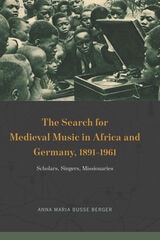
The Search for Medieval Music in Africa and Germany, 1891-1961
Scholars, Singers, MissionariesAnna Maria Busse Berger
University of Chicago Press, 2020
The book unfolds in three parts. Busse Berger starts with the origins of comparative musicology circa 1900, when early proponents used ideas from comparative linguistics to test whether parallels could be drawn between nonwestern and medieval European music. She then turns to youth movements of the era—the Wandervogel, Jugendmusikbewegung, and Singbewegung—whose focus on joint music making influenced many musicologists. Finally, she considers case studies of Protestant and Catholic mission societies in what is now Tanzania, where missionaries—many of them musicologists and former youth-group members—extended the discipline via ethnographic research and a focus on local music and communities. In highlighting these long-overlooked transnational connections and the role of global music in early musicology, Busse Berger shapes a fresh conception of music scholarship during a pivotal part of the twentieth century.