Results by title
5 books match the query 'N'
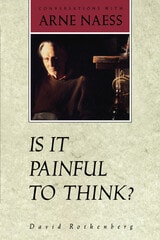
Is It Painful To Think
Conversations with Arne NaessDavid Rothenberg
University of Minnesota Press, 1992
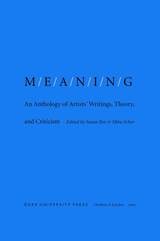
M/E/A/N/I/N/G
An Anthology of Artists' Writings, Theory, and CriticismSusan Bee and Mira Schor, eds.
Duke University Press, 2000
With its emphasis on artists’ perspectives of aesthetic and social issues, this anthology provides a unique opportunity to enter into the fray of the most hotly contested art issues of the past few decades: the visibility of women artists, sexuality and the arts, censorship, art world racism, the legacies of modernism, artists as mothers, visual art in the digital age, and the rewards and toils of a lifelong career in art. The stellar cast of contributing artists and art writers includes Nancy Spero, Richard Tuttle, David Humphrey, Thomas McEvilley, Laura Cottingham, Johanna Drucker, David Reed, Carolee Schneemann, Whitney Chadwick, Robert Storr, Leon Golub, Charles Bernstein, and Alison Knowles.
This compelling and theoretically savvy collection will be of interest to artists, art historians, critics, and a general audience interested in the views of practicing artists.
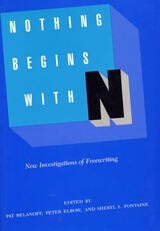
Nothing Begins with N
New Investigations of FreewritingEdited by Pat Belanoff, Peter Elbow, and Sheryl I. Fontaine
Southern Illinois University Press, 1991
The 16 essays in this book provide a theoretical underpinning for freewriting.
Sheryl I. Fontaine opens the book with a description of the organization, purpose, and content of students’ 10-minute unfocused freewriting.
Pat Belanoff discusses the relationship between skilled and unskilled student writers.
Richard H. Haswell analyzes forms of freewriting.
Lynn Hammond describes the focused freewriting strategies used in legal writing and in the analysis of poetry.
Joy Marsella and Thomas L. Hilgers suggest ways of teaching freewriting as a heuristic.
Diana George and Art Young show what teachers learned about the writing abilities of three engineering students through freewriting journals.
Anne E. Mullin seeks to determine whether freewriting lives up to claims made for it.
Barbara W. Cheshire assesses the efficacy of freewriting.
James W. Pennebaker checks the short- and long-term effects of freewriting on students’ emotional lives.
Ken Macrorie notes that freewriting means being freed to use certain powers.
Peter Elbow shows how authors use freewriting.
Robert Whitney tells "why I hate to freewrite."
Karen Ferro considers her own freewriting, showing how it leads to a deeper self-understanding.
Chris Anderson discusses the qualities in freewriting that we should maintain in revision.
Burton Hatlen shows the parallels between writing projective verse and freewriting.
Sheridan Blau describes the results of experiments with invisible writing.
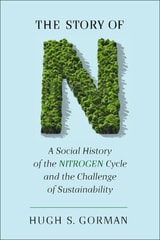
The Story of N
A Social History of the Nitrogen Cycle and the Challenge of SustainabilityGorman, Hugh S.
Rutgers University Press, 2013
In The Story of N, Hugh S. Gorman analyzes the notion of sustainability from a fresh perspective—the integration of human activities with the biogeochemical cycling of nitrogen—and provides a supportive alternative to studying sustainability through the lens of climate change and the cycling of carbon. It is the first book to examine the social processes by which industrial societies learned to bypass a fundamental ecological limit and, later, began addressing the resulting concerns by establishing limits of their own
The book is organized into three parts. Part I, “The Knowledge of Nature,” explores the emergence of the nitrogen cycle before humans arrived on the scene and the changes that occurred as stationary agricultural societies took root. Part II, “Learning to Bypass an Ecological Limit,” examines the role of science and market capitalism in accelerating the pace of innovation, eventually allowing humans to bypass the activity of nitrogen-fixing bacteria. Part III, “Learning to Establish Human-Defined Limits,” covers the twentieth-century response to the nitrogen-related concerns that emerged as more nitrogenous compounds flowed into the environment. A concluding chapter, “The Challenge of Sustainability,” places the entire story in the context of constructing an ecological economy in which innovations that contribute to sustainable practices are rewarded.
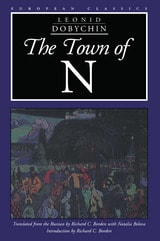
The Town of N
Leonid Dobychin
Northwestern University Press, 1998