Results by title
5 books match the query 'NAFTA'
Ethical Borders
NAFTA, Globalization, and Mexican MigrationAuthored by Bill Ong Hing
Temple University Press, 2010
In his topical new book, Ethical Borders, Bill Ong Hing asks, why do undocumented immigrants from Mexico continue to enter the United States and, what would discourage this surreptitious traffic? An expert on immigration law and policy, Hing examines the relationship between NAFTA, globalization, and undocumented migration, and he considers the policy options for controlling immigration. He develops an ethical rationale for opening up the U.S./Mexican border, as well as improving conditions in Mexico so that its citizens would have little incentive to migrate.
In Ethical Borders Hing insists that reforming NAFTA is vital to ameliorating much of the poverty that drives undocumented immigration and he points to the European Union's immigration and economic development policies as a model for North America. Hing considers the world-wide economic crisis and the social problems that attend labor migration into homogenous countries, arguing for a spectrum of changes, including stricter border enforcement and more effective barriers; a path to citizenship for undocumented migrants; or a guest worker program.
Hing also situates NAFTA and its effects in the larger, and rapidly shifting, context of globalization—particularly the recent rise of China as the world's economic giant. Showing how NAFTA’s unforeseen consequences have been detrimental to Mexico, Hing passionately argues that the United States is ethically bound to address the problems in a way that puts prosperity within the grasp of all North Americans.
Mass Media and Free Trade
NAFTA and the Cultural IndustriesEdited by Emile G. McAnany and Kenton T. Wilkinson
University of Texas Press, 1997
As United States television programs, movies, music, and other cultural products make their way around the globe, a vigorous debate over "cultural imperialism" is growing in many countries. This book brings together experts in economics, sociology, anthropology, the humanities, and communications to explore what effects the North American Free Trade Agreement will have on the flow of cultural products among Mexico, the United States, and Canada.
After an overview of free trade and the cultural industries, the book covers the following topics: dominance and resistance, cultural trade and identity in relation to Mexico and to French Canada, and intellectual property rights. Based on present trends, the contributors predict that there will be a steadily increasing flow of cultural products from the United States to its neighbors.
This book grew out of a 1994 conference that brought together leaders of the cultural industries, policy makers, and scholars. It represents state-of-the-art thinking about the global influence of U.S. cultural industries.
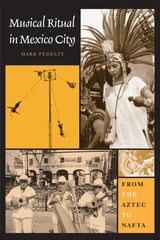
Musical Ritual in Mexico City
From the Aztec to NAFTABy Mark Pedelty
University of Texas Press, 2004
On the Zócalo, the main square of Mexico City, Mexico's entire musical history is performed every day. "Mexica" percussionists drum and dance to the music of Aztec rituals on the open plaza. Inside the Metropolitan Cathedral, choristers sing colonial villancicos. Outside the National Palace, the Mexican army marching band plays the "Himno Nacional," a vestige of the nineteenth century. And all around the square, people listen to the contemporary sounds of pop, rock, and música grupera. In all, some seven centuries of music maintain a living presence in the modern city.
This book offers an up-to-date, comprehensive history and ethnography of musical rituals in the world's largest city. Mark Pedelty details the dominant musical rites of the Aztec, colonial, national, revolutionary, modern, and contemporary eras, analyzing the role that musical ritual played in governance, resistance, and social change. His approach is twofold. Historical chapters describe the rituals and their functions, while ethnographic chapters explore how these musical forms continue to resonate in contemporary Mexican society. As a whole, the book provides a living record of cultural continuity, change, and vitality.
NAFTA and Labor in North America
Norman Caulfield
University of Illinois Press, 2010
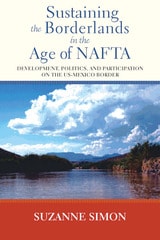
Sustaining the Borderlands in the Age of NAFTA
Development, Politics, and Participation on the US-Mexico BorderSuzanne Simon
Vanderbilt University Press, 2014
Although the key to the side accords' anticipated success lay in their ostensibly generous encouragement of a participatory politics and sustainable development opportunities, Sustaining the Borderlands reveals that the Mexican border populations for which they were largely created are effectively excluded from participating due to the ongoing online, territorial, class, and cultural barriers that shape the borderlands. Rather than experiencing the side accords and their companion institutions as transparent and accessible, residents experienced them as opaque and indecipherable. Simon concludes that the side accords have failed to deliver on their promise of bringing democracy to Mexico because practical mechanisms that would ensure their effective implementation were never put in place.
NAFTA took effect at a time when Mexico was undergoing a democratic transition. The treaty was supposed to encourage this transition and improve environmental and labor conditions on the US-Mexico border. This book demonstrates that, twenty years later, the promises of NAFTA have not come to pass.