Results by title
3 books match the query 'NSZZ "Solidarność" (Labor organization)'
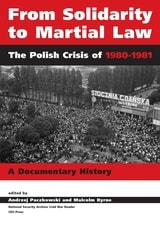
From Solidarity to Martial Law
The Polish Crisis of 1980–1981The National Security Archive Paczkowski
Central European University Press, 2007
95 documents on the events that represent a pivotal moment in modern Polish and world history: 16 months between August 1980 when the Solidarity trade union was founded and December 1981 when Polish authorities declared martial law and crushed the nationwide opposition movement that had grown up around the union. Transcripts of Soviet and Polish Politburo meetings give a detailed picture of the goals, motivations and deliberations of the leaders of these countries. Records of Warsaw Pact gatherings, notes of bilateral sessions of the communist camp provide additional pieces to the puzzle of what Moscow and its allies had in mind. Materials are included from Solidarity, too.
[more]

Solidarity and the Politics of Anti-Politics
Opposition and Reform in Poland since 1968David Ost
Temple University Press, 1991
"For both academic analysts and political activists, this book offers useful lessons from the Polish experience with anti-politics and neocorporatism."
--Political Science Quarterly
Based on extensive use of primary sources, this book provides an analysis of Solidarity, from its ideological origins in the Polish "new left," through the dramatic revolutionary months of 1980-81, and up to the union's remarkable resurgence in 1988-89, when it sat down with the government to negotiate Poland's future. David Ost focuses on what Solidarity is trying to accomplish and why it is likely that the movement will succeed.
He traces the conflict between the ruling Communist Party and the opposition, Solidarity's response to it, and the resulting reforms. Noting that Poland is the one country in the world where "radicals of ‘68" came to be in a position to negotiate with a government about the nature of the political system, Ost asks what Poland tells us about the possibility for realizing a "new left" theory of democracy in the modern world.
As a Fulbright Fellow at Warsaw University and Polish correspondent for the weekly newspaper In These Times during the Solidarity uprising and a frequent visitor to Poland since then, David Ost has had access to a great deal of unpublished material on the labor movement. Without dwelling on the familiar history of August 1980, he offers some of the unfamiliar subtleties--such as the significance of the Szczecin as opposed to the Gdansk Accord--and shows how they shaped the budding union's understanding of the conflicts ahead. Unique in its attention to the critical, formative period following August 1980, this study is the most current and comprehensive analysis of a movement that continues to transform the nature of East European society.
"In his superb book, ...political scientist David Ost chronicles the trajectory of the Polish post-war opposition from its roots in the fascist resistance up to the actions of Solidarity in 19.... [He] astutely bridges academic disciplines, interweaving social theory with intellectual and political history to explain Solidarity's raison d'etre.... In an age when definitions of left and right have become obscured, Solidarity and the Politics of Anti-Politics stands out at a creative example of left thought."
--In These Times
"Ost contributes not only an explication of Polish political life, but he also presents a vision of democracy applicable to the Western world as a whole."
--Jewish Currents
"An invaluable contribution."
--Choice
[more]

Solidarity's Secret
The Women Who Defeated Communism in PolandShana Penn
University of Michigan Press, 2006
"This important book explores one of the most pivotal periods in Polish history and deals with a topic nearly everyone else overlooked. Shana Penn's study begins with a simple question I wish I had thought more about myself: once the leadership of Solidarity had been arrested during the 1981 military coup, who kept the movement alive over the following months and years? The answer will surprise you, as Penn delves into the lives of seven Polish women activists who rose to the call, set about saving an entire political movement, and in time turned themselves into some of the most powerful women in Poland today."
---Lech Walesa, former President of Poland and winner of the 1983 Nobel Peace Prize
Solidarity's Secret is the first book to record the crucial yet little-known role women played in the rise of an independent press in Poland and in the fall of that country's communist government.
Shana Penn pieces together a decade of interviews with the women behind the Polish pro-democracy movement-women whose massive contributions were obscured by the more public successes of their male counterparts.
Penn reveals the story of how these brave women ran Solidarity and the main opposition newspaper, Tygodnik Mazowsze, while prominent men like Lech Walesa were underground or in jail during the 1980s martial law years. The same women then went on to play influential roles in post-communist Poland.
Solidarity's Secret gives us a richly detailed story-within-a-story-unheard of not only in the West, but until recently even within Poland itself-from one of the most important eras in modern history.
[more]