Results by title
3 books match the query 'Nagasaki-shi (Japan)'
Truman and the Hiroshima Cult
Robert P. Newman
Michigan State University Press, 1995
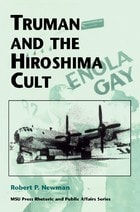
The United States dropped atomic bombs on Japan in 1945 to end World War II as quickly and with as few casualties as possible. That is the compelling and elegantly simple argument Newman puts forward in his new study of World War II's end, Truman and the Hiroshima Cult. According to Newman: (1) The U.S. Strategic Bombing Survey conclusions that Japan was ready to surrender without "the Bomb" are fraudulent; (2) America’s "unconditional surrender" doctrine did not significantly prolong the war; and (3) President Harry S. Truman’s decision to use atomic weapons on Japanese cities was not a "racist act," nor was it a calculated political maneuver to threaten Joseph Stalin’s Eastern hegemony. Simply stated, Newman argues that Truman made a sensible military decision. As commander in chief, he was concerned with ending a devastating and costly war as quickly as possible and with saving millions of lives.
Yet, Newman goes further in his discussion, seeking the reasons why so much hostility has been generated by what happened in the skies over Hiroshima and Nagasaki in early August, 1945. The source of discontent, he concludes, is a "cult" that has grown up in the United States since the 1960s. It was weaned on the disillusionment spawned by concerns about a military industrial complex, American duplicity and failure in the Vietnam War, and a mistrust of government following Watergate. The cult has a shrine, a holy day, a distinctive rhetoric of victimization, various items of scripture, and, in Japan, support from a powerful Marxist constituency. "As with other cults, it is ahistorical," Newman declares. "Its devotees elevate fugitive and unrepresentative events to cosmic status. And most of all, they believe." Newman’s analysis goes to the heart of the process by which scholars interpret historical events and raises disturbing issues about the way historians select and distort evidence about the past to suit special political agendas.
Weapons for Victory
The Hiroshima Decision Fifty Years LaterRobert James Maddox
University of Missouri Press, 2004
The highly acclaimed Weapons for Victory originally appeared in 1995, the fiftieth anniversary of the end of World War II. Now, in this paperback edition, Robert James Maddox provides a new introduction about the ongoing controversy related to the decision to bomb Hiroshima.
Writing Ground Zero
Japanese Literature and the Atomic BombJohn Whittier Treat
University of Chicago Press, 1994
Treat recounts the controversial history of Japanese public discourse around Hiroshima and Nagasaki—a discourse alternatively celebrated and censored—from August 6, 1945, to the present day. He includes works from the earliest survivor writers, including Hara Tamiki and Ota Yoko, to such important Japanese intellectuals today as Oe Kenzaburo and Oda Makoto. Treat argues that the insights of Japanese writers into the lessons of modern atrocity share much in common with those of Holocaust writers in Europe and the practitioners of recent poststructuralist nuclear criticism in America. In chapters that take up writers as diverse as Hiroshima poets, Tokyo critics, and Nagasaki women novelists, he explores the implications of these works for critical, literary, and cultural theory.
Treat summarizes the Japanese contribution to such ongoing international debates as the crisis of modern ethics, the relationship of experience to memory, and the possibility of writing history. This Japanese perspective, Treat shows, both confirms and amends many of the assertions made in the West on the shift that the death camps and nuclear weapons have jointly signaled for the modern world and for the future.
Writing Ground Zero will be read not only by students of Japan, but by all readers concerned with the fate of culture after the fact of nuclear war in our time.