Results by title
8 books match the query 'Nahuatl language'
Codex Chimalpopoca
The Text in Nahuatl with a Glossary and Grammatical NotesJohn Bierhorst
University of Arizona Press, 2011
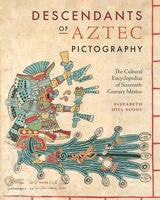
Descendants of Aztec Pictography
The Cultural Encyclopedias of Sixteenth-Century MexicoBy Elizabeth Hill Boone
University of Texas Press, 2021
In the aftermath of the sixteenth-century Spanish conquest of Mexico, Spanish friars and authorities partnered with indigenous rulers and savants to gather detailed information on Aztec history, religious beliefs, and culture. The pictorial books they created served the Spanish as aids to evangelization and governance, but their content came from the native intellectuals, painters, and writers who helped to create them. Examining the nine major surviving texts, preeminent Latin American art historian Elizabeth Hill Boone explores how indigenous artists and writers documented their ancestral culture.
Analyzing the texts as one distinct corpus, Boone shows how they combined European and indigenous traditions of documentation and considers questions of motive, authorship, and audience. For Spanish authorities, she shows, the books revealed Aztec ideology and practice, while for the indigenous community, they preserved venerated ways of pictorial expression as well as rhetorical and linguistic features of ancient discourses. The first comparative analysis of these encyclopedias, Descendants of Aztec Pictography analyzes how the painted compilations embraced artistic traditions from both sides of the Atlantic.
Dialogue with Europe, Dialogue with the Past
Colonial Nahua and Quechua Elites in Their Own WordsJustyna Olko
University Press of Colorado, 2018
In each chapter a particular document is transcribed exactly as it appears in the original manuscript or colonial printed document, with the editor placing it in historical context and considering the degree of European influence. These texts show the nobility through documents they themselves produced or caused to be produced—such as wills, land deeds, and petitions—and prioritize indigenous ways of expression, perspectives, and concepts. Together, the chapters demonstrate that native elites were independent actors as well as agents of social change and indigenous sustainability in colonial society. Additionally, the volume diversifies the commonly homogenous term “cacique” and recognizes the differences in elites throughout Mesoamerica and the Andes.
Showcasing important and varied colonial genres of indigenous writing, Dialogue with Europe, Dialogue with the Past reveals some of the realities, needs, strategies, behaviors, and attitudes associated with the lives of the elites. Each document and its accompanying commentary provide additional insight into how the nobility negotiated everyday life. The book will be of great interest to students and researchers of Mesoamerican and Andean history, as well as those interested in indigenous colonial societies in the Spanish Empire.
Contributors: Agnieszka Brylak, Maria Castañeda de la Paz, Katarzyna Granicka, Gregory Haimovich, Anastasia Kalyuta, Julia Madajczak, Patrycja Prządka-Giersz
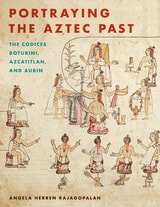
Portraying the Aztec Past
The Codices Boturini, Azcatitlan, and AubinBy Angela Herren Rajagopalan
University of Texas Press, 2019
During the period of Aztec expansion and empire (ca. 1325–1525), scribes of high social standing used a pictographic writing system to paint hundreds of manuscripts detailing myriad aspects of life, including historical, calendric, and religious information. Following the Spanish conquest, native and mestizo tlacuiloque (artist-scribes) of the sixteenth century continued to use pre-Hispanic pictorial writing systems to record information about native culture. Three of these manuscripts—Codex Boturini, Codex Azcatitlan, and Codex Aubin—document the origin and migration of the Mexica people, one of several indigenous groups often collectively referred to as “Aztec.”
In Portraying the Aztec Past, Angela Herren Rajagopalan offers a thorough study of these closely linked manuscripts, articulating their narrative and formal connections and examining differences in format, style, and communicative strategies. Through analyses that focus on the materials, stylistic traits, facture, and narrative qualities of the codices, she places these annals in their historical and social contexts. Her work adds to our understanding of the production and function of these manuscripts and explores how Mexica identity is presented and framed after the conquest.
Speaking Mexicano
Dynamics of Syncretic Language in Central MexicoJane H. Hill and Kenneth C. Hill
University of Arizona Press, 1986
"The genius of this work is the integration of the linguistic analysis with the cultural and political analysis."—Latin American Anthropology Review
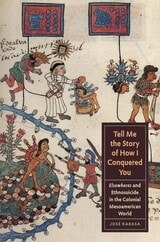
Tell Me the Story of How I Conquered You
Elsewheres and Ethnosuicide in the Colonial Mesoamerican WorldBy José Rabasa
University of Texas Press, 2011
Folio 46r from Codex Telleriano-Remensis was created in the sixteenth century under the supervision of Spanish missionaries in central Mexico. As an artifact of seismic cultural and political shifts, the manuscript painting is a singular document of indigenous response to Spanish conquest. Examining the ways in which the folio's tlacuilo (indigenous painter/writer) creates a pictorial vocabulary, this book embraces the place "outside" history from which this rich document emerged.
Applying contemporary intellectual perspectives, including aspects of gender, modernity, nation, and visual representation itself, José Rabasa reveals new perspectives on colonial order. Folio 46r becomes a metaphor for reading the totality of the codex and for reflecting on the postcolonial theoretical issues now brought to bear on the past. Ambitious and innovative (such as the invention of the concepts of elsewheres and ethnosuicide, and the emphasis on intuition), Tell Me the Story of How I Conquered You embraces the performative force of the native scribe while acknowledging the ineffable traits of 46r—traits that remain untenably foreign to the modern excavator/scholar. Posing provocative questions about the unspoken dialogues between evangelizing friars and their spiritual conquests, this book offers a theoretic-political experiment on the possibility of learning from the tlacuilo ways of seeing the world that dislocate the predominance of the West.
The Aztecs at Independence
Nahua Culture Makers in Central Mexico, 1799–1832Miriam Melton-Villanueva
University of Arizona Press, 2016
The Aztecs at Independence offers the first internal ethnographic view of these central Mexican indigenous communities in the critical transitional time of Independence. Miriam Melton-Villanueva uses previously unknown Nahuatl-language sources—primarily last wills and testaments—to provide a comprehensive understanding of indigenous societies during the transition from colonial to postcolonial times. The book describes the cultural life of people now called Nahuas or Mexicas in the nineteenth century—based on their own words, their own written records. The book uses previously unknown, unstudied, and untranslated indigenous texts to bring Nahua society into history, fleshing out glimpses of daily life in the early nineteenth century. Thus, The Aztecs at Independence describes life at the most local level: Nahua lineages of ritual and writing, guilds and societies, the people that take turns administering festivals and attending to the last wishes of the dying.
Interwoven with personal stories and memory, The Aztecs at Independence invites a general audience along on a scholarly journey, where readers are asked to imagine Nahua concepts and their contemporary meanings that give light to modern problems.
The Nahua
Language and Culture from the 16th Century to the PresentGalen Brokaw
University Press of Colorado, 2024
During the colonial period, Nahuatl became a means of empowerment, oppression, and indoctrination. In modern times, Nahuatl continues to serve as an ideological lightning rod for both the Mexican government and Indigenous communities. Contributors to this volume focus on Nahua intellectual production from the sixteenth century to the present; contact and the negotiation of meaning; adaptations of Christian lore that show how representations of creation, hell, and the Passion of Christ reflected Nahua perceptions and understandings; Nahua cultural expressions, including poetry, healing rituals, and even running; language and geography; Nahuatl place-names; and the transformation of Nahuatl speakers from antiquity to the present.
Showcasing how Nahuatl’s cultural resilience permanently shaped the region’s social geography, The Nahua engages the field’s interest in the nonhomogenous character of the language, with regional and subregional dialects and pronunciations that reflect the history of pre-Columbian migrations and modern-era influences. Bridging the study of Nahuatl as a “historical” Indigenous language tradition with the study of modern-day speakers and their experiences, this work is of significance to students, scholars, and speakers of the languages as well as those studying colonial New Spain, Indigenous resilience, or Indigenous linguistics.