Results by title
6 books match the query 'Nairobi'

Al Qaeda Declares War
The African Embassy Bombings and America’s Search for JusticeTod Hoffman
University Press of New England, 2014

Girl Power?
A History of Girl-Focused Development from NairobiSarah Bellows-Blakely
University of Chicago Press, 2025
Girl-focused education programs have long been at the heart of international policymaking—when girls’ access to education is ensured, the reasoning goes, they are more likely to turn into productive adults who can drive economic growth. These ideas combine strands of feminism and capitalism that have a specific and understudied origin. In this book, historian Sarah Bellows-Blakely shows how a doctored study of girls’ education in East and Southern Africa led to the creation of international norms in the United Nations that would go on to guide policymaking on women’s rights and economic growth, promoting neoliberal feminist policy at the expense of other forms of gender-based justice.
Focusing on the growth of free-market feminism and girl-focused economic development planning through the relationship between UNICEF and the Nairobi-based NGO FEMNET, Bellows-Blakely reveals how their joint efforts set the blueprints for linked movements of economic development and women’s rights that are still ongoing. Through a narrative of the UNICEF-FEMNET lobbying campaign, Bellows-Blakely shows how multiple, contested girl-focused visions of economic programming and gender justice became selectively erased in favor of an approach to global policy centered on the free-market construction and strategic deployment of the African “girl child.”
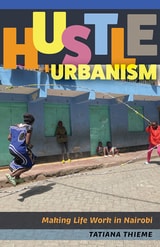
Hustle Urbanism
Making Life Work in NairobiTatiana Thieme
University of Minnesota Press, 2025
Exploring hustle as a social, cultural, and economic phenomenon in contemporary Nairobi
In Nairobi’s underserved neighborhoods, “hustle” has emerged as both a vital survival strategy and a way of life for youth. Exploring the multiple meanings and manifestations of the hustle economy across different scenarios of provisioning, distribution, exchange, learning, and mobilizing, Hustle Urbanism draws on more than a decade of ethnographic engagement to center the logics, perspectives, and inventive strategies of a group of youth who constantly navigate job scarcity, inadequate basic services, and climate-induced harms.
Tatiana Thieme shows how young people develop tools of resistance against the legacies of colonial violence and uneven urban development while carving out spaces of opportunity for themselves and their peers. The stories she includes bring thick ethnographic detail and longitudinal perspective to the lives and livelihoods of youth whose diverse skill sets and knowledges span from circular economies and eco-activism to hip hop and local leadership. Filling a significant gap in both existing scholarship and popular discussion, Hustle Urbanism offers critical theorization of precarious urban environments and the affirmative modes of making life work in the city against the odds.
While Thieme cautions against fetishizing hustle as a form of social and economic uplift, she calls for a greater recognition of the ingenuity and skill involved in hustle urbanism, arguing that studying hustle narratives and practices opens up timely empirical and theoretical questions about overlapping urban struggles and possibilities that coexist in the everyday city.
Retail e-book files for this title are screen-reader friendly with images accompanied by short alt text and/or extended descriptions.
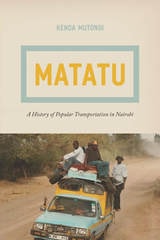
Matatu
A History of Popular Transportation in NairobiKenda Mutongi
University of Chicago Press, 2017
As Mutongi shows, matatus offer a window onto the socioeconomic and political conditions of late-twentieth-century Africa. In their diversity of idiosyncratic designs, they reflect multiple and divergent aspects of Kenyan life—including, for example, rapid urbanization, organized crime, entrepreneurship, social insecurity, the transition to democracy, and popular culture—at once embodying Kenya’s staggering social problems as well as the bright promises of its future. Offering a shining model of interdisciplinary analysis, Mutongi mixes historical, ethnographic, literary, linguistic, and economic approaches to tell the story of the matatu and explore the entrepreneurial aesthetics of the postcolonial world.
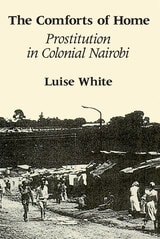
The Comforts of Home
Prostitution in Colonial NairobiLuise White
University of Chicago Press, 1990
"White's book . . . takes a unique approach to a largely unexplored aspect of African History. It enhances our understanding of African social history, political economy, and gender studies. It is a book that deserves to be widely read."—Elizabeth Schmidt, American Historical Review
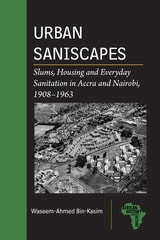
Urban Saniscapes
Slums, Housing and Everyday Sanitation in Accra and Nairobi, 1908–1963Waseem-Ahmed Bin-Kasim
Michigan State University Press, 2025