Results by title
2 books match the query 'Najmabadi, Afsaneh'
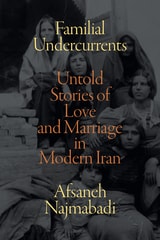
Familial Undercurrents
Untold Stories of Love and Marriage in Modern IranAfsaneh Najmabadi
Duke University Press, 2022
Not long after her father died, Afsaneh Najmabadi discovered that her father had a secret second family and that she had a sister she never knew about. In Familial Undercurrents, Najmabadi uncovers her family’s complex experiences of polygamous marriage to tell a larger story of the transformations of notions of love, marriage, and family life in mid-twentieth-century Iran. She traces how the idea of “marrying for love” and the desire for companionate, monogamous marriage acquired dominance in Tehran’s emerging urban middle class. Considering the role played in that process by late nineteenth- and early twentieth-century romance novels, reformist newspapers, plays, and other literature, Najmabadi outlines the rituals and objects---such as wedding outfits, letter writing, and family portraits---that came to characterize the ideal companionate marriage. She reveals how in the course of one generation men’s polygamy had evolved from an acceptable open practice to a taboo best kept secret. At the same time, she chronicles the urban transformations of Tehran and how its architecture and neighborhood social networks both influenced and became emblematic of the myriad forms of modern Iranian family life.
[more]

Professing Selves
Transsexuality and Same-Sex Desire in Contemporary IranAfsaneh Najmabadi
Duke University Press, 2013
Since the mid-1980s, the Islamic Republic of Iran has permitted, and partially subsidized, sex reassignment surgery. In Professing Selves, Afsaneh Najmabadi explores the meaning of transsexuality in contemporary Iran. Combining historical and ethnographic research, she describes how, in the postrevolutionary era, the domains of law, psychology and psychiatry, Islamic jurisprudence, and biomedicine became invested in distinguishing between the acceptable "true" transsexual and other categories of identification, notably the "true" homosexual, an unacceptable category of existence in Iran. Najmabadi argues that this collaboration among medical authorities, specialized clerics, and state officials—which made transsexuality a legally tolerated, if not exactly celebrated, category of being—grew out of Iran's particular experience of Islamicized modernity. Paradoxically, state regulation has produced new spaces for non-normative living in Iran, since determining who is genuinely "trans" depends largely on the stories that people choose to tell, on the selves that they profess.
[more]