Results by title
8 books match the query 'Napoleon I, Emperor of the French'
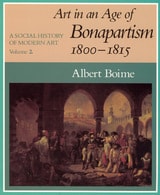
A Social History of Modern Art, Volume 2
Art in an Age of Bonapartism, 1800-1815Albert Boime
University of Chicago Press, 1990
Heavily illustrated, this volume is an invaluable social history of modern art during the Napoleonic era.
Stimulating and informative, this volume will become a valuable resource for faculty and undergraduates.—R. W. Liscombe, Choice

Controversial Concordats
The Vatican's Relations with Napoleon, Mussolini, and HitlerFrank J. Coppa
Catholic University of America Press, 1999

Napoleonic Friendship
Military Fraternity, Intimacy, and Sexuality in Nineteenth-Century FranceBrian Joseph Martin
University of New Hampshire Press, 2011
Winner of the Laurence Wylie Prize in French Cultural Studies
One of the first books on “Gays in the Military” published following the historic repeal of “Don't Ask Don't Tell” in 2011, Napoleonic Friendship examines the history of male intimacy in the French military, from Napoleon to the First World War. Echoing the historical record of gay soldiers in the United States, Napoleonic Friendship is the first book-length study on the origin of queer soldiers in modern France. Based on extensive archival research in France, the book traces the development of affectionate friendships in the French Army from 1789 to 1916.
Following the French Revolution, radical military reforms created conditions for new physical and emotional intimacy between soldiers, establishing a model of fraternal affection during the Revolutionary and Napoleonic Wars that would persist amid the ravages of the Franco-Prussian War and World War I. Through readings of Napoleonic military memoirs (and other non-fiction archival material) and French military fiction (from Hugo and Balzac to Zola and Proust), Martin examines a broad range of emotional and erotic relationships, from combat buddies to soldier lovers. He argues that the French Revolution's emphasis on military fraternity evolved into an unprecedented sense of camaraderie in the armies of Napoleon. For many soldiers, the hardships of combat led to intimate friendships. For some, the homosociality of military life inspired mutual affection, lifelong commitment, and homoerotic desire.
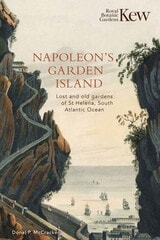
Napoleon’s Garden Island
Lost and Old Gardens of St Helena, South Atlantic OceanDonal P. McCracken
Royal Botanic Gardens, Kew, 2022
Though the South Atlantic island of St. Helena is best known as the site of Napoleon’s exile following his final defeat in 1815, this remote locale also has a rich gardening heritage and a population of highly diverse flora, both exotic and endemic. This is due to St. Helena’s history as a stopover for the vast East India Company fleets on their way to Europe, whose cargo holds carried not only spices but also plants from China, Malaysia, and India. As a result, St. Helena became a botanical hub and the island’s private plantation houses cultivated a number of extraordinarily varied gardens.
Illustrated throughout with drawings, maps, and archival materials, Napoleon’s Garden Island looks to St. Helena’s past and future alike. McCracken explores the island’s native and introduced flora, ultimately appealing for the establishment of a new permanent garden to showcase this singular botanical blend. Turning away from the military matters that characterize most other books about St. Helena’s history, Napoleon’s Garden Island highights how a dazzling assortment of plants have thrived thousands of miles from their nearest neighbors.
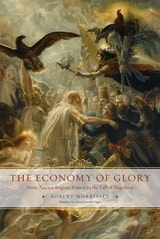
The Economy of Glory
From Ancien Régime France to the Fall of NapoleonRobert Morrissey
University of Chicago Press, 2013
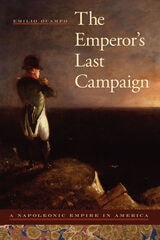
The Emperor's Last Campaign
A Napoleonic Empire in AmericaEmilio Ocampo
University of Alabama Press, 2009
WINNER OF THE 2009 LITERARY AWARD, SPONSORED BY THE INTERNATIONAL NAPOLEONIC SOCIETY/LA SOCIETE NAPOLEONIENNE INTERNATIONALE OF MONTREAL, QUEBEC'S LITERARY COMMITTEE
The fascinating story of the breakdown of the Spanish empire in America and the rise of the United States as a world power
Napoleon’s last campaign didn’t end at Waterloo. After that fateful day on June 1815, hundreds if not thousands of veterans of Napoleon’s army emigrated to America. Many went farther south and joined the rebels fighting for independence in the Spanish colonies, from Mexico to Buenos Aires. The Bonapartists roiled the Western World as they sought fortune, fame, and glory in the expanding United States and in the tumultuous Spanish Americas suffering from repression and civil disorder, and even in the states of Europe. They were joined by adventurers from other nations who shared their admiration for the fallen emperor.
This is the first full-length examination of the Bonapartists who emigrated from France after Napoleon’s defeat and exile, who formed a loose confederation with adventurers and romantics, and who contemplated a new empire in the Western Hemisphere. The scheme had the support and encouragement of the fallen emperor himself and his brother Joseph, former King of Spain, who lived in exile in the United States.
Emilio Ocampo has examined archives on three continents and sources in several languages to ferret out the evidence—a monumental task considering that conspirators tried to leave no evidence of their plans, and that a failed plot, like failure in general, leaves few claimants. Ocampo reinterprets Latin American independence as an international event that drew in all the major powers. By illuminating the complex connections between the shattered France of the Bourbon restoration; an England threatened by radical politician inspired by the French Revolution; Napoleon in exile at St. Helena; the United States, where home-grown adventurers and French émigrés alike saw opportunity; and the collapsing Spanish colonial empire, where revolutionaries were allying themselves with the veterans of Napoleon’s Grande Armée, Ocampo brings together two bodies of scholarship: Napoleonic history and Latin American independence. He does so by tracing the steps of four of the most fascinating characters of the era: two Britons disaffected with their own government—Lord Thomas Cochrane and Sir Robert Wilson—and two former generals of Napolean’s army named Charles Lallemand and Michel Brayer.
The Emperor’s Last Campaign is a fascinating story, well told, and peopled with all sorts of improbable characters and schemes that perhaps just missed coming to full fruition but that in the process contributed to one of the most important events of the nineteenth century: the breakdown of the Spanish empire in America and the rise of the United States as a world power.
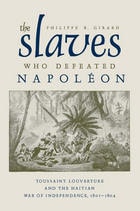
The Slaves Who Defeated Napoléon
Toussaint Louverture and the Haitian War of Independence, 1801–1804Philippe R. Girard
University of Alabama Press, 2011
A deeply researched and definitive account of the climactic battle at the end of the Haitian Revolution
Among the many rebellions against European colonial empires, the Haitian Revolution against France is among the most dramatic and complex. Having begun in 1791 as France was in the throes of its own young revolution, the conflict reached its dramatic climax when Napoleon dispatched a heavily armed expeditionary force led by his brother-in-law Charles Leclerc to re-establish slavery and the sugar economy that had so enriched France. Philippe Girard’s Slaves Who Defeated Napoleon is a deeply researched and engrossing account of this invasion and its spectacular defeat.
For this ambitious account, Philippe Girard has studied not only primary records in Haiti itself but also rare documents from nineteen public and private archives and research libraries in French, U.S., British, and Spanish collections. His more inclusive approach provides a fuller, more accurate and detailed narrative. He reveals not only key military movements, but also less-known aspects like the activities of U.S. merchants, in-fighting within Napoleon’s government, and communication between both sides and other European powers. Girard fills the work with unforgettable stories of those who led or were caught up in the war, people like poorly armed Black soldiers who ambushed Bonaparte’s columns, French child drummers, Jewish bankers in Kingston, weapon smugglers from Quaker Philadelphia, Polish artillerists, and mixed-raced people struggling to preserve their freedom against both Black and white opponents.
Transcending pat ideological and racial categories, the book brings into focus an Atlantic society at the crossroads of African and European influences, where Haitian rebels fought France while embracing its ideals.
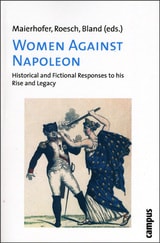
Women Against Napoleon
Historical and Fictional Responses to his Rise and LegacyEdited by Waltraud Maierhofer, Gertrud Roesch, and Caroline Bland
Campus Verlag, 2007