Results by title
4 books match the query 'Napoleonic Wars, 1800-1815'
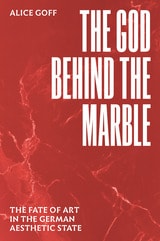
The God behind the Marble
The Fate of Art in the German Aesthetic StateAlice Goff
University of Chicago Press, 2024
For German philosophers at the turn of the nineteenth century, beautiful works of art acted as beacons of freedom, instruments of progress that could model and stimulate the moral autonomy of their beholders. Amid the Revolutionary and Napoleonic wars, Germans struggled to uphold these ideals as they contended with the destruction of art collections, looting, and questions about cultural property. As artworks fell prey to the violence they were supposed to transcend, some began to wonder how art could deliver liberation if it could also quickly become a spoil of war. Alice Goff considers a variety of works—including forty porphyry columns from the tomb of Charlemagne, the Quadriga from the Brandenburg Gate in Berlin, the Laocoön group from Rome, a medieval bronze reliquary from Goslar, a Last Judgment from Danzig, and the mummified body of an official from the Rhenish hamlet of Sinzig—following the conflicts over the ownership, interpretation, conservation, and exhibition of German collections during the Napoleonic period and its aftermath.
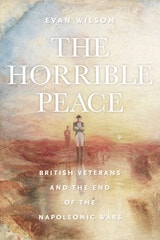
The Horrible Peace
British Veterans and the End of the Napoleonic WarsEvan Wilson
University of Massachusetts Press, 2023
Few battles in world history provide a cleaner dividing line than Waterloo: before, there was Napoleon; after, there was the Pax Britannica. While Waterloo marked France’s defeat and Britain’s ascendance as an imperial power, the war was far from over for many soldiers and sailors, who were forced to contend with the lasting effects of battlefield trauma, the realities of an impossibly tight labor market, and growing social unrest. The Horrible Peace details a story of distress and discontent, of victory complicated by volcanism, and of the challenges facing Britain at the beginning of its victorious century.
Examining the process of demobilization and its consequences for British society, Evan Wilson draws on archival research and veterans’ memoirs to tell the story of this period through the experiences of veterans who struggled to reintegrate and soldiers and sailors who remained in service as Britain attempted to defend and expand the empire. Veterans were indeed central to Britain’s experience of peace, as they took to the streets to protest the government’s indifference to widespread unemployment and misery. The fighting did not stop at Waterloo.

Thomas Hardy'S Tragic Poetry
The Lyrics And The DynastsKatherine K. Maynard
University of Iowa Press, 1991
Contrary to some scholars, tragic poetry did not die with the rise of melodrama in nineteenth-century theater or the glowing secularism spread by the proliferation of liberal-scientific philosophies. Rather, artists found alternative means to portray tragic situations.Thomas Hardy's Tragic Poetry convincingly argues that Hardy's lyric poetry and The Dynasts occupy a pivotal place in the development of modern tragic poetry and drama, crystallizing the tragic feeling that surfaces intermittently in Romantic and Victorian poems and plays.
Many scholars have noted the tragic forms and themes of Thomas Hardy's novels, but the tragic quality of his lyric poems has received less critical attention. Katherine Maynard remedies that situation by tracing the emergence of the Hardyean figure—tragically isolated against the backdrop of a stark landscape, neutral universe, or indifferent social milieu—through both a review of critical opinion about tragedy's place within modern literature and a survey of the frustrated attempts by major nineteenth-century poets to write tragic drama. Hardy's epic-drama The Dynasts is seen as a fulcrum work, bearing many of the flaws of its dramatic forebears but also illustrating his use of contemporary science and philosophy in the service of dramatic irony. Maynard examines a significant sample of lyrics to identify the contribution of Hardy's poetry to our understanding of tragic literature. She places the thematic and formal innovations of Hardy's tragic poetry squarely within the main lines of development from Wordsworth's Solitary to Beckett's lone figures waiting in a desert for a Godot who never arrives.
Ultimately, Thomas Hardy's Tragic Poetry calls for a rereading of Hardy's poetry as "tragic," arguing that he was able, paradoxically, to incorporate these literary and philosophical conventions of his time which some critics insist signaled the death of tragic literature. This study will prove fascinating for Hardyists, students of nineteenth-century literature, and all those interested in the ongoing development of poetry.
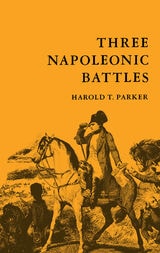
Three Napoleonic Battles
Harold T. Parker
Duke University Press, 1983