Results by title
3 books match the query 'Narcotics, Control of'
Crime and Justice, Volume 13
Drugs and CrimeEdited by Michael Tonry and James Q. Wilson
University of Chicago Press Journals, 1991
[more]
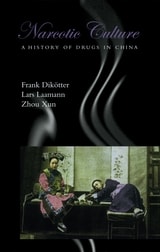
Narcotic Culture
A History of Drugs in ChinaFrank Dikötter, Lars Laamann, and Zhou Xun
University of Chicago Press, 2004
To this day, the perception persists that China was a civilization defeated by imperialist Britain's most desirable trade commodity, opium—a drug that turned the Chinese into cadaverous addicts in the iron grip of dependence. Britain, in an effort to reverse the damage caused by opium addiction, launched its own version of the "war on drugs," which lasted roughly sixty years, from 1880 to World War II and the beginning of Chinese communism. But, as Narcotic Culture brilliantly shows, the real scandal in Chinese history was not the expansion of the drug trade by Britain in the early nineteenth century, but rather the failure of the British to grasp the consequences of prohibition.
In a stunning historical reversal, Frank Dikötter, Lars Laamann, and Zhou Xun tell this different story of the relationship between opium and the Chinese. They reveal that opium actually had few harmful effects on either health or longevity; in fact, it was prepared and appreciated in highly complex rituals with inbuilt constraints preventing excessive use. Opium was even used as a medicinal panacea in China before the availability of aspirin and penicillin. But as a result of the British effort to eradicate opium, the Chinese turned from the relatively benign use of that drug to heroin, morphine, cocaine, and countless other psychoactive substances. Narcotic Culture provides abundant evidence that the transition from a tolerated opium culture to a system of prohibition produced a "cure" that was far worse than the disease.
Delving into a history of drugs and their abuses, Narcotic Culture is part revisionist history of imperial and twentieth-century Britain and part sobering portrait of the dangers of prohibition.
[more]
Why Our Drug Laws Have Failed
James Gray
Temple University Press, 2001
Our drug prohibition policy is hopeless, just as Prohibition, our alcohol prohibition policy, was before it. Today there are more drugs in our communities and at lower prices and higher strengths than ever before.
We have built large numbers of prisons, but they are overflowing with non-violent drug offenders. The huge profits made from drug sales are corrupting people and institutions here and abroad. And far from being protected by our drug prohibition policy, our children are being recruited by it to a lifestyle of drug use and drug selling.
Judge Gray's book drives a stake through the heart of the War on Drugs. After documenting the wide-ranging harms caused by this failed policy, Judge Gray also gives us hope. We have viable options. The author evaluates these options, ranging from education and drug treatment to different strategies for taking the profit out of drug-dealing.
Many officials will not say publicly what they acknowledge privately about the failure of the War on Drugs. Politicians especially are afraid of not appearing "tough on drugs." But Judge Gray's conclusions as a veteran trial judge and former federal prosecutor are reinforced by the testimonies of more than forty other judges nationwide.
[more]