Results by title
5 books match the query 'Nation - Building'
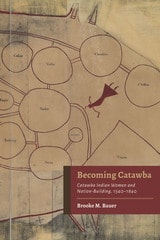
Becoming Catawba
Catawba Indian Women and Nation-Building, 1540–1840Brooke M. Bauer
University of Alabama Press, 2023
WINNER OF THE ANNE B. & JAMES B. MCMILLAN PRIZE IN SOUTHERN HISTORY
WINNER OF THE ERMINIE WHEELER-VOEGELIN BOOK AWARD
WINNER OF THE BERSHIRE CONFERENCE OF WOMEN HISTORIANS BOOK AWARD
WINNER OF THE GEORGE C. ROGERS, JR. AWARD FROM THE SOUTH CAROLINA HISTORICAL SOCIETY
The story of Catawba women who experienced sweeping changes to their world but held onto traditional customs to create and preserve a Catawba identity and build a nation.
Brooke M. Bauer’s Becoming Catawba: Catawba Indian Women and Nation-Building, 1540–1840 is the first book-length study of the role Catawba women played in creating and preserving a cohesive tribal identity over three centuries of colonization and cultural turmoil. Bauer, a citizen of the Catawba Indian Nation of South Carolina, weaves ethnohistorical methodologies, family history, cultural context, and the Catawba language together to generate an internal perspective on the Catawbas’ history and heritage in the area now known as the Carolina Piedmont.
This unique and important study examines the lives and legacies of women who executed complex decision-making and diplomacy to navigate shifting frameworks of kinship, land ownership, and cultural production in dealings with colonial encroachments, white settlers, and Euro-American legal systems and governments from the mid-sixteenth century to the early nineteenth century. Personified in the figure of Sally New River, a Catawba cultural leader to whom 500 remaining acres of occupied tribal lands were deeded on behalf of the community in 1796 and which she managed until her death in 1821, Bauer reveals how women worked to ensure the survival of the Catawba people and their Catawba identity, an effort that resulted in a unified nation.
Bauer’s approach is primarily ethnohistorical, although it draws on a number of interdisciplinary strategies. In particular, Bauer uses “upstreaming,” a critical strategy that moves toward the period under study by using present-day community members’ connections to historical knowledge—for example, family histories and oral traditions—to interpret primary-source data. Additionally, Bauer employs archaeological data and material culture as a means of performing feminist recuperation, filling the gaps and silences left by the records, newspapers, and historical accounts as primarily written by and for white men. Ultimately, Becoming Catawba effects a welcome intervention at the intersections of Native, women’s, and Southern history, expanding the diversity and modes of experience in the fraught, multifaceted cultural environment of the early American South.
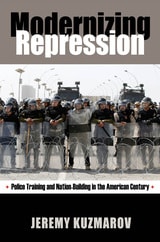
Modernizing Repression
Police Training and Nation-Building in the American CenturyJeremy Kuzmarov
University of Massachusetts Press, 2012
As American troops became bogged down first in Iraq and then Afghanistan, a key component of U.S. strategy was to build up local police and security forces in an attempt to establish law and order. This approach, Jeremy Kuzmarov shows, is consistent with practices honed over more than a century in developing nations within the expanding orbit of the American empire. From the conquest of the Philippines and Haiti at the turn of the twentieth century through Cold War interventions and the War on Terror, police training has been valued as a cost-effective means of suppressing radical and nationalist movements, precluding the need for direct U.S. military intervention and thereby avoiding the public opposition it often arouses.
Unlike the spectacular but ephemeral pyrotechnics of the battlefield, police training programs have had lasting consequences for countries under the American imperial umbrella, fostering new elites, creating powerful tools of social control, and stifling political reform. These programs have also backfired, breeding widespread resistance, violence, and instability—telltale signs of “blowback” that has done more to undermine than advance U.S. strategic interests abroad.

Nation-Building in Kenya
John W. Harbeson
Northwestern University Press, 1973

Nation-Building
A Key Concept For Peaceful Conflict Transformation?Jochen Hippler
Pluto Press, 2005
Currently the international debate on nation-building is heavily dominated by US actors and authors, especially by writers connected to the Bush administration or its policies. This book presents academic and political alternatives, presenting a critical view from 'Old Europe'.
The book combines academic research and analysis with policy orientation, with contributors from both fields. It clarifies the terminology distinguishing developmental, peace-related, imperial and analytical approaches to nation-building. Highlighting its connections to globalisation, democracy, ethnic and religious minorities, the contributors consider case studies such as Somalia, the Balkans, Afghanistan, Iraq, and Nigeria.
Dr. Jochen Hippler, Political Scientist at the University of Duisburg-Essen and its Institute for Development and Peace (INEF), specialises in regional conflicts and interventionism in the Third World, political identities, and the Middle East. He is the former Director of the Transnational Institute in Amsterdam and the author of numerous books and articles including Pax Americana (Pluto Press 1994), The Democratisation of Disempowerment (Pluto Press 1995) and The Next Threat (Pluto Press 1995).
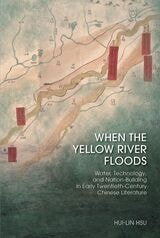
When the Yellow River Floods
Water, Technology, and Nation-Building in Early Twentieth-Century Chinese LiteratureHui-Lin Hsu
Hong Kong University Press, 2024
When the Yellow River Floods explores the relationship between environmental degradation, hydraulic engineering, and nation-building in the context of Liu E’s The Travels of Lao Can. This book provides a unique perspective on modern Chinese literary history that goes beyond conventional narratives that focus solely on political and cultural factors. The main areas covered include the role of water management in literary nation-building and the connections between the novel’s various themes, such as river engineering, medical and political discourses, national sentiment, and landscape description.
By offering a comprehensive analysis of The Travels of Lao Can, this book broadens the understanding of nation-building in early twentieth-century China, highlighting the impact of environmental crises and hydraulics on the formation of national literature and consciousness. When the Yellow River Floods provides a new perspective on the environmental roots of modern Chinese literature, making it an essential read for those seeking to understand the complex interplay between literature, the environment, and national identity in China. This book will be of interest to scholars and students of Chinese literature, history, and environmental studies.