Results by title
2 books match the query 'National characteristics, Haitian'
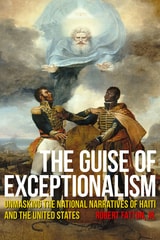
The Guise of Exceptionalism
Unmasking the National Narratives of Haiti and the United StatesRobert Fatton
Rutgers University Press, 2021
The Guise of Exceptionalism compares the historical origins of Haitian and American exceptionalisms. It also traces how exceptionalism as a narrative of uniqueness has shaped relations between the two countries from their early days of independence through the contemporary period. Exceptionalism is at the core of every national founding narrative. It allows countries to purge history of injurious stains, and embellish it with mythical innocence and claims of distinction. Exceptionalism also builds the bonds of solidarity that forge an imagined national fellowship of the chosen, but it excludes those deemed unfit for membership because of their race, ethnicity, gender, or class. Exceptionalism, however, is not frozen. As a social invention, it changes over time, but always within the parameters of its original principles. Our capacity to reinvent it is dependent on the degree of hegemony achieved by the ruling class, and if this class has the infrastructural power to gradually co-opt and include €the groups it had once excluded.
[more]
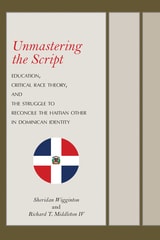
Unmastering the Script
Education, Critical Race Theory, and the Struggle to Reconcile the Haitian Other in Dominican IdentitySheridan Wigginton and Richard T. Middleton IV
University of Alabama Press, 2019
Analyzes textbooks in the Dominican Republic for evidence of reproducing Haitian Otherness
Unmastering the Script: Education, Critical Race Theory, and the Struggle to Reconcile the Haitian Other in Dominican Identity examines how school curriculum–based representations of Dominican identity navigate black racial identity, its relatedness to Haiti, and the culturally entrenched pejorative image of the Haitian Other in Dominican society. Wigginton and Middleton analyze how social science textbooks and historical biographies intended for young Dominicans reflect an increasing shift toward a clear and public inclusion of blackness in Dominican identity that serves to renegotiate the country’s long-standing antiblack racial master script.
The authors argue that although many of the attempts at this inclusion reflect a lessening of “black denial,” when considered as a whole, the materials often struggle to find a consistent and coherent narrative for the place of blackness within Dominican identity, particularly regarding the ways in which blackness continues to be meaningfully related to the otherness of Haitian racial identity. Unmastering the Script approaches the text materials as an example of “reconstructing” and “unburying” an African past, supporting the uneven, slow, and highly context-specific nature of the process.
This work engages with multiple disciplines including history, anthropology, education, and race studies, building on a new wave of Dominican scholarship that considers how contemporary perspectives of Dominican identity both accept the existence of an African past and seek to properly weigh its importance. The use of critical race theory as the framework facilitates unfolding the past political and legal agendas of governing elites in the Dominican Republic and also helps to unlock the nuance of an increasingly black-inclusive Dominican identity. In addition, this framework allows the unveiling of some of the socially damaging effects the Haitian Other master script can have on children, particularly those of Haitian ancestry, in the Dominican Republic.
[more]