Results by title
5 books match the query 'National characteristics, Mexican, in literature'
Artful Assassins
Murder as Art in Modern MexicoFernando Fabio Sanchez
Vanderbilt University Press, 2010
Sanchez argues that the seemingly hopeless cycle of violence experienced by Mexico in the 20th century, as reflected in its "crime genre," reveals a broader intrinsic cultural and political failure that suggests grave implications for the current state of crisis. Tracing the development of a national Mexican identity from the 1910 Mexican Revolution onward, Sanchez focuses on the indelible presence of violence and crime underlying the major works that contributed to a larger communal narrative.
Artful Assassins ultimately offers a panoramic overview of the evolution of Mexican arts and letters, as well as nationalism, by claiming murder and assassination as literary and cinematic motifs. The collapse of post-revolutionary political unity was presaged all along in Mexican culture, Sanchez argues. It need only to have been sought in the art of the nation.
Mexican Masculinities
Robert McKee Irwin
University of Minnesota Press, 2003
A fascinating examination of masculinity in nineteenth- and twentieth-century Mexico
The first of its kind and a powerful challenge to customary views of gender and sexuality in the life and literature of Mexico, this book traces literary representations of masculinity in Mexico from independence in 1810 to the 1960s, and shows how these intersect with the constructions of nation and nationality.
The rhetoric of “Mexicanness” makes constant use of images of masculinity, though it does so in shifting and often contradictory ways. Robert McKee Irwin’s work follows these shifts from the male homosocial bonding that was central to notions of national integration in the nineteenth century, to questioning of gender norms stirred by science and scandals at the turn of the century, to the virulent reaction against gender chaos after the Mexican revolution, to the association of Mexicanness with machismo and homophobia in the literature of the 1940s and 1950s—even as male homosexuality was established as an integral part of national culture.As the first historical study of how masculinity and, particularly, homosexuality were understood in Mexico in the national era, this book not only provides “queer readings” of most major canonical texts of the period in question, but also uncovers a variety of unknown texts from queer Mexican history, including the 1906 novel Los 41, which reenacts the scandal of a turn-of-the-century transvestite ball that launched modern discussion of homosexuality in Mexico. It is a radical undermining of the simple hetero/homosexual and masculine/feminine oppositions that have for so long informed views of the country’s national character.
Mexico, Nation in Transit
Contemporary Representations of Mexican Migration to the United StatesChristina L. Sisk
University of Arizona Press, 2011
Sisk’s transnational investigation moves easily across the US–Mexico border, analyzing films made on both sides, literature de la frontera, Mexican rock music, migrant narratives, and texts written by second- and third-generation immigrants. Included are the perspectives of those who left Mexico, those who were left behind, and the children who travel back “home.” Sisk discovers that the loss of Mexicans to the United States through emigration has had an effect on Mexico similar to the impact of the perceived Mexican invasion of the United States.
Spanning the social sciences and the humanities, Mexico, Nation in Transit poses a new transnational alternative to the postnational view that geopolitical borders are being erased by the forces of migration and globalization, and the nationalist view that borders must be strictly enforced. It shows that borders, like identities, are not easy to locate precisely.
The Uses of Failure in Mexican Literature and Identity
By John A. Ochoa
University of Texas Press, 2005
While the concept of defeat in the Mexican literary canon is frequently acknowledged, it has rarely been explored in the fullness of the psychological and religious contexts that define this aspect of "mexicanidad." Going beyond the simple narrative of self-defeat, The Uses of Failure in Mexican Literature and Identity presents a model of failure as a source of knowledge and renewed self-awareness.
Studying the relationship between national identity and failure, John Ochoa revisits the foundational texts of Mexican intellectual and literary history, the "national monuments," and offers a new vision of the pivotal events that echo throughout Mexican aesthetics and politics. The Uses of Failure in Mexican Literature and Identity encompasses five centuries of thought, including the works of the Conquistador Bernal Díaz del Castillo, whose sixteenth-century True History of the Conquest of New Spain formed Spanish-speaking Mexico's early self-perceptions; José Vasconcelos, the essayist and politician who helped rebuild the nation after the Revolution of 1910; and the contemporary novelist Carlos Fuentes.
A fascinating study of a nation's volatile journey towards a sense of self, The Uses of Failure elegantly weaves ethical issues, the philosophical implications of language, and a sociocritical examination of Latin American writing for a sparkling addition to the dialogue on global literature.
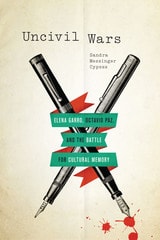
Uncivil Wars
Elena Garro, Octavio Paz, and the Battle for Cultural MemoryBy Sandra Messinger Cypess
University of Texas Press, 2012
The first English-language book to place the works of Elena Garro (1916–1998) and Octavio Paz (1914–1998) in dialogue with each other, Uncivil Wars evokes the lives of two celebrated literary figures who wrote about many of the same experiences and contributed to the formation of Mexican national identity but were judged quite differently, primarily because of gender.
While Paz’s privileged, prize-winning legacy has endured worldwide, Garro’s literary gifts garnered no international prizes and received less attention in Latin American literary circles. Restoring a dual perspective on these two dynamic writers and their world, Uncivil Wars chronicles a collective memory of wars that shaped Mexico, and in turn shaped Garro and Paz, from the Conquest period to the Mexican Revolution; the Spanish Civil War, which the couple witnessed while traveling abroad; and the student massacre at Tlatelolco Plaza in 1968, which brought about social and political changes and further tensions in the battle of the sexes. The cultural contexts of machismo and ethnicity provide an equally rich ground for Sandra Cypess’s exploration of the tandem between the writers’ personal lives and their literary production. Uncivil Wars illuminates the complexities of Mexican society as seen through a tense marriage of two talented, often oppositional writers. The result is an alternative interpretation of the myths and realities that have shaped Mexican identity, and its literary soul, well into the twenty-first century.