Results by title
2 books match the query 'National characteristics, Russian'
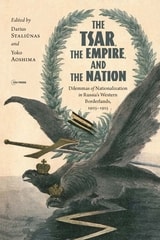
The Tsar, The Empire, and The Nation
Dilemmas of Nationalization in Russia's Western Borderlands, 1905-1915Darius Staliunas
Central European University Press, 2021
This collection of essays addresses the challenge of modern nationalism to the tsarist Russian Empire. First appearing on the empire’s western periphery this challenge, was most prevalent in twelve provinces extending from Ukrainian lands in the south to the Baltic provinces in the north, as well as to the Kingdom of Poland.
At issue is whether the late Russian Empire entered World War I as a multiethnic state with many of its age-old mechanisms run by a multiethnic elite, or as a Russian state predominantly managed by ethnic Russians. The tsarist vision of prioritizing loyalty among all subjects over privileging ethnic Russians and discriminating against non-Russians faced a fundamental problem: as soon as the opportunity presented itself, non-Russians would increase their demands and become increasingly separatist.
The authors found that although the imperial government did not really identify with popular Russian nationalism, it sometimes ended up implementing policies promoted by Russian nationalist proponents. Matters addressed include native language education, interconfessional rivalry, the “Jewish question,” the origins of mass tourism in the western provinces, as well as the emergence of Russian nationalist attitudes in the aftermath of the first Russian revolution.
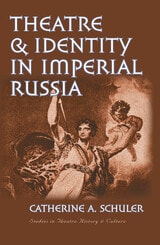
Theatre and Identity in Imperial Russia
Catherine A. Schuler
University of Iowa Press, 2009
Schuler draws upon contemporary journals written and published by the educated nobility and the intelligentsia—who represented the intellectual, aesthetic, and cultural groups of the day—as well as upon the laws of the Russian empire and upon theatrical memoirs. With fascinating detail, she spotlights the ideologically charged binaries ascribed to prominent actors—authentic/performed, primitive/civilized, Russian/Western—that mirrored the volatility of national identity from the Napoleonic Wars through the reign of Alexander II.
If the path traveled by Russian artists and audiences from the turn of the nineteenth century to the era of the Great Reforms reveals anything about Russian culture and society, it may be that there is nothing more difficult than being Russian in Russia. By exploring the ways in which theatrical administrators, playwrights, and actors responded to three tsars, two wars, and a major revolt, this carefully crafted book demonstrates the battle for the hearts and minds of the Russian people.