Results by title
5 books match the query 'National monuments'

National Monuments
Heid E. Erdrich
Michigan State University Press, 2008
Many of the poems in National Monuments explore bodies, particularly the bodies of indigenous women worldwide, as monuments—in life, in photos, in graves, in traveling exhibitions, and in plastic representations at the airport. Erdrich sometimes imagines what ancient bones would say if they could speak. Her poems remind us that we make monuments out of what remains—monuments are actually our own imaginings of the meaning or significance of things that are, in themselves, silent.
As Erdrich moves from the expectedly "poetic" to the voice of a newspaper headline or popular culture, we are jarred into wondering how we make our own meanings when the present is so immediately confronted by the past (or vice versa). The language of the scientists that Erdrich sometimes quotes in epigraphs seems reductive in comparison to the richness of tone and meaning that these poems—filled with puns, allusions, and wordplay—provide.
Erdrich's poetry is literary in the best sense of the word, infused with an awareness of the poetic canon. Her revisions of and replies to poems by William Carlos Williams, Robert Frost, and others offer an indigenous perspective quite different from the monuments of American literature they address.
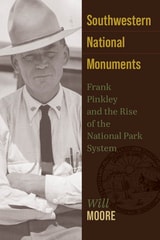
Southwestern National Monuments
Frank Pinkley and the Rise of the National Park SystemWill Moore
University of Utah Press, 2025
This volume uncovers the little-known legacy of Frank Pinkley, the first superintendent of the Southwestern National Monuments (SWNM)—a unique National Park Service unit established in 1923. Pinkley’s leadership and innovative approach helped protect and develop thirty diverse monuments, ranging from Montezuma Castle to White Sands, linked by miles of rough roads and united by their historical, archaeological, and natural significance.
Drawing on archived SWNM Monthly Reports, Will Moore reconstructs the stories behind these monuments and their contributions to the nascent national park system. From the pioneering all-Navajo Mobile Unit of the Civilian Conservation Corps to visionary work in visitor education, Pinkley and his team helped to set a course for the protection of American landscapes. Southwestern National Monuments is essential reading for anyone passionate about America's natural heritage and national parks.
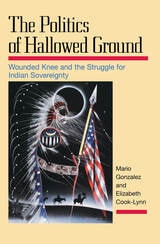
The Politics of Hallowed Ground
Wounded Knee and the Struggle for Indian SovereigntyMario Gonzalez and Elizabeth Cook-Lynn
University of Illinois Press, 1999
Inside the Sioux Nation's pursuit of recognition and justice
This book is the powerful story of the ongoing struggle of indigenous Americans in the twentieth century United States and of its shift in focus from traditional battlefield and massacre sites to federal courtrooms and the halls of Congress.
The Politics of Hallowed Ground includes excerpts from the diary kept by Mario Gonzalez, the attorney for the Sioux Nation in its struggle for recognition of the Wounded Knee Massacre site as a national monument. Gonzalez's personal record of the struggle is coupled with commentary by Elizabeth Cook-Lynn, a Native American writer who places the work in its historical context. Together, the two voices will draw the reader into far more than the continuing struggle of the Sioux people to achieve justice.
The book covers Sioux history from before the Wounded Knee tragedy to modern times, through the Sioux Nation's long and often rancorous dialogue with the U.S. government over control of South Dakota's Black Hills, traditional Sioux lands recognized by treaty in 1877 and never forfeited or sold. After reading a 13-year-old survivor's narrative of what happened at Wounded Knee and the list of the dead and wounded, readers will find it difficult not to share the Sioux perspective.
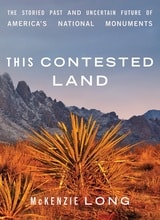
This Contested Land
The Storied Past and Uncertain Future of America's National MonumentsMcKenzie Long
University of Minnesota Press, 2022
One woman’s enlightening trek through the natural histories, cultural stories, and present perils of thirteen national monuments, from Maine to Hawaii—now available in paperback
This land is your land. When it comes to national monuments, the sentiment could hardly be more fraught. Gold Butte in Nevada, Organ Mountains–Desert Peaks in New Mexico, Katahdin Woods and Waters in Maine, Cascade–Siskiyou in Oregon and California: these are among the thirteen natural sites McKenzie Long visits in This Contested Land, an eye-opening exploration of the stories these national monuments tell, the passions they stir, and the controversies surrounding them today.
Starting amid the fragrant sagebrush and red dirt of Bears Ears National Monument on the eve of the Trump Administration’s decision to reduce the site by 85 percent, Long climbs sandstone cliffs, is awed by Ancestral Pueblo cliff dwellings and is intrigued by 4,000-year-old petroglyphs. She hikes through remote pink canyons recently removed from the boundary of Grand Staircase–Escalante, skis to a backcountry hut in Maine to view a truly dark night sky, snorkels in warm Hawaiian waters to plumb the meaning of marine preserves, volunteers near the most contaminated nuclear site in the United States, and witnesses firsthand the diverse forms of devotion evoked by the Rio Grande. In essays both contemplative and resonant, This Contested Land confronts an unjust past and imagines a collaborative future that bears witness to these regions’ enduring Indigenous connections.
From hazardous climate change realities to volatile tensions between economic development and environmental conservation, practical and philosophical issues arise as Long seeks the complicated and often overlooked—or suppressed—stories of these incomparable places. Her journey, mindfully undertaken and movingly described, emphasizes in clear and urgent terms the unique significance of, and grave threats to, these contested lands.
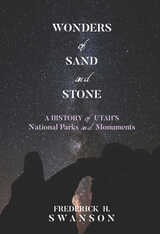
Wonders of Sand and Stone
A History of Utah's National Parks and MonumentsFrederick H. Swanson
University of Utah Press, 2020
Drawing on extensive historical research, Swanson presents little-known accounts of people who saw in these sculptured landscapes something worth protecting. Readers are introduced to the region’s early explorers, scientists, artists, and travelers as well as the local residents and tourism promoters who worked with the National Park Service to build the system of parks and monuments we know today, when Utah’s national parks and monuments face multiple challenges from increased human use and from development outside their borders. As scientists continue to uncover the astonishing diversity of life in these desert and mountain landscapes, and archaeologists and Native Americans document their rich cultural resources, the management of these federal lands remains critically important. Swanson provides us with a detailed and timely background to advance and inform discussions about what form that management should take.