Results by title
4 books match the query 'National state'

Crisis Bargaining and the State
The Domestic Politics of International ConflictSusan Peterson
University of Michigan Press, 1996
The first book to systematically explore the importance of domestic institutions to crisis bargaining, Crisis Bargaining and the State argues that the influence of a state's bargaining behavior on its opponents foreign policy depends on the nature of the opposing government--its institutional structures and the strategic beliefs of its leaders. The author shows in three detailed case studies--the Crimean War crisis, the Fashoda crisis, and the Berlin crisis--the significance of domestic factors to questions of war and peace.
Peterson offers a comprehensive analysis of the domestic politics of crisis bargaining. She uses differences in state structure to explain variations in foreign policy processes and outcomes. By introducing domestic structure as a crucial intervening variable between the international environment and a state's foreign policy during an acute conflict, Peterson shows how existing cognitive and bureaucratic approaches provide complementary, not competing, explanations of crisis bargaining.
Crisis Bargaining and the State: The Domestic Politics of International Conflict applies recent research in the field of international political economy on the relationship between ideas, institutions, and the international environment to the issue of crisis bargaining. It will appeal to students, scholars, and policymakers interested in crisis bargaining, international security, and international relations.
Susan Peterson is Assistant Professor, Department of Government, The College of William & Mary.
[more]

Fragments of Development
Nation, Gender, and the Space of ModernitySuzanne Bergeron
University of Michigan Press, 2005
"A bold and challenging consideration of questions of development, economic globalization, communities and subjectivity from a unique feminist perspective. A must-read book for those who wish to understand restructuring and resistance in this era of intensified globalization."
---Isabella C. Bakker, York University
"Bergeron's pathbreaking analysis challenges orthodox development theories, questions current feminist economic thinking and highlights crucial new gendered challenges to globalization."
---Jane Parpart, Dalhousie University
"Cutting-edge scholarship. Bergeron deftly engages the complexity of current debates while retaining clarity, improving analyses, and illuminating alternatives."
---V. S. Peterson, University of Arizona
By tracing out the intersection between the imagined space of the national economy and the gendered construction of "expert" knowledge in development thought, Suzanne Bergeron provides a provocative analysis of development discourse and practice. By elaborating a framework of including/excluding economic subjects and activities in development economics, she provides a rich account of the role that economists have played in framing the contested political and cultural space of development.
Bergeron's account of the construction of the national economy as an object of development policy follows its shifting meanings through modernization and growth models, dependency theory, structural adjustment, and contemporary debates about globalization and highlights how intersections of nation and economy are based on gendered and colonial scripts. The author's analysis of development debates effectively demonstrates that critics of development who ignore economists' nation stories may actually bolster the formation they are attempting to subvert. Fragments of Development is essential reading for those interested in development studies, feminist economics, international political economy, and globalization studies.
[more]
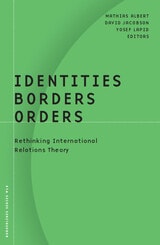
Identities, Borders, Orders
Rethinking International Relations TheoryMathias Albert
University of Minnesota Press, 2001
An interdisciplinary exploration of the role of sovereignty, national identity, and borders in international politics.
Political Science
An interdisciplinary exploration of the role of sovereignty, national identity, and borders in international politics.Informed by current debates in social theory, Identities, Borders, Orders brings together a multinational group of respected scholars to seek and encourage imaginative adaptations and recombinations of concepts, theories, and perspectives across disciplinary lines. These contributors take up a variety of substantive, theoretical, and normative issues such as migration, nationalism, citizenship, human rights, democracy, and security. Together, their essays contribute significantly to our understanding of sovereignty, national identity, and borders. Contributors: Didier Bigo, Institut d’Etudes Politiques de Paris; Lothar Brock, U of Frankfurt am Main; Chris Brown, London School of Economics; Neil Harvey, New Mexico State U; Martin O. Heisler, U of Maryland; Rey Koslowski, Rutgers U; Friedrich Kratochwil, Ludwig Maximilians U, Munich; Ronnie D. Lipschutz, UC Santa Cruz; Richard W. Mansbach, Iowa State U; David Newman, Ben Gurion U of the Negev, Israel; Antje Wiener, Queen’s U of Belfast; and Frankie Wilmer, Montana State U.[more]

Re-Forming the State
The Politics of Privatization in Latin America and EuropeHector E. Schamis
University of Michigan Press, 2002
With evidence drawn from Argentina, Chile, Mexico, Great Britain, and Hungary, Re-forming the State examines the processes leading to, and the political effects of, market reform experiments and focuses specifically on the patterns of collective action and coalition building that drive privatization. The author's argument calls into question established approaches in the discipline of economics and in the fields of comparative and international political economy.
The experience of privatization shows that the public and the private are neither contradictory nor mutually exclusive spheres, and that power relations between them are not necessarily zero-sum. To stress the point, the author borrows from the literature on state formation, which has extensively examined the historical processes of key private groups. The evidence presented shows why and how, by restructuring coalitional and institutional arenas, the state uses marketization to generate political order and to distribute political power. Thus, the author specifies the conditions under which political change is conceived in terms of and channeled through economic policy; in other words, how the state is "re-formed" through privatization. Re-forming the State thus highlights how privatization is simultaneously a movement from public to private, but also a movement from non-state to state, as the reduction of state assets leads to institutional changes that increase state capacities for defining and enforcing property rights, extracting revenue, and centralizing administrative and political resources.
Hector E. Schamis is Assistant Professor of Government, Cornell University.
[more]