Results by title
5 books match the query 'Nationalisms'

Alter-Nations
Nationalisms, Terror, and the State in Nineteenth-Century Britain and IrelandAmy E. Martin
The Ohio State University Press, 2012
Alter-Nations: Nationalisms, Terror, and the State in Nineteenth-Century Britain and Ireland investigates how Victorian cultural production on both sides of the Irish Sea grappled with the complex relationship between British imperial nationalism and Irish anticolonial nationalism. In the process, this study reconceptualizes the history of modern nationhood in Britain and Ireland.
Taking as its archive political theory, polemical prose, novels, political cartoons, memoir, and newspaper writings, Amy E. Martin’s Alter-Nations examines the central place of Irish anticolonial nationalism in Victorian culture and provides a new genealogy of categories such as “nationalism” “terror,” and “the state.” In texts from Britain and Ireland, we can trace the emergence of new narratives of Irish immigration, racial difference, and Irish violence as central to capitalist national crisis in nineteenth-century Britain. In visual culture and newspaper writing of the 1860s, the modern idea of “terrorism” as irrational and racialized anticolonial violence first comes into being. This new ideology of terrorism finds its counterpart in Victorian theorizations of the modern hegemonic state form, which justify the state’s monopoly of violence by imagining its apparatuses as specifically anti-terrorist. At the same time, Irish Fenian writings articulate anticolonial critique that anticipates the problematics of postcolonial studies and attempts to reimagine in generative and radical ways anticolonialism’s relation to modernity and the state form. By so doing, Alter-Nations argues for the centrality of Irish studies to postcolonial and Victorian studies, and reconceptualizes the boundaries and concerns of those fields.
[more]

Between Woman and Nation
Nationalisms, Transnational Feminisms, and the StateCaren Kaplan, Norma Alarcón, and Minoo Moallem, eds.
Duke University Press, 1999
In Between Woman and Nation constructions such as nationalism, homeland, country, region, and locality are for the first time examined in the context of gender. The contributors—leading scholars of ethnicity, transnationalism, globalization, and feminist theory—are united in their determination to locate and describe the performative space of interactions between woman and nation. These are interactions, claim the contributors, that cannot be essentialized.
This interdisciplinarily collection investigates women in diverse locales—ranging from Quebec to Beirut. The contributors consider such subjects as Yucatan feminism, Islamic fundamentalisms, Canadian gender formations, historic Chicana/o struggles, and Israeli/Palestinian conflicts. Divided into three parts, the collection first examines constructions of nationalism and communities whose practices complicate these constructions. The second section discusses regulations of particular nation-states and how they affect the lives of women, while the third presents studies of transnational identity formation, in which contributors critique ideas such as “multicultural nationalism” and “global feminism.” Arguing provocatively that such movements and concepts inadequately represent women’s interests, contributors examine how such beliefs and their attendant organizations may actually bolster the very formations they ought to subvert.
In its demonstration of the critical possibilities of feminist alliances across discrepant and distinct material conditions, Between Woman and Nation will make a unique contribution to women’s studies, feminist theory, studies of globalization and transnationalism, ethnic studies, and cultural studies.
[more]

Kamikaze, Cherry Blossoms, and Nationalisms
The Militarization of Aesthetics in Japanese HistoryEmiko Ohnuki-Tierney
University of Chicago Press, 2002
Why did almost one thousand highly educated "student soldiers" volunteer to serve in Japan's tokkotai (kamikaze) operations near the end of World War II, even though Japan was losing the war? In this fascinating study of the role of symbolism and aesthetics in totalitarian ideology, Emiko Ohnuki-Tierney shows how the state manipulated the time-honored Japanese symbol of the cherry blossom to convince people that it was their honor to "die like beautiful falling cherry petals" for the emperor.
Drawing on diaries never before published in English, Ohnuki-Tierney describes these young men's agonies and even defiance against the imperial ideology. Passionately devoted to cosmopolitan intellectual traditions, the pilots saw the cherry blossom not in militaristic terms, but as a symbol of the painful beauty and unresolved ambiguities of their tragically brief lives. Using Japan as an example, the author breaks new ground in the understanding of symbolic communication, nationalism, and totalitarian ideologies and their execution.
Drawing on diaries never before published in English, Ohnuki-Tierney describes these young men's agonies and even defiance against the imperial ideology. Passionately devoted to cosmopolitan intellectual traditions, the pilots saw the cherry blossom not in militaristic terms, but as a symbol of the painful beauty and unresolved ambiguities of their tragically brief lives. Using Japan as an example, the author breaks new ground in the understanding of symbolic communication, nationalism, and totalitarian ideologies and their execution.
[more]
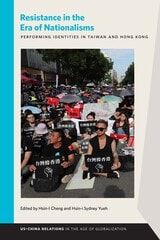
Resistance in the Era of Nationalisms
Performing Identities in Taiwan and Hong KongHsin-I Cheng
Michigan State University Press, 2023
The desire of the people of Taiwan and Hong Kong to exercise democratic self-rule, fully embody their local identities, and become global citizens challenges the big-power politics between China and the United States. Occupying a critical stance on the margins, the local perspectives and international relations of these two cosmopolitan and postcolonial societies challenge both narratives centered on China and those focused on the U.S.–China power struggle. Taking a culture-centered approach to the communicative process of “glocalized resistance” in an era of rising nationalisms, the chapters in this volume address topics ranging from the rhetoric of political leaders and the language games of mass protesters on social media to resistant street performance. These chapters showcase the geocultural identity-in-the-making of the Taiwanese and Hong Kong people and offer insights into societies under imminent threat by an aggressive neighbor.
[more]
“Good Mothers”, Nations and Nationalisms
Cases from Lithuania, Russia and SwedenYulia Gradskova
Central European University Press, 2026
This book explores constructions of the “good mother” within diverse nations and nationalisms, focusing on three contexts grappling with distinct forms of “demographic anxiety.” Inspired by Sara Farris’ inquiry into femonationalism and utilizing “maternalism” and “politics of care” as critical theoretical instruments, the book analyses the evolving political and social expectations imposed upon mothers in Lithuania, migrant mothers, including postsocialist migrant mothers from Central Asia and Caucasus in Sweden, and women in the militarizing authoritarian Russian state’s construction of maternity within its “traditional values” agenda. It also probes both how “good motherhood” is enacted and contested by individual mothers, as well as how it is mobilized in resisting conservative, ethnonationalist tendencies and militarism (in the case of Russia). The book’s chapters illuminate the roles of political and social actors engaged with renegotiating materialist politics—such as grassroots birth activist movements and maternalist social policy campaigns—as well as those defying militarism.
[more]