Results by title
3 books match the query 'Natural Environment'

Aesthetics of the Natural Environment
Emily Brady
University of Alabama Press, 2003
Aesthetic experience is one of the fundamental ways that we develop a relationship to our natural surroundings. Emily Brady provides a comprehensive study of this type of experience and the central philosophical issues related to it, developing her own original theory of aesthetic appreciation of nature. She provides useful background to the current debate and an up-to-date critical appraisal of contemporary theories.
The context of the contemporary debate is laid out through a discussion of aesthetic experience and aesthetic qualities; early theories of aesthetic appreciation of nature, including the beautiful, the sublime, and the picturesque; and differences between artistic and environmental appreciation and interpretation. Brady situates her own approach in relation to a set of noncognitive accounts of appreciation. Her "integrated aesthetic" brings together various features of appreciation, including the senses, emotion, and imagination, with a reappraisal of the concept of disinterestedness. These ideas are further developed within the more practical domains of aesthetic judgment and education of the environment and through an examination of the role of aesthetic value in environmental conservation.
Arnold Berleant of Long Island University, a pioneer in this area of research, has declared Brady’s work, “admirably comprehensive coverage of the subject.” Julie C. Van Camp of California State University, Long Beach, has said, “The bibliography is priceless. . . . The discussions of such philosophers as Kant and Dewey seem plausible and understandable to an audience of students and the educated public.” This book will be valuable to readers interested in such wide-ranging subjects as philosophy, aesthetics, ethics, ecology, conservation, environmental policy-making, geography, and landscape architecture.
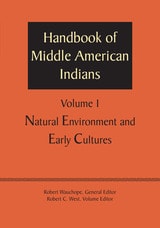
Handbook of Middle American Indians, Volume 1
Natural Environment and Early CulturesRobert Wauchope, series editor; Robert C. West, volume editor
University of Texas Press, 1964
This is the first volume of the monumental Handbook of Middle American Indians, a definitive encyclopaedia of the environment, archaeology, ethnology, social anthropology, ethnohistory, linguistics, and physical anthropology of the native peoples of Mexico and Central America. The Handbook was published in cooperation with the Middle American Research Institute of Tulane University under the general editorship of Robert Wauchope (1909–1979). This volume of the Handbook was edited by Dr. Robert C. West (1913–2001), Boyd Professor of Geography at Louisiana State University, an outstanding authority on Latin America. He was formerly cultural geographer for the Smithsonian Institution.
Included in this first volume are chapters written by leading authorities in various fields of the natural and social sciences that are concerned with the natural environment of Middle America, its role in the shaping of Indian cultures, the earliest primitive hunters of this area, the beginnings of agriculture, and the broad patterns of prehistoric civilizations there.
There are articles on the geohistory and paleogeography of Middle America, its surface configuration and associated geology, hydrography, the American Mediterranean, oceanography and marine life along the Pacific coast, weather and climate, natural vegetation, the soils and their relation to the Indian peoples and cultures, fauna , the natural regions of Middle America, the primitive hunters, the food-gathering and incipient agricultural stage of prehistoric Middle America, origins of agriculture there, and the patterns of farming life and civilization.
The Handbook of Middle American Indians was assembled and edited at the Middle American Research Institute of Tulane University with the assistance of grants from the National Science Foundation and under the sponsorship of the National Research Council Committee on Latin American Anthropology.
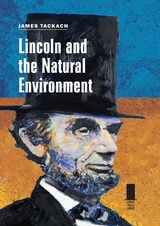
Lincoln and the Natural Environment
James Tackach
Southern Illinois University Press, 2019
In this groundbreaking environmental biography of Abraham Lincoln, James Tackach maps Lincoln’s lifelong relationship with the natural world from his birth and boyhood on Midwestern farms through his political career and presidency dealing with the effects of the Industrial Revolution and the Civil War.
Lincoln was born in a generation that grew up on farms but began to move to cities as industrialization transformed the American economy. Turning away from the outdoor, manual labor of his youth, he chose careers in law and politics but always found solace outside first on the prairies of Illinois and, later, at the woodsy presidential retreat. As Tackach shows, Lincoln relied on examples and metaphors from the natural world in his speeches and writings.
As a member of the Whig Party Lincoln endorsed the Industrial Revolution, which transformed the nation’s economy and its physical, social, and cultural landscapes, and advocated for the creation of railroads, canals, roads, and bridges to facilitate growth and the distribution of products. But he and his party failed to take steps to protect the natural environment. Surveying the destruction of the environment in the mid-nineteenth century, Tackach outlines how some American writers, the first voices for protection and conservation, began to call attention to the results of deforestation and the overhunting of animals during Lincoln’s lifetime.
As commander in chief during the Civil War, Lincoln approved a strategy that included significant infrastructure and environmental damage. In the South, where most of the battles occurred, Union troops burned cities and towns and destroyed plantations, farms, and natural landscapes. Tackach argues that, midway through his presidency, Lincoln seemed to sense that postwar Reconstruction would have to be spiritual, political, economic, and environmental in order to heal the nation’s wounds. He signed the Morrill Act, creating the land-grant colleges, and the environmentally progressive Yosemite Grant Act, which preserved thousands of acres of forest in California.
The first scholar to thoroughly investigate Lincoln’s lifelong relationship with the natural environment, Tackach paints Lincoln’s personal and professional life against the backdrop of nineteenth-century American environmental history, issues, and writers, providing insights into contemporary environmental issues.