Results by title
3 books match the query 'Natural Law Tradition'
Proportionalism and the Natural Law Tradition
Christopher Kaczor
Catholic University of America Press, 2002
Consequentialism and Catholic ethics seem to be natural enemies. The Catholic prohibition against intentionally killing the innocent, lying, committing adultery, and so on contradicts the very essence of consequentialism that no act may be assessed as good or evil independently of its consequences. However in the 1960s within the Catholic tradition itself, there arose a method in ethics called proportionalism which practically, if not theoretically, affirmed that which consequentialists have long affirmed and Catholic ethicists had so long denied, namely one may do evil that good may come. According to proportionalists, so long as the good effects are proportioned to the bad effects of the act, the act is licit even if evil is used as a means to achieve the good.
In this book, Christopher Kaczor argues against the plausibility of proportionalism and its first proponents, namely Peter Knauer, Joseph Fuchs, Bruno Schüller, Louis Janssens, and Richard McCormick. Examining the genealogy of the movement, he disputes a received history that depicts proportionalism as a recovery of Thomas Aquinas. Instead, contends Kaczor, proportionalism is best seen as the organic successor to the moral manuals of the pre-Vatican II era. Proportionalism arises not from Thomas but rather extends many of the tendencies and presuppositions of the manuals. In particular, it retains their marginalizing of the account of human action as a knowing-willing involving a number of stages not always consciously recognized yet carefully described by Thomas in Summa theologiae, Prima Secundae, 6-17. Kaczor shows that a great deal of the plausibility of proportionalism rests on a fragile foundation that is rapidly eroding, an education in the moral manuals.
In this book, Christopher Kaczor argues against the plausibility of proportionalism and its first proponents, namely Peter Knauer, Joseph Fuchs, Bruno Schüller, Louis Janssens, and Richard McCormick. Examining the genealogy of the movement, he disputes a received history that depicts proportionalism as a recovery of Thomas Aquinas. Instead, contends Kaczor, proportionalism is best seen as the organic successor to the moral manuals of the pre-Vatican II era. Proportionalism arises not from Thomas but rather extends many of the tendencies and presuppositions of the manuals. In particular, it retains their marginalizing of the account of human action as a knowing-willing involving a number of stages not always consciously recognized yet carefully described by Thomas in Summa theologiae, Prima Secundae, 6-17. Kaczor shows that a great deal of the plausibility of proportionalism rests on a fragile foundation that is rapidly eroding, an education in the moral manuals.
[more]
St. Thomas Aquinas and the Natural Law Tradition
Contemporary PerspectivesJohn Goyette
Catholic University of America Press, 2004
To explore and evaluate the current revival, this volume brings together many of the foremost scholars on natural law. They examine the relation between Thomistic natural law and the larger philosophical and theological tradition. Furthermore, they assess the contemporary relevance of St. Thomas's natural law doctrine to current legal and political philosophy.
[more]
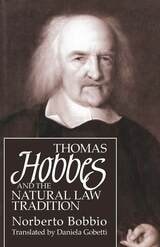
Thomas Hobbes and the Natural Law Tradition
Norberto Bobbio
University of Chicago Press, 1993
Pre-eminent among European political philosophers, Norberto Bobbio has throughout his career turned to the political theory of Thomas Hobbes. Gathered here for the first time are the most important of his essays which together provide both a valuable introduction to Hobbes's thought and a fresh understanding of Hobbes's place in the theory of modern politics.
Tracing Hobbes's work through De Cive and Leviathan, Bobbio identifies the philosopher's relation to the tradition of natural law. That Hobbes must now be understood in both this tradition as well as in the seemingly contradictory positivist tradition becomes clear for the first time in Bobbio's account. Bobbio also demonstrates that Hobbes cannot be easily labelled "liberal" or "totalitarian"; in Bobbio's provocative analysis of Hobbes's justification of the state, Hobbes emerges as a true conservative.
Though his primary concern is to reconstruct the inner logic of Hobbes's thought, Bobbio is also attentive to the philosopher's biography and weaves into his analysis details of Hobbes's life and world—his exile in France, his relation with the Mersenne circle, his disputes with Anglican bishops, and accusations of heresy leveled against him. The result is a revealing, thoroughly new portrait of the first theorist of the modern state.
[more]