Results by title
2 books match the query 'Natural Origins'
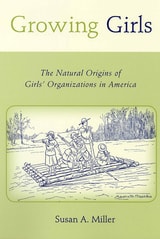
Growing Girls
The Natural Origins of Girls' Organizations in AmericaMiller, Susan A
Rutgers University Press, 2007
In the early years of the twentieth century, Americans began to recognize adolescence as a developmental phase distinct from both childhood and adulthood. This awareness, however, came fraught with anxiety about the debilitating effects of modern life on adolescents of both sexes. For boys, competitive sports as well as "primitive" outdoor activities offered by fledging organizations such as the Boy Scouts would enable them to combat the effeminacy of an overly civilized society. But for girls, the remedy wasn't quite so clear.
Surprisingly, the "girl problem"?a crisis caused by the transition from a sheltered, family-centered Victorian childhood to modern adolescence where self-control and a strong democratic spirit were required of reliable citizens?was also solved by way of traditionally masculine, adventurous, outdoor activities, as practiced by the Girl Scouts, the Camp Fire Girls, and many other similar organizations.
Susan A. Miller explores these girls' organizations that sprung up in the first half of the twentieth century from a socio-historical perspective, showing how the notions of uniform identity, civic duty, "primitive domesticity," and fitness shaped the formation of the modern girl.
[more]
The Natural Origins of Economics
Margaret Schabas
University of Chicago Press, 2005
References to the economy are ubiquitous in modern life, and virtually every facet of human activity has capitulated to market mechanisms. In the early modern period, however, there was no common perception of the economy, and discourses on money, trade, and commerce treated economic phenomena as properties of physical nature. Only in the early nineteenth century did economists begin to posit and identify the economy as a distinct object, divorcing it from natural processes and attaching it exclusively to human laws and agency.
In The Natural Origins of Economics, Margaret Schabas traces the emergence and transformation of economics in the eighteenth and nineteenth centuries from a natural to a social science. Focusing on the works of several prominent economists—David Hume, Adam Smith, Thomas Malthus, David Ricardo, and John Stuart Mill—Schabas examines their conceptual debt to natural science and thus locates the evolution of economic ideas within the history of science. An ambitious study, The Natural Origins of Economics will be of interest to economists, historians, and philosophers alike.
In The Natural Origins of Economics, Margaret Schabas traces the emergence and transformation of economics in the eighteenth and nineteenth centuries from a natural to a social science. Focusing on the works of several prominent economists—David Hume, Adam Smith, Thomas Malthus, David Ricardo, and John Stuart Mill—Schabas examines their conceptual debt to natural science and thus locates the evolution of economic ideas within the history of science. An ambitious study, The Natural Origins of Economics will be of interest to economists, historians, and philosophers alike.
[more]